





























The rise of Advanced Driver Assistance Systems in India shows that semi-autonomous driving is no longer a distant concept, but the country is only partially ready for it. India is progressing fast on technology and features, yet still catching up on roads, regulations and driver behaviour needed to use ADAS safely and effectively.
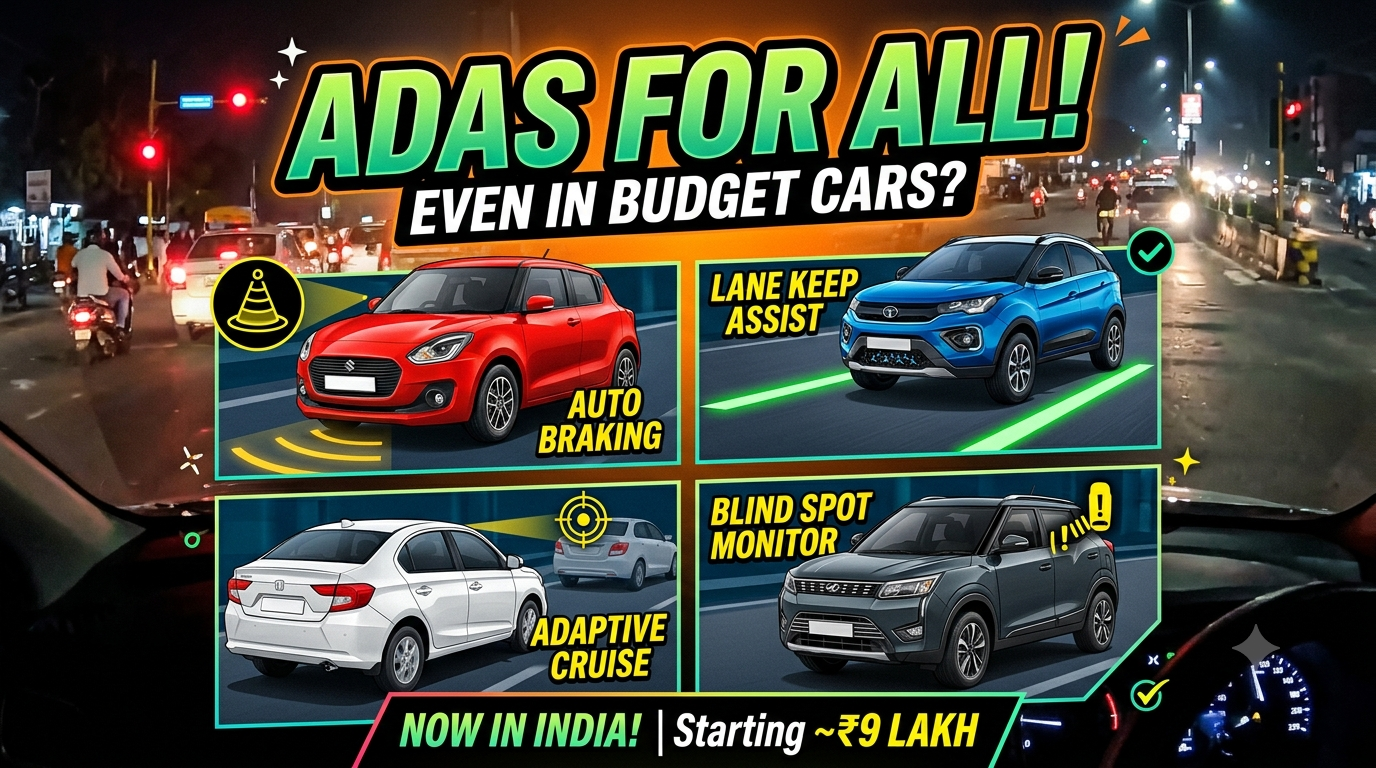
Advanced Driver Assistance Systems include features such as adaptive cruise control, lane-keeping assist, automatic emergency braking, blind-spot monitoring and traffic sign recognition. These systems use cameras, radar and software to support the driver in braking, steering and maintaining safe distances, but the driver remains responsible and must stay attentive at all times. In global terms, most of what we call “ADAS” in Indian cars falls under Level 1 and Level 2 automation, which means the car can assist but not drive itself.
In India, ADAS started as a luxury-car feature, but in the last few years it has moved into more affordable, mid-range cars like compact SUVs and premium hatchbacks. Several mass-market brands now offer Level 2 features such as lane-keep assist, adaptive cruise control and autonomous emergency braking in models priced roughly between 12 and 20 lakh rupees. This means that technology once limited to imported cars is now reachable for upper middle-class buyers and even some aspirational first-time car owners. The growing demand for connected screens and tech-heavy interiors has also helped ADAS become a selling point rather than just a safety add-on.
Even so, overall adoption remains modest compared to the full market. Studies over the past two years have shown that less than one in ten new cars sold in India is equipped with ADAS, and penetration is highly skewed toward higher price brackets. In entry-level cars under about ten lakh rupees, ADAS availability is extremely low, often below a few percent, mainly because cost pressures are intense in this segment. For budget-conscious buyers, basic safety equipment like ABS, airbags and rear parking sensors still matter more than advanced features that can raise the vehicle price by tens of thousands of rupees.
Where ADAS is available, Indian buyers are slowly becoming more receptive to it. Surveys suggest that a significant portion of drivers who have experienced ADAS in a test drive or in someone else’s car are willing to pay extra for these features in their own vehicle. Many people value the peace of mind offered by forward collision warnings, automatic braking and lane departure alerts, especially for highway driving. However, the same users also point out irritation with false alarms and beeping in chaotic city traffic, where lane markings are poor, vehicles cut in frequently and two-wheelers occupy every gap. This mix of appreciation and annoyance is shaping how ADAS is perceived.
Indian driving conditions are a major challenge for semi-autonomous systems. Many roads have faded or missing lane markings, unexpected obstacles, pedestrians crossing anywhere and heterogeneous traffic ranging from tractors to auto-rickshaws to bicycles. In such environments, camera- and radar-based systems can misread situations or trigger warnings too frequently. When drivers do not trust the system, they either switch off features like lane-keeping assist or continue to rely fully on their own reflexes, defeating the purpose of partial automation. For ADAS to be truly effective on Indian roads, tuning and localisation of algorithms is just as important as hardware.
Driver behaviour and awareness are another weak link. Semi-autonomous features are meant to assist an attentive driver, but some users misinterpret them as self-driving capabilities. There have been global cases of drivers taking their hands off the wheel or becoming distracted because the car can steer and brake on its own for short periods. If such attitudes become common in India without proper education, ADAS could lead to overconfidence and new types of accidents. Clear communication, warnings in the car’s interface and strong messaging in marketing and manuals are critical so that buyers understand that ADAS does not replace human responsibility.
Regulation and standards are still evolving. India has made progress in mandating basic safety features, but there is no comprehensive, dedicated regulatory framework for ADAS performance, testing and driver education comparable to some developed markets. As more budget and mid-range cars adopt Level 2 systems, regulators will need to define minimum performance standards, testing protocols tailored to Indian conditions and guidelines for how these features are advertised. Without this, there is a risk that some implementations may be inconsistent in quality, which can confuse consumers and erode trust in the technology.
On the positive side, the trend line points clearly towards growth. Industry analyses project that by the end of this decade, a large share of new passenger vehicles sold in India could have some form of ADAS, with much stronger penetration in the “affordable” and mid segments than today. As volumes grow, the cost of sensors and software will fall, making features like automatic emergency braking and lane assist viable even in lower-priced models. At the same time, improvements in road infrastructure under national highway and state projects, including better lane markings and more disciplined traffic in certain corridors, will create friendlier environments for semi-autonomous functions, especially on expressways.
So, is India ready for semi-autonomous driving in budget cars? Technologically, the answer is: we are getting there very quickly. Indian OEMs are proving they can integrate radar, cameras and sophisticated software even in relatively affordable models, and many buyers are curious and open to trying these features. However, in terms of road discipline, public awareness, regulation and infrastructure, India is still in a transition phase. Semi-autonomous systems can improve safety and comfort, but they will only deliver their full potential when drivers treat them as intelligent assistants rather than autopilots and when the ecosystem around them matures. For now, ADAS in budget cars is an important stepping stone on the road to autonomy, not the destination itself.