





















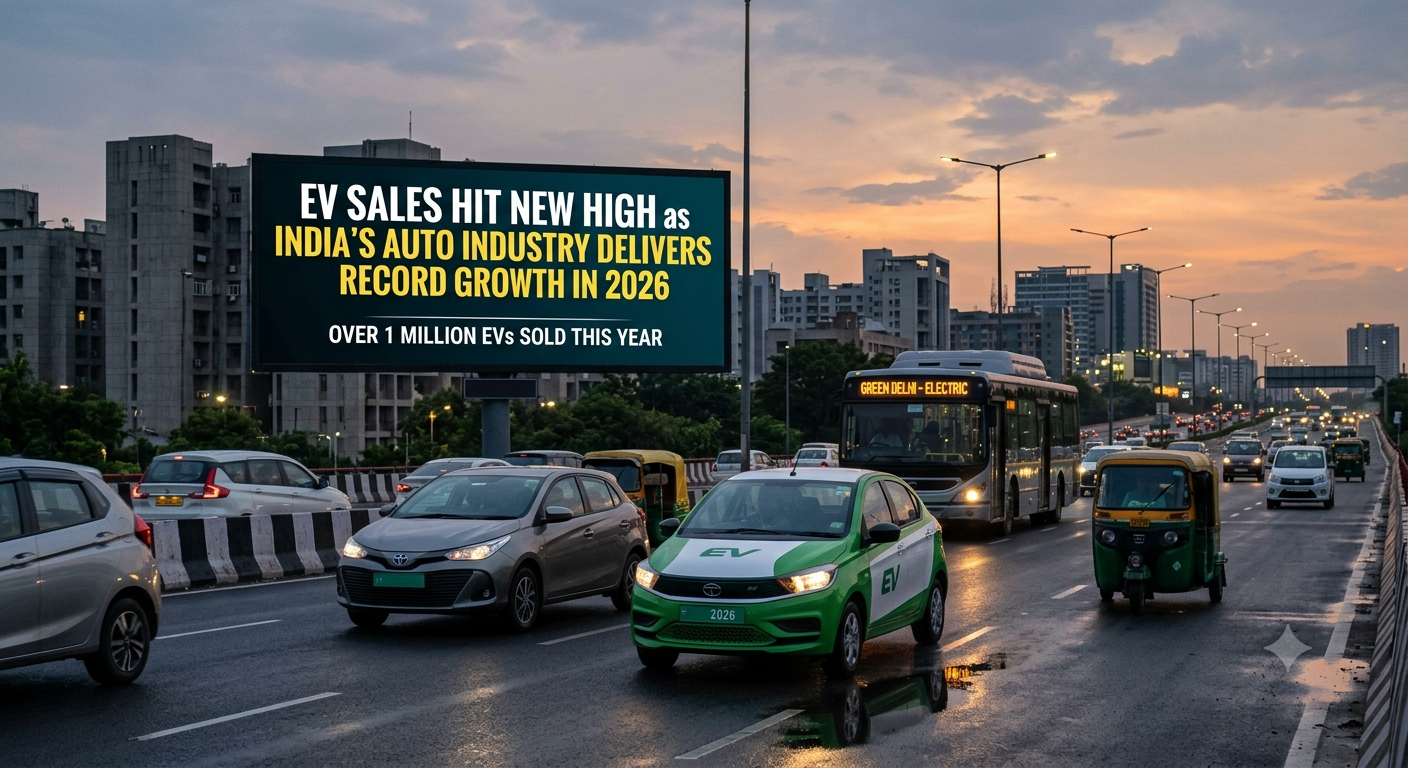
India’s electric vehicle story has moved from promise to performance, with EV sales touching new records in FY26 even as the broader auto industry posts its best-ever year. The numbers show that EVs are no longer a niche, but they also reveal how uneven and challenging this transition still is.
Record EV Sales in FY26
According to retail data from the Federation of Automobile Dealers Associations, India sold about 24.5 lakh electric vehicles in FY26, up roughly 25 percent from around 19.7 lakh units the previous year. This makes FY26 the third consecutive year of strong double-digit EV growth and the first time EV volumes have firmly crossed the 20 lakh mark.
Monthly data shows the momentum building across the year, with EV registrations peaking at around 2.8 lakh units in March 2026, compared with about 1.7 lakh in April 2025. In May 2026 alone, EV retail sales touched 2.71 lakh units, a 45 percent year-on-year jump, and EVs accounted for more than 11 percent of total vehicle sales for the first time.Two- and Three-Wheelers Lead the Charge
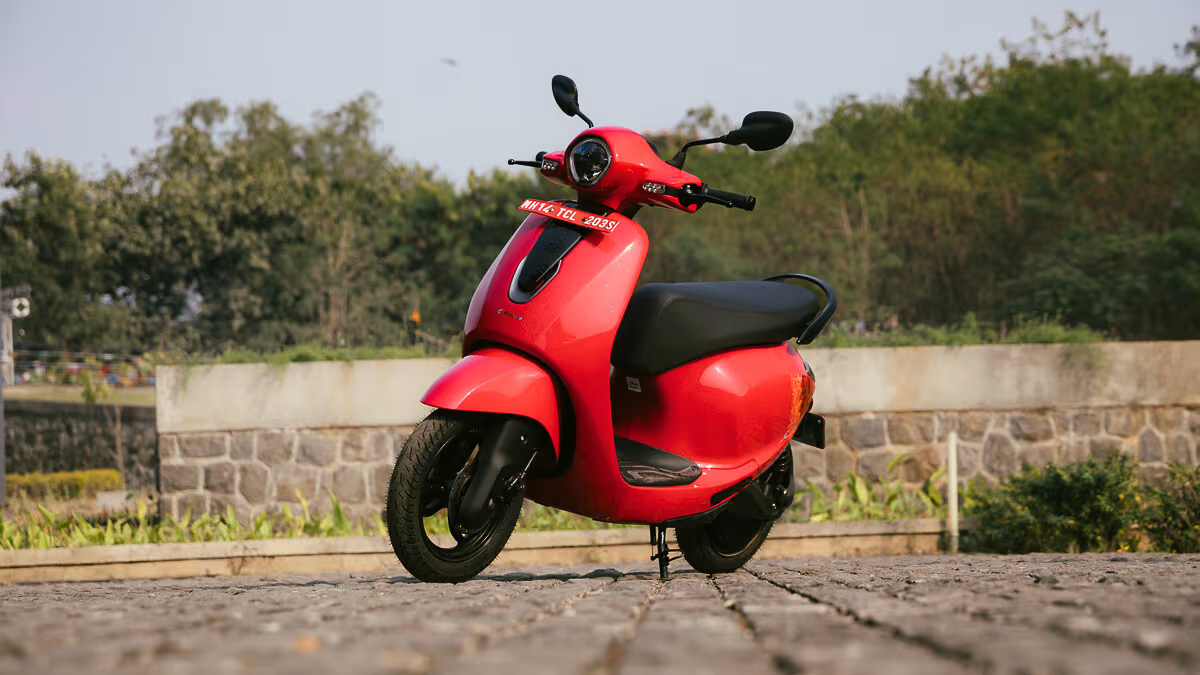
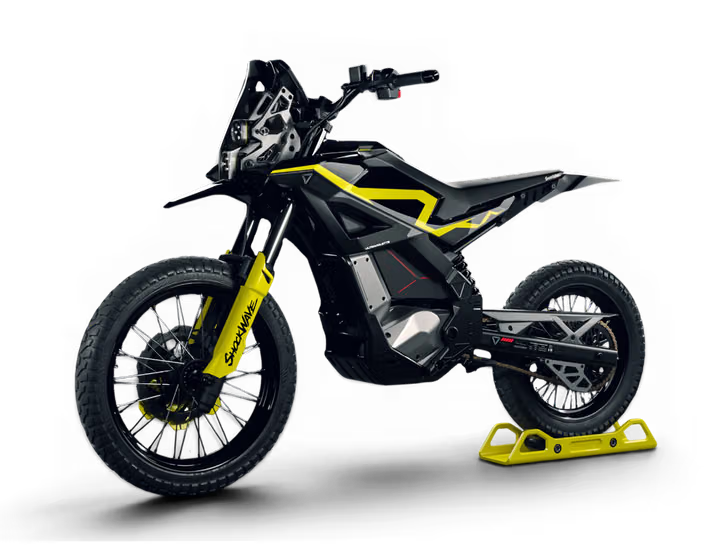
The bulk of India’s EV boom is still driven by two- and three-wheelers. Electric two-wheeler sales have grown rapidly as delivery fleets, gig workers and urban commuters look for lower running costs and protection against volatile petrol prices. In February 2026, for example, e‑two-wheeler retail touched about 1.11 lakh units, up 45.6 percent from a year earlier, even though there was a modest month-on-month dip.
Electric three-wheelers remain India’s most electrified segment, with high adoption in last-mile passenger and cargo transport. For many auto-rickshaw drivers and small businesses, EVs offer lower fuel and maintenance costs compared with CNG or diesel, and in some cities they benefit from local incentives and easier permits.
Passenger EVs: Small Base, Big Growth
Passenger electric vehicles still form a smaller slice of the market but are growing the fastest. Retail sales of electric passenger vehicles in February 2026 rose about 44 percent year-on-year to roughly 13,700 units. Over H1 FY26, PV EV sales more than doubled compared with the previous year, driven by new models, more competitive pricing and higher consumer confidence.
Brand-wise, Tata Motors remains the clear leader in electric cars, but Mahindra, JSW MG Motor and others are catching up quickly. In March 2026, Tata sold over 8,200 electric cars, Mahindra more than 5,200 and JSW MG just over 5,100, with Maruti Suzuki and new entrant VinFast also beginning to show volume. This growing competition is pushing better range, features and value into the market.
Auto Industry Hits All-Time High
EV growth is happening within an auto market that itself is on a historic high. Data from the Society of Indian Automobile Manufacturers shows total domestic wholesales in FY26 at about 2.83 crore units, up 10.4 percent from 2.56 crore in FY25. Passenger vehicle sales reached roughly 46.4 lakh units, a 7.9 percent increase, while commercial vehicles grew 12.6 percent to around 10.8 lakh units. Two-wheelers remained the volume backbone at about 2.17 crore units, up 10.7 percent year-on-year, and three-wheelers grew 12.8 percent to 8.36 lakh units.
Industry bodies note that every major vehicle category recorded its highest-ever annual sales in FY26, something that has not happened in about seven years. Analysts attribute this to tax cuts under recent GST reforms, easing interest rates, a strong festive season and robust rural demand in the second half of the year.
Why EVs Are Surging Now
Several factors explain why EV sales are hitting new highs at the same time as overall auto demand is booming.auto.
-
Fuel prices and global oil uncertainty have made the long-term economics of EVs more attractive, especially for high-mileage users.
-
Central and state incentives, such as purchase subsidies, lower road tax and registration waivers, continue to support EV adoption, even as some schemes are gradually rationalised.
-
Charging infrastructure has improved in key corridors and metros, and more residential and workplace charging options are emerging, reducing range anxiety for many users.
-
Automakers are launching more locally produced EVs across price points, which has helped bring down upfront prices and improved after-sales support.
The Challenges Beneath the Record
Despite the impressive numbers, EV penetration is still in the low double digits of total vehicle sales, and far lower if you look only at passenger cars. Outside big cities, concerns about charging access, resale value and long-term battery life remain significant. The rapid growth also puts pressure on the charging and power grid infrastructure, and raises questions about localising cell and battery manufacturing to reduce import dependence and costs.
On the broader auto side, manufacturers face rising input costs, currency risks and the need to keep investing in both internal-combustion and electric platforms simultaneously. As policy nudges the market toward cleaner and safer vehicles, companies must balance compliance spending with affordability, especially in entry-level segments.
What Comes Next
For now, FY26 will be remembered as the year when India’s auto industry and its EV segment both hit new records together, rather than one growing at the expense of the other. Over the next few years, the key questions will be how quickly EVs can move beyond early adopters into the true mass market, and how well the ecosystem of charging, financing, recycling and grid readiness can keep up.