





























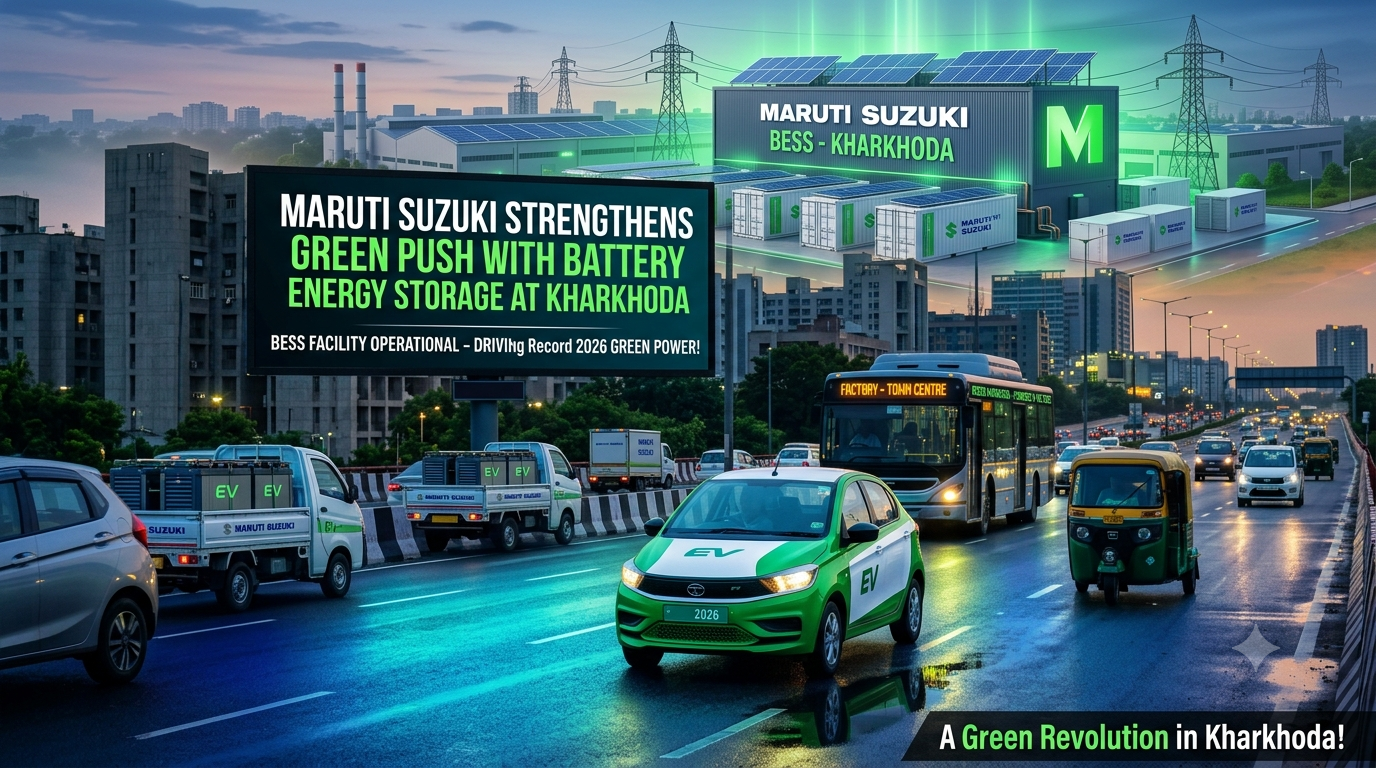
Maruti Suzuki India Limited has taken another decisive step in its green energy journey by commissioning a 1 MWh Battery Energy Storage System at its Kharkhoda manufacturing facility in Haryana. The move underlines the company’s strategy of building a more self-reliant, sustainable energy ecosystem for its operations, while aligning closely with India’s wider decarbonisation goals. By pairing large-scale solar power with on-site energy storage, Maruti Suzuki is working to reduce both its dependence on the grid and its overall carbon footprint.
The Kharkhoda plant already houses a 20 MWp solar power project, installed in 2025, which supplies clean electricity to the facility. Solar power generation, however, does not always match the plant’s electricity demand. On facility holidays or low-demand periods, the solar array continues to produce energy that previously could not be fully utilised because there was no immediate load. Without storage, this surplus power essentially went to waste. The newly commissioned Battery Energy Storage System (BESS) is designed precisely to solve this mismatch between generation and consumption.
A BESS functions like a large rechargeable battery for the factory. When solar generation is high but demand is low, the system stores the excess energy. Later, when the plant restarts or when demand spikes, this stored electricity can be fed back into the facility’s internal grid. In this way, Maruti Suzuki can use more of its self-generated solar power, reduce reliance on conventional grid electricity and improve the overall efficiency of its renewable energy assets. For Kharkhoda, the BESS has been integrated into the internal electricity distribution network as a pilot initiative, giving the company valuable operational experience with large-scale storage.
Beyond internal efficiency, the Battery Energy Storage System also contributes to better grid stability. Industrial facilities with large solar plants can sometimes cause fluctuations in power flows, especially when generation ramps up or down quickly due to weather changes or operational schedules. By absorbing excess power and releasing it in a controlled manner, the BESS acts as a buffer that smooths these variations. This is beneficial not only for the plant’s internal operations but also for the local grid, which experiences more stable loads and fewer sudden peaks or drops.
Maruti Suzuki’s Managing Director and CEO, Hisashi Takeuchi, highlighted how closely this initiative aligns with India’s push for self-reliant energy ecosystems. By investing in on-site storage, the company is strengthening its ability to manage energy independently, reduce exposure to grid constraints and support the broader transition to cleaner power. With an expected lifecycle of about 15 years, the BESS is projected to reduce nearly 54 tonnes of carbon dioxide emissions annually, reflecting the carbon savings from substituting stored solar energy for fossil fuel-based electricity.
This project also fits into a broader climate strategy that goes beyond incremental improvements. Maruti Suzuki has committed to lowering Scope 1 and Scope 2 emissions from its manufacturing operations, not only in terms of CO₂ emissions per vehicle produced but also in absolute emissions, even as production volumes rise over time. Scope 1 emissions refer to direct emissions from sources controlled by the company, such as factory boilers or on-site generators, while Scope 2 emissions come from purchased electricity and heat. By increasing the share of renewable and stored energy used in its plants, the company can cut both categories simultaneously.
The Kharkhoda initiative is closely aligned with the environmental vision of its parent company, Suzuki Motor Corporation. Suzuki has set an intermediate target to reduce Scope 1 and Scope 2 CO₂ emissions by 42 percent by FY 2030–31 compared to FY 2022–23 levels. To meet such an ambitious goal, incremental energy-saving measures are not enough; they must be complemented by structural changes in how energy is sourced, stored and consumed. The combination of a large solar plant and a substantial battery storage system is one such structural change that can deliver long-term, measurable reductions in emissions.
As Maruti Suzuki’s production volumes are expected to grow in the coming years, especially with expanded capacity at Kharkhoda and other plants, the challenge is to decouple growth from emissions. Without interventions like BESS and renewable energy projects, higher output would typically mean higher absolute CO₂ emissions, even if energy efficiency improves. By putting storage and renewables at the core of its energy strategy, the company is signalling that future capacity expansion will be backed by cleaner power, helping keep total emissions in check while meeting market demand.
The Kharkhoda BESS also serves as a pilot and learning platform. The experience gained here in system design, integration with the internal grid, operation under Indian climatic and grid conditions and long-term maintenance can inform similar deployments at other facilities. Over time, Maruti Suzuki could scale up storage capacities, adopt more advanced control systems or explore combinations with other technologies such as demand response or green hydrogen, depending on economics and policy support.
For India’s broader automotive and industrial sectors, projects like this demonstrate how large manufacturers can move beyond basic compliance and take proactive steps in energy transformation. As regulators tighten emissions norms and investors increasingly focus on ESG (environmental, social and governance) performance, companies that invest early in clean energy infrastructure may gain both reputational and operational advantages. Lower energy costs, more reliable power and reduced regulatory risk can all flow from a well-designed green energy ecosystem.
In essence, Maruti Suzuki’s 1 MWh Battery Energy Storage System at Kharkhoda is more than just a technical upgrade. It is a symbol of how the country’s largest carmaker is attempting to align high-volume manufacturing with climate commitments and national energy goals. By capturing the full potential of its solar plant and improving grid stability, the company is turning sustainability from a slogan into an operational reality one that will shape how it builds cars, manages energy and meets its environmental responsibilities over the next decade and beyond.