




















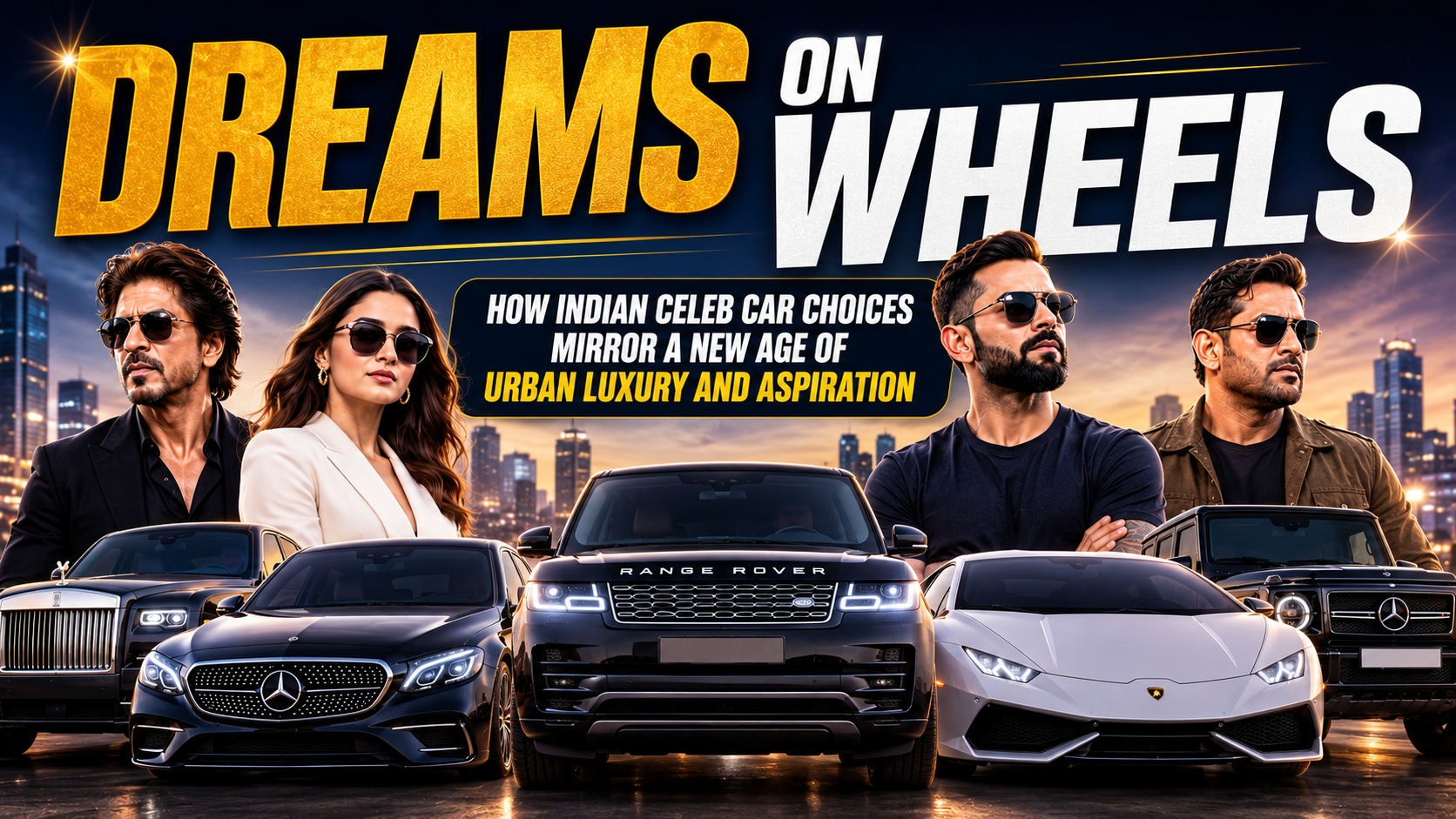
In today’s India, cars are no longer just about getting from point A to point B they’re rolling declarations of identity, success and lifestyle. As cities swell, incomes rise and global brands flood the market, the garage has quietly become one of the most aspirational spaces in the urban home. Nowhere is this more visible than in the way Indian celebrities choose and upgrade their cars. Their journeys from first, modest machines to today’s fleets of luxury sedans, SUVs and EVs beautifully mirror how urban India itself has evolved from basic mobility to full‑blown automotive lifestyle.
For an entire generation of Indians who came of age in the 1980s and 1990s, the dream was simple: owning any car at all, usually a small, reliable hatchback. This era is perfectly captured by icons like Sachin Tendulkar, whose first car was a humble Maruti 800. For middle‑class families, the 800 symbolised entry into a new world of convenience: no more crowded buses, no more dependence on taxis, just the independence to move on your own schedule. That Sachin, now surrounded by exotics and luxury cars, began with the same model so many ordinary Indians aspired to, shows how tightly celebrity and common dreams were once intertwined. The car wasn’t about status; it was about freedom.
Shah Rukh Khan’s early motoring story adds another shade to this picture. His first set of four wheels was a Maruti Omni, a van more associated with practicality than prestige. At that time, a vehicle like the Omni was the perfect fit for someone hustling between theatre rehearsals, TV shoots and film sets. It could carry people, props and luggage without fuss. This reflected a broader urban reality: the first car had to justify itself by doing multiple jobs family mover, cargo hauler, sometimes even business asset. For a struggling actor, choosing a multipurpose workhorse made perfect sense. In many ways, SRK’s Omni symbolised a utilitarian chapter of Indian car culture, where function trumped form and lifestyle branding was almost non‑existent.
Go a little further back and you arrive in the era of the Premier Padmini and Hindustan Ambassador, cars that dominated Indian roads before liberalisation. Superstar Rajinikanth’s first car, the Premier Padmini, expressed a very particular kind of urban aspiration. Based on the Fiat 1100, it looked more stylish and modern than many of its rivals and quickly became associated with progress and sophistication. For someone who rose from being a bus conductor to one of Indian cinema’s biggest names, the Padmini represented more than just mobility it was a badge of “having made it” in a time when choices were limited and any private car ownership was a major milestone. The emotional attachment many still feel for this car speaks to an era when owning one personally chosen vehicle was enough to define a lifestyle.
All of this changed dramatically once India opened up economically and global brands began entering the market. By the late 2000s, the idea of “dreams on wheels” had shifted from simply owning a car to owning a particular kind of car. Premium badges from Europe, Japan and later the US started reshaping urban aspirations. This is where celebrity garages began visibly pulling away from the mainstream, even as they continued to influence it. Deepika Padukone’s association with premium SUVs like the Audi Q7, for example, captures the moment when full‑size luxury SUVs became the new aspirational objects of metro India. The Q7, with its muscular stance, plush interiors and powerful engines, turned the everyday run to the studio or airport into a lifestyle statement. For audiences seeing her step out of such a vehicle, the car became part of her star image modern, global, and confidently successful.
Priyanka Chopra Jonas takes the narrative further into the realm of global luxury and international mobility. Her move from a largely India‑based career to a truly international one is reflected in the cars she is most associated with flagship luxury sedans and, increasingly, cutting‑edge EVs. A Mercedes‑Benz S‑Class or a high‑end electric luxury model such as a flagship EV fits seamlessly with her persona: high fashion, boardroom‑ready, equally at home in Mumbai, Los Angeles or London. For urban Indians watching her trajectory, these cars don’t just represent comfort; they represent a borderless lifestyle. The aspiration is no longer just to own a car, or even a premium car, but to drive something that signals you move in global circles, care about technology and are tuned into the future of mobility.
What’s interesting is how these individual celebrity choices feed back into broader urban car culture. When someone like Deepika is seen in an Audi Q7 or similar luxury SUV, the segment itself becomes more aspirational. These cars start showing up in the dreams of corporate professionals, entrepreneurs and influencers who want a vehicle that announces success even before they step out. Similarly, Priyanka’s embrace of premium, tech‑heavy luxury sedans and electrified models helps normalise the idea of EVs and hybrid mobility as part of the high‑end lifestyle, not just eco‑conscious experimentation. The car, in these narratives, is as much a lifestyle accessory as a functional tool on par with designer labels, watches, or homes in gated communities.
At the same time, the nostalgia around simpler first cars Maruti 800s, Omnis, Padminis adds emotional depth to this new age of urban luxury. Many celebrities openly reminisce about their modest beginnings, and fans respond to that honesty. It creates a powerful contrast: the same star who now arrives in a German flagship once learned to drive in a small, basic hatchback. For readers and viewers, this duality keeps aspiration grounded. It says, “You start where you can, and you grow from there.” In content terms, this lets auto‑lifestyle stories bridge two worlds: the relatable charm of simple cars and the aspirational magnetism of premium machines.
In today’s cities, where Instagram stories, airport spottings and paparazzi pictures constantly circulate, celebrity car choices act as trend‑setters for an entire generation. A luxury SUV is no longer just a family vehicle with extra space; it is an “urban throne” for stars, influencers, and those who emulate them. High‑end sedans and EVs are not just about tech and refinement; they are signals that the owner has stepped into a new class of global, environmentally aware luxury. Even the decision to hold on to an old first car, restore it, or talk fondly about it in interviews shapes how fans think about nostalgia and sustainability.
“Dreams on Wheels” in this new age are therefore layered. At one level, they’re about owning the badges and body styles you see your favourite stars step out of Q7s, S‑Class sedans, Land Cruisers, electric flagships. At another, they’re about embracing a whole lifestyle around the car: weekend drives, social media flexes, curated interiors, tech features, and the story you tell when someone asks, “What was your first car?” Indian celeb garages, with their mix of modest origin stories and ultra‑luxurious present realities, perfectly mirror this journey. They show how far urban India has travelled from seeing a car as a rare utility to treating it as a central part of personal identity and aspiration. In the process, each star’s choice becomes more than a purchase; it becomes a signpost on the road that millions of dreamers hope to drive down next.