



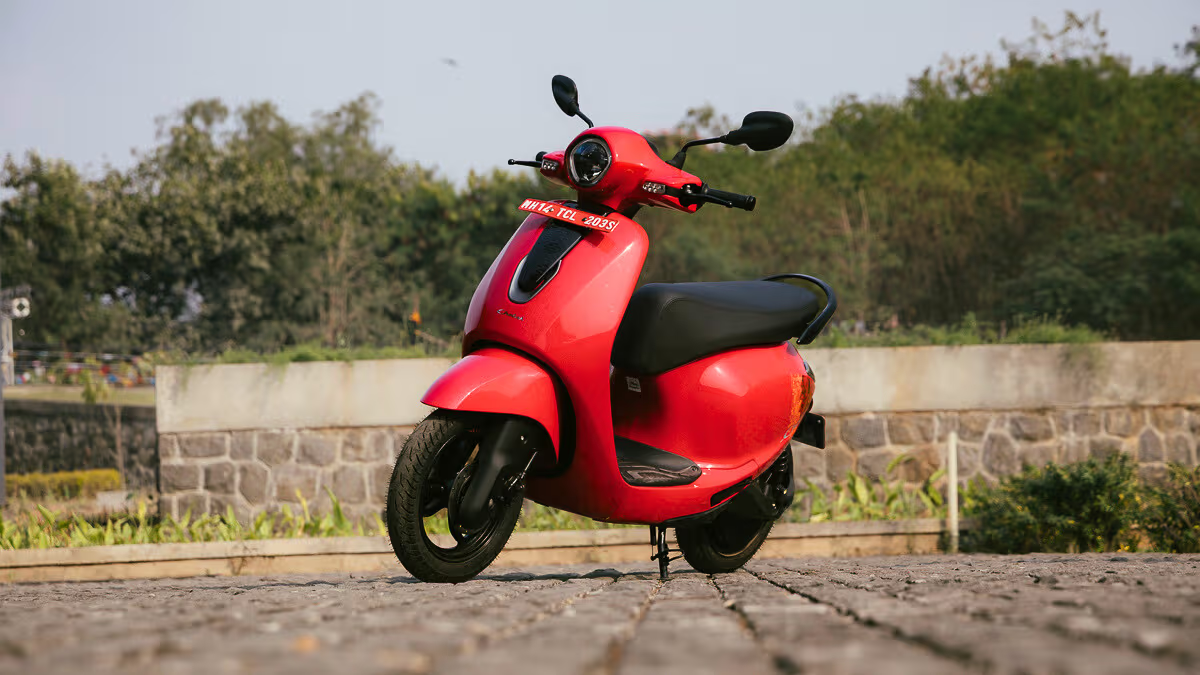

















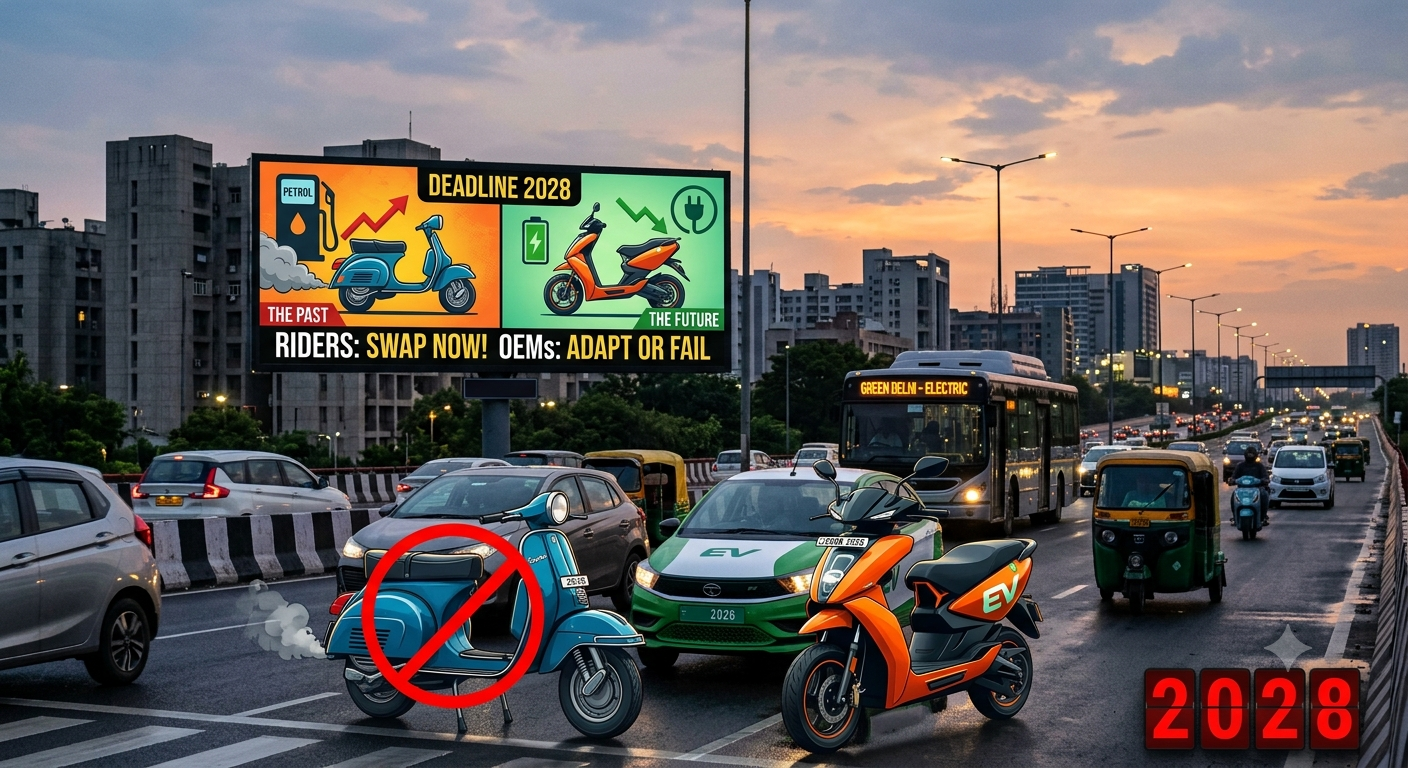
Delhi’s new electric vehicle policy sets a clear cut-off date for petrol-powered two-wheelers. From 1 April 2028, new registrations of petrol and CNG scooters and motorcycles in the capital will no longer be allowed, and only electric two-wheelers will be eligible for fresh registration. Existing petrol scooters already on the road can continue to run, but anyone planning to buy a new bike or scooter after the deadline will have to choose an electric model. This shift is part of a broader plan to clean up Delhi’s toxic air and push the city towards a largely electric vehicle fleet by the end of the decade.
For everyday riders, the most immediate impact is on purchase decisions between now and 2028. You can still buy and register a petrol two-wheeler in Delhi during 2026 and 2027, as long as it meets the emission and registration rules in place, but after the cut-off date only electric scooters and motorcycles can get new registration numbers. This means many riders who prefer the familiarity and perceived reliability of petrol may advance their purchase plans to beat the deadline. At the same time, the policy is designed to nudge buyers towards electric options earlier by offering upfront financial incentives, tax breaks and scrappage benefits.
Cost is a big concern for riders, and the policy tries to soften the blow by reducing the upfront price gap between petrol and electric two-wheelers. The Delhi government has proposed subsidies for electric scooters and bikes that can go up to around thirty to fifty thousand rupees in the initial phase, calculated on a per kilowatt hour basis and capped per vehicle. Road tax and registration fees for electric two-wheelers are proposed to be fully waived, which can make an electric scooter significantly cheaper on-paper than a comparable petrol model. For those scrapping an old petrol two-wheeler and replacing it with an EV, an additional scrappage incentive of roughly ten thousand rupees is under consideration.
Running costs will also change. Electric scooters typically have far lower per kilometre energy costs compared with petrol, because electricity is cheaper per unit of energy and electric drivetrains are more efficient. Riders who commute daily can expect substantial savings on fuel, especially if they charge at home or at subsidised public chargers. However, these savings depend on reliable access to charging and the price of electricity in their area. Riders who live in apartments without dedicated parking or charging points may find daily charging logistics more complicated than simply visiting a fuel station.
Range and charging time are other practical issues. Many modern electric scooters in India now offer real-world ranges suitable for city use, often between sixty and one hundred kilometres per charge in mixed conditions. For most urban commuters in Delhi this is adequate, but riders who frequently undertake longer trips or highway rides may feel constrained compared with a petrol scooter that can be refuelled in minutes. Faster chargers and battery-swapping networks are emerging, but coverage is still uneven, meaning the user experience will vary between central areas with good infrastructure and outer colonies where charging options are limited.
For OEMs, the 2028 deadline is both a challenge and an opportunity. Manufacturers of petrol two-wheelers must now plan for a future in Delhi where new internal combustion engine models cannot be sold, which will gradually shrink their addressable market in the capital. They will need to accelerate development and launch of electric models tailored to Delhi’s conditions, including affordable entry-level scooters for mass-market buyers, higher range models for premium customers and robust products for delivery and fleet segments. Companies that move quickly can capture first-mover advantage and secure strong brand recall among early EV adopters.
Supply chains and dealer networks will also need to adapt. Traditional dealerships that rely heavily on petrol two-wheeler volumes will have to transform into EV-focused outlets, invest in training technicians for electric drivetrains and integrate charging or battery service solutions. OEMs will need to secure reliable battery supply, invest in localisation of key EV components and perhaps partner with charging companies to offer bundled home chargers or subscription-based charging plans. This transition involves capital expenditure and operational risk, but policy clarity up to 2030 gives manufacturers a planning horizon to phase investments.
Fleet operators and delivery companies face earlier and stricter timelines. Many policies propose that commercial two-wheeler fleets, such as e-commerce and food-delivery bikes, transition to electric before private owners do, so that high-usage vehicles shift first. This can significantly reduce emissions and noise in dense areas but forces fleet operators to rethink their entire operating model. They must manage charging schedules, route planning and battery health, while ensuring riders are comfortable using electric vehicles. OEMs that design fleet-friendly EV products and offer flexible financing or leasing options could capture a large share of this segment.
From an environmental perspective, the petrol scooter deadline is a major step in tackling Delhi’s chronic air pollution. Two-wheelers are a large share of the city’s vehicle population, and shifting new additions to zero tailpipe emissions is expected to reduce particulate matter and nitrogen oxide emissions over time, especially when combined with parallel measures for cars, buses and autorickshaws. The decision aligns with Delhi’s ambition to have a substantial portion of its vehicle fleet electric by 2030 and demonstrates how city-level policies can lead the national transition. If the policy is implemented effectively, the air quality benefits may strengthen public support for stricter measures on other vehicle categories in the future.
Still, the success of this policy will depend on execution. Riders will judge the transition by real-world factors such as product reliability, service quality, resale values and the convenience of charging. OEMs and policymakers must work together to address concerns about battery life, safety and fire risks, and to ensure that charging infrastructure keeps pace with vehicle adoption. Clear communication, transparency on incentives and a smooth experience at registration and dealerships will be vital to avoid confusion or resentment as the 2028 deadline approaches. Delhi’s decision is a bold signal to both riders and manufacturers that the era of petrol scooters in the capital is nearing its end, and those who prepare early are likely to benefit the most.