





















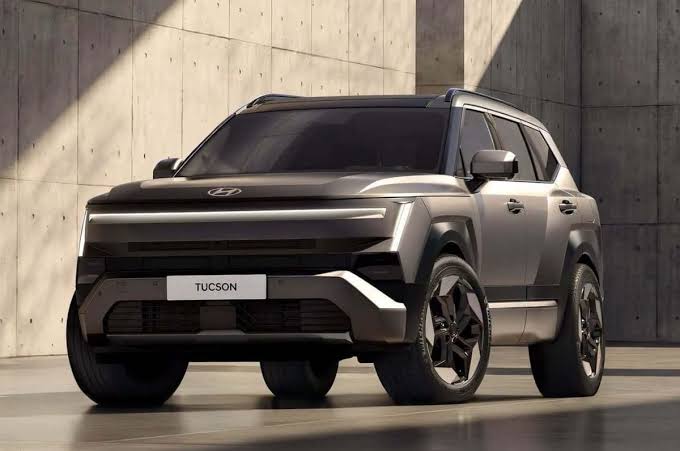
Hyundai has unveiled the redesigned 2027 Tucson SUV featuring a new design language, bigger body and premium cabin. The next generation model of Hyundai Tucson uses the company’s new “Art of Steel” design language and is expected to offer more interior space than its predecessor.
Though the South Korean automaker has revealed both the exterior and interior of the 2027 Hyundai Tucson, exact details about the powertrain have not been unveiled yet. The SUV is expected to be offered with petrol, diesel and electrified powertrain options in the international markets. However, the launch date and specs of the model in India remain unknown.
New “Art of Steel” Design
The new generation Tucson sports a sharp and upright body design compared to its predecessor. Hyundai states that the new “Art of Steel” design language is inspired by the strength and tension of steel.
The SUV sports a boxier silhouette, prominent wheel arches and a muscular posture. Chunky body cladding covers the lower parts of the body, lending a rugged touch to the SUV. The SUV is also fitted with two-tone alloy wheels and flared wheel arches.
At the front end of the Tucson, one can see a squared-off fascia with full-width LED light strip. The vertically positioned LED strips are present on either sides of the fascia while the main headlamps of a box shape are mounted low on the front body.
The new Tucson SUV features a horizontally aligned air intake and two-tone design of the front bumper. Hyundai is expected to unveil an XRT version of the SUV with different bumper design and other exterior changes.
The side profile of the Tucson is distinguished with faux roof rails, pull type door handles and silver skirting reaching to the rear pillar. With the help of the new design, Hyundai has made the Tucson look more like an SUV and a modern one.
Larger Dimensions
In comparison to its predecessor, the new 2027 Hyundai Tucson has grown bigger in size. The length, width and height of the SUV are 4,700mm, 1,905mm and 1,685mm respectively. The wheelbase of the SUV is 2,785mm.
In comparison to the predecessor, the new Tucson has become 60mm longer, 40mm wider and 30mm wheelbase longer. With these extra dimensions, Hyundai claims that it has created best-in-class interior space.
The bigger frame is expected to ensure better legroom and shoulder room for the passengers. In addition, the increased size can help boost the stability and overall presence of the SUV.
It will be particularly beneficial for the rear seat passengers, as Hyundai has increased the angle of opening the rear door by 10 degrees up to 83 degrees.
The 2027 model of the SUV will be available in five new colours: Serenity White Pearl, Driftwood Grey Matte, Driftwood Grey Metallic, Red Rock Orange Matte and Goyo Copper Pearl.
Rear Design Featuring Angular Features
The rear end of the SUV features the continuation of the angular theme. The SUV has a narrow LED strip of lights, vertical LED lighting elements and “TUCSON” lettering in bold font.
In addition, it gets a bulky rear bumper and roof spoiler. The XRT version will have a unique design of wheel arches, specific alloy wheels, special skid plate, new rear bumper design and XRT badging.
The new Tucson’s upright shape, black cladding and specific lighting give the SUV a more rugged appearance. Apparently, Hyundai wants the new Tucson to stand out in the segment of premium SUVs.
Premium Two-Tone Interior
As for the interior of the next-generation SUV, it has also undergone a major design transformation. The new SUV has a modern two-tone design with a neat, layered dashboard and a lifted centre pillar.
The new cabin is supposed to be available in two colour combinations of dual tone and one single tone, depending on the specification of the SUV. Orange ambient lighting will add to the overall design.
In addition, the SUV will get two-tone D-cut steering wheel with Hyundai’s pixel-style logo. Transmission selector will be installed on the steering column, thus providing extra space for the central console. Such design is characteristic of premium European vehicles.
A slim digital instrument display will be located behind the steering wheel, while the centre of the dashboard will accommodate a big tablet-like screen. The infotainment system of the vehicle is supposed to be based on Hyundai’s Pleos operating system; however, the full range of functions is not yet known.
In addition, Hyundai has kept some physical controls below the main display, which is going to help to operate certain functions without the help of the touchscreen.
Read this- BMW X1 Long Wheelbase Priced at ₹49.90 Lakh with ₹44,444 EMI and 60% Buyback Offer
Features and Tech
The production-ready Tucson is expected to come loaded with equipment. Some features which could be included are front seats with electric adjustments, dual-zone automatic climate control, two wireless charging stations and LED ambient lighting.
Panoramic glass roof, premium sound system, 360-degree camera and connected car technology could also be found on the SUV. The vehicle is expected to offer multiple driving modes where drivers could change the behavior of the car according to different driving conditions.
In terms of safety, it could have multiple airbags, electronic stability control and advanced driver assistance systems package. This ADAS package could feature functions such as adaptive cruise control, lane departure assist, forward collision warning and autonomous emergency braking.
Hyundai has not revealed the full list of features for the new SUV, therefore, equipment could differ from country to country.
Technical Specifications Unconfirmed
Hyundai has not yet published the technical specifications of the 2027 Tucson. The previous-generation Tucson, which was available in India, had a 2.0-liter naturally-aspirated petrol engine with 156hp and a 2.0-liter turbocharged diesel engine with 186hp.
The petrol engine came with a six-speed torque converter automatic transmission, whereas the diesel engine was mated to an eight-speed torque converter automatic gearbox. The petrol model featured only front-wheel-drive, while the top-of-the-line diesel variant was available in AWD configuration.
Globally, the Tucson is offered with strong hybrid and plug-in hybrid engines. The next-generation Tucson could be offered with similar hybrid and electrified engines, but this has not been confirmed by Hyundai.
With its bolder “Art of Steel” look, increased dimensions and premium interior, the 2027 Tucson could be an interesting competitor to SUVs like the Jeep Compass, Volkswagen Tiguan and Toyota RAV4 in the international market.
With its striking “Art of Steel” design, increased dimensions, upgraded interior and electrified powertrain, the upcoming Hyundai Tucson is one step forward for the marque. More information about its engines, technology, price and availability would be revealed closer to its official launch.
Watch this-