

































While buying the first car is exciting, many first-time car buyers in India make mistakes leading to paying lakhs more over the next 5-7 years.
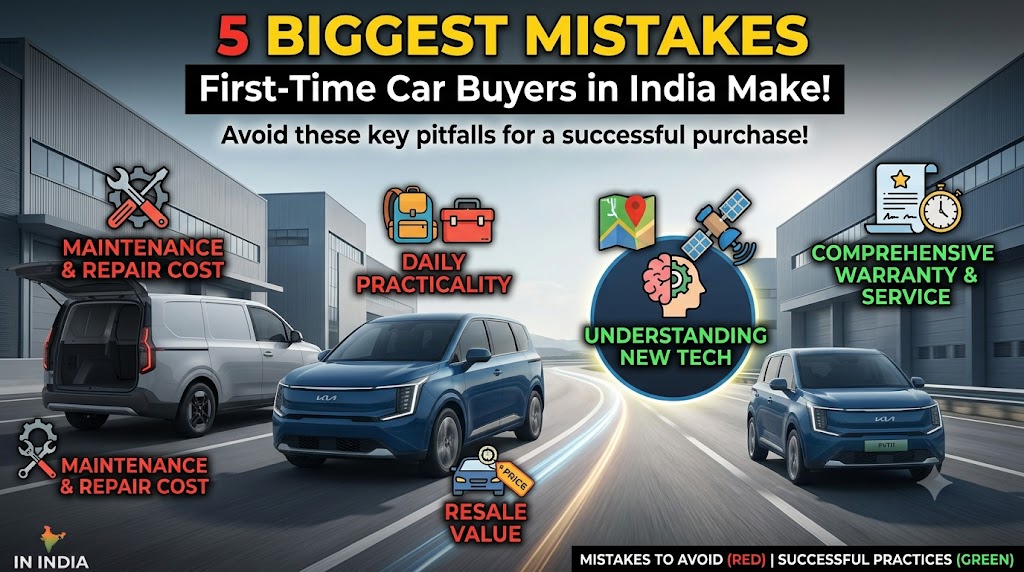
From budget hatchbacks to feature-laden SUVs and EVs, first-time buyers in India tend to fall for the wrong details and features without evaluating the total life cycle cost of a vehicle. Here are the five biggest mistakes first-time car buyers in India make, along with ways to avoid them.
1) Fixing EMI First Instead of On-Road Budget
Many first-time car buyers fix their EMI amount and look for a car in the given range, rather than fixing a total on-road budget and calculating the EMI.
While a ₹10,000 EMI seems affordable, it doesn’t account for:
Down-payment: Usually 15–30% of on-road price
Interest: 20–40% of the ex-showroom price over 5–7 years
Insurance: Comprehensive insurance can be ₹40,000–₹80,000 for the first year
Maintenance, fuel or charging and depreciation: The running cost and value retention of the car
Instead, first-time buyers should fix their on-road budget, including insurance and registration, and calculate the EMI.
Using a standard EMI calculator, the buyer should fix the EMI for both 5–6 year and 7-year tenures to calculate the total outgoing for all 3–5 segments of hatchbacks, sedans, SUVs and EVs under consideration.
It’s also important to ensure that the EMI, combined with the running cost (fuel or charging, insurance, maintenance), doesn’t exceed a comfortable percentage of the buyer’s monthly income.
Read this- Bike News India September 2026: New Himalayan 440, Jawa 42 All Stars, Hero 125R & Kawasaki Fire Sale
2) Buying the Wrong Segment Type
Many first-time car buyers tend to fall for trends and buy an SUV, sunroof or feature they don’t need. Some of the biggest segment mistakes made by first-time buyers in India include:
City only commuter buying a large SUV: The buyer ends up spending more upfront, as well as on fuel/EV charging and has a difficult time finding parking or navigating on congested city roads
Highway driver buying the cheapest available model: Small cars with high mileage may offer poor stability on highways and a sense of insecurity at higher speeds
Families of 4–5 members preferring style over space: A sloping roof or cramped rear seat can soon become a pain on long drives
Instead, first-time car buyers should consider the following tips to help pick the right segment:
List out their typical weekly pattern – city-only commuting, 50–50 split of city and highway or regular long distance travel
Fix the number of regular occupants, as well as the need for boot space
Pick the segment based on the pattern and need, and then the powertrain (fuel type)
City only – Hatchback or compact SUV with good mileage or EV range
50–50 split – Compact Sedan or mid-size SUV with highway friendly character
Large family – 5-seater with good rear seat space or 7-seater MPV/SUV
3) Ignoring Safety Features and Structural Safety
While features, mileage and style are appealing, many buyers in India ignore safety technologies and vehicle structure safety.
Some of the most common mistakes first-time car buyers in India make when it comes to safety include:
Buying the cheapest variant without dual airbags, ABS with EBD, rear parking sensors or rear camera
Assuming heavier cars are always safer than lighter cars
Missing out on ADAS (driver assistant technologies) even when they are available at a slightly higher price in the same segment
On the contrary, first-time car buyers should make dual front airbags, ABS with EBD and rear parking sensors a must-buy, even in the entry-level variant.
Buyers should research the safety ratings (Bharat NCAP or Global NCAP) of cars under consideration and shortlist only those offering a 4–5 star rating. If the buyer’s budget allows, they can also consider variants with ADAS (Level 1 or 2) technologies, if they spend a lot of time on highways.
Spending a little extra on a safer variant can literally save your life and improve your car’s resale value too.
Watch this- New Baleno 2026 Mileage and drive review!
4) Skipping or Skipping Proper Test-Drives
Many first-time car buyers skip test-driving altogether, while many simply do a 5-minute drive in their desired location and regret the purchase once they start using the car.
Some of the biggest test-drive mistakes include:
Only driving on a city route and not testing the highway behavior, braking at speed or handling rough patches
Not adjusting the seat and steering to their liking and making subjective judgements
Not noticing the comfort and noise levels after 20–30 minutes of driving
Instead, first-time buyers should insist on doing a multi-lane test drive with a route that includes:
City traffic
A flyover or highway section
A rough patch
They should also adjust the seat and steering to their desired position and evaluate the headroom, legroom and reach of the steering. It’s a good idea to spend 20–30 minutes driving on the test route and observe how their back, neck and thighs feel as well as how fatigued they get while pressing the clutch/brake/accelerator.
If the buyer has shortlisted 2–3 cars, it’s a good idea to ask for a comparative test drive on the same route and quickly identify differences in driving dynamics.
5) Missing Key Factors in Ownership Cost
Many first-time car buyers in India fix the ex-showroom cost and EMI, while many forget about the running cost of the car in terms of fuel or EV charging, periodic service, insurance and depreciation (loss of value).
Some of the biggest ownership cost mistakes made by first-time buyers in India include:
Comparing fuel cost of cars with higher mileage against EVs without considering the running cost of the EV in ₹/km
Not assessing periodic maintenance cost of cars, especially with a package service quote for 5 years/50,000–60,000 km
Missing out on checking insurance premium quotes for the chosen variant and comparing quotes with 2–3 other variants in the same segment
Not considering depreciation of the car, especially for cars they intend to keep for 5 years before upgrading
Instead, first-time buyers should calculate the cost per km and running cost (fuel, EV charging, package service cost) in ₹/km for all cars under consideration.
They should also ask for insurance premium quotes for all shortlisted variants and compare it against 2–3 other variants in similar segments. It’s also a good idea to look at used car listings for 3–5 year old cars of the shortlisted models to assess the typical resale value.
A car that seemed more expensive initially can end up being a better deal if its running cost and depreciation are lower.
How to Avoid These Mistakes in Practice
To sum up, here are some quick ways to avoid these mistakes:
Fix the on-road budget and avoid focusing only on EMI
Fix segment and powertrain based on usage (city, highway, family size)
Make the essential safety technologies (dual airbags, ABS with EBD, rear parking sensors) a must-have
Do proper test drives – not just 5-minute drives and not only on city roads
Calculate the 5-year running cost and resale value
Avoiding these mistakes can help first-time car buyers in India avoid spending lakhs more on their first car.
Watch this-