














India’s auto dealers are turning more positive towards their OEM partners in 2026, but the benefits are far from evenly shared. In the sixth edition of the Federation of Automobile Dealers Associations (FADA) Dealer Satisfaction Study (DSS 2026), JSW MG Motor led the four wheeler mass-market segment, Royal Enfield led the conventional two-wheelers and Tata Motors Commercial Vehicles (CV) led the CV manufacturers.
The overall Dealer Satisfaction Index (DSI) for the Indian auto industry rose 29 points year-on-year to 810, indicating improvement in dealer – OEM relations across the board, but profitability, inventory pressure and long-term business viability remain a concern for dealers, particularly for brands that scored below the segment average.
Four wheeler mass market: JSW MG retains top spot
In the 4W mass-market category, JSW MG Motor India retained a number one position with 865 points, well above the segment average of 810. This is the second consecutive year that the brand has led the segment in the FADA study, reflecting dealer confidence in its product pipeline, margins and support systems.
The top three in the 4W mass-market segment were:
1. JSW MG Motor India – 865 points
2. Mahindra & Mahindra – 853 points
3. Tata Motors (PV) – 836 points
Kia Motors followed with 812 points, while Toyota Kirloskar Motor, Hyundai Motor India, Maruti Suzuki India and Renault India recorded 778, 766, 670 and 597 points respectively. The wide gap between the leaders and laggards shows that dealer satisfaction is not directly proportional to sales volume; some of India’s largest brands scored below the segment average.
Dealers rated OEMs on parameters such as profitability, inventory management, marketing support, after-sales backing, training, communication transparency and long-term business viability. JSW MG’s high score suggests that dealers are relatively happy with margins, model mix (including EVs and ICE SUVs) and the brand’s growth trajectory under the JSW umbrella.
Two-wheelers: Royal Enfield edges past Hero in a tight race
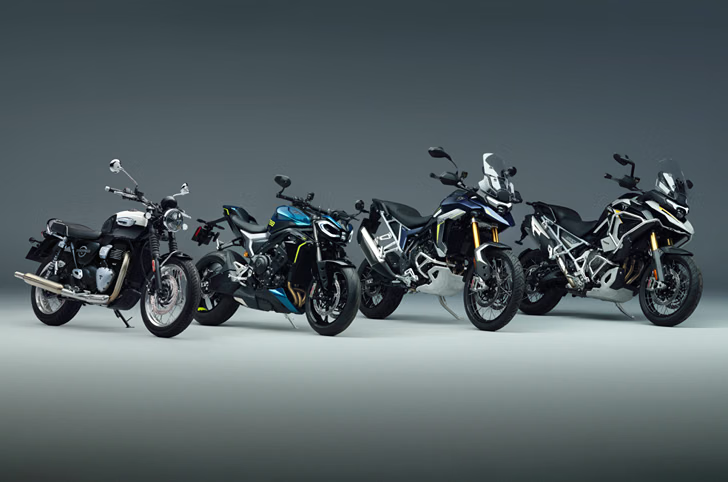
In the conventional two-wheeler segment, Royal Enfield led the rankings with 878 points, narrowly ahead of Hero MotoCorp at 873. Both brands were significantly above the two-wheeler segment average of 827, indicating that dealers of these two companies are much more satisfied than the industry norm.
The two-wheeler rankings were:
1. Royal Enfield – 878 points
2. Hero MotoCorp – 873 points
3. TVS Motor Company – 689 points
4. Suzuki Motorcycle India – 666 points
5. Honda Motorcycle & Scooter India (HMSI) – 631 points
6. Bajaj Auto – 570 points
Royal Enfield’s lead reflects strong dealer confidence in its premiumisation strategy, new model launches (including 450cc and EV platforms) and healthy realisations per unit. Hero’s close second shows that despite intense competition in the commuter segment, its vast network, cost control and steady product updates keep dealers relatively satisfied.
The sharp drop after the top two highlights structural issues for some mass-market two-wheeler brands, including margin pressure, high inventory and slower model refresh cycles.
Read this- Tata Curvv Series X launched: Feature- loaded SUV coupé from ₹9.99 lakh
Commercial vehicles: Tata Motors CV leads
In the commercial vehicle segment, Tata Motors CV secured the highest position with 800 points, followed by Ashok Leyland at 769 and Eicher at 744. This indicates that CV dealers of Tata Motors are more satisfied with product support, uptime, financing tie-ups and after-sales ecosystem compared to rivals.
The CV segment is particularly sensitive to total cost of ownership, vehicle uptime and resale value, so higher satisfaction scores often translate into stronger repeat purchases and brand loyalty.
Electric vehicles: Ather and VinFast top their categories
FADA also tracked dealer satisfaction in emerging EV segments.
In electric two-wheelers, Ather Energy led the rankings.
In electric passenger vehicles, VinFast topped the list.
These results suggest that EV-focused brands with dedicated sales and service ecosystems are managing dealer expectations better than some legacy OEMs still transitioning to electric.
Key themes: Profitability, inventory and after-sales support
While the overall DSI has improved, FADA’s study highlights persistent pain points:
Profitability: Many dealers, especially in high-volume mass-market brands, feel that per-unit margins are insufficient given rising operational costs and compliance burdens.
Inventory management: Aggressive wholesale targets and mismatched production – demand planning lead to high stock levels, forcing discounts and hurting dealer cash flow.
After-sales support: Dealers want better parts availability, faster claim settlements, more technical training and stronger digital tools to manage service operations.
Long-term viability: Uncertainty around ICE vs EV transition, changing regulations and shifting OEM strategies make some dealers cautious about long-term investments in infrastructure.
FADA has used these insights to push for more transparent communication, sustainable dealership economics and collaborative planning between OEMs and dealers.
Why dealer satisfaction matters
Dealer satisfaction is not just an internal industry metric; it directly impacts customer experience. Satisfied dealers are more likely to:
Invest in better showroom and workshop infrastructure
Train staff more rigorously
Maintain healthier inventory of models and colours
Offer more transparent pricing and smoother after-sales service
Conversely, low satisfaction often leads to cost-cutting, high staff attrition and compromised service quality, which eventually hurts brand image and repeat purchases.
What the 2026 study signals for India’s auto retail
The 2026 FADA DSS shows that India’s auto retail ecosystem is gradually improving, but the benefits are unevenly distributed. Brands that have aligned product strategy, pricing, margins and dealer support – like JSW MG, Royal Enfield and Tata Motors CV – are seeing much higher dealer confidence.
For volume leaders with lower scores, the study is a clear signal to revisit inventory policies, margin structures and communication frameworks with their dealer networks. As the industry moves towards stricter emission norms, higher safety standards and a growing EV share, a healthy, profitable dealer network will be critical to sustaining growth.
In short, the 2026 FADA study underlines a simple truth: in India’s auto business, happy dealers are as important as happy customers.
Watch this-