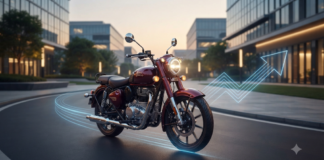



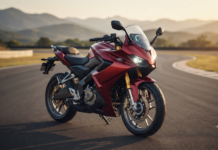












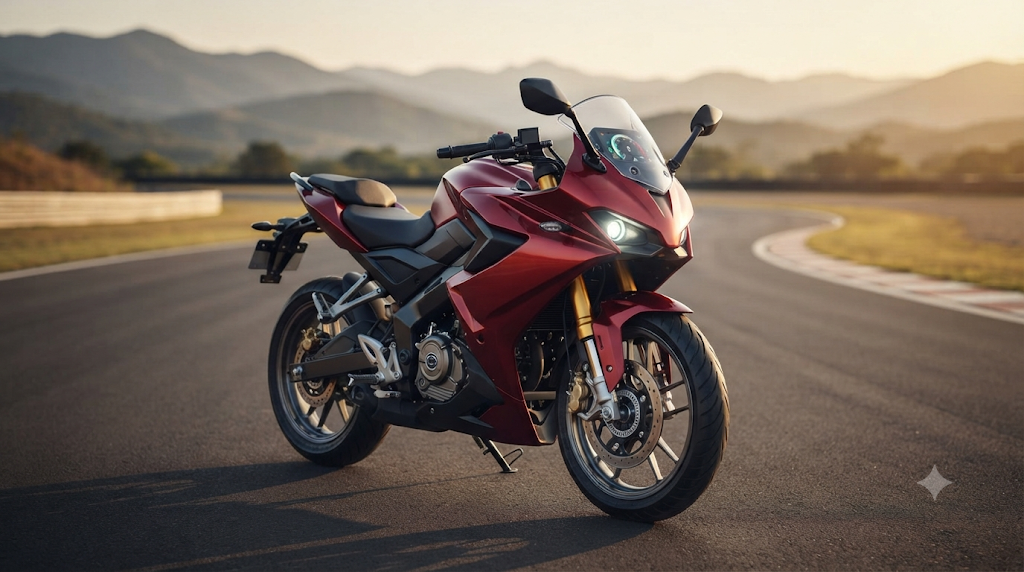
Pulsar RS200 gets upgraded specification including increased power, riding modes and a TFT panel, with prices set at Rs.1.98 Lakh.
This upgrade includes the addition of an electronic throttle body, traction control, multiple riding modes and a TFT dash. As opposed to visual upgrades, this update has instead focused on adding equipment to improve riding.
Although the exterior design is unchanged, the new specification has made this an extensive upgrade. New features such as the Sports Shifter, adjustable controls and smartphone integration for navigation have been added. Additionally, upside down forks have been added in place of telescopic forks. As a result, the Pulsar RS200 has become a more competitive choice within the affordable fully faired segment.
Increased Power Output
The new Pulsar RS200 model has increased power to 25.5bhp from 24.5bhp. Combined with the addition of new electronics, Bajaj has improved both the power of the bike, and the way riders can control that power.
However, no improvements have been made to acceleration times, fuel economy or extensive performance tests. Therefore, it cannot be assumed that the increased power has led to a large improvement in top speed. Only a ridden test can give us a proper insight into how much of a difference has been made in passing situations, urban riding and long motorway journeys.
Riding Modes
The Pulsar RS200 now includes multiple riding modes thanks to the addition of an Electronic Throttle Body (ETB). This allows for the bike to be adapted to suit various riding situations.
It is not yet clear what types of riding modes are present, nor how they alter throttle response and power. Without knowing this, it is difficult to fully understand how beneficial this change is. We do know that the riding modes can be changed depending on the riding conditions.
Traction Control & Sports Shifter
Another major addition to the Pulsar RS200 is Traction Control. This will reduce wheel slippage in low grip conditions. Combined with the new riding modes and electronic throttle, this improves the bike’s rider assistance features.
Another change included in this update is the Sports Shifter. It is unclear how this works. It is not confirmed whether this allows no clutch up/down shifts, just up shifts, just down shifts or both. Due to this uncertainty, it should not be assumed that this Sports Shifter performs the same function as a certain quick shifter from a competing brand.
Navigation Support
The instrument panel has undergone a large change. It has changed to a 5 inch TFT screen. This means that Google Maps can be mirrored onto the dash, allowing for easy navigation on the vehicle. This is one of the most noticeable updates to the bike.
Although this makes navigation easier on the bike, we have not been given full details on the compatibility with phones, required connections and full menu options. Therefore, it is unknown yet how easy this feature is to use in practice. If a rider regularly travels in unfamiliar areas, it will be very useful.
Read this- Denza D9 vs MG M9 – Which Luxury EV MPV Should You Go For?
Improved Practical Features
Adjustable controls, USB Type C charging point, hazard button and Panic Brake Alert have all been added. This makes the overall upgrade in this bike range quite extensive, with increased practicality and safety features.
Adjustable controls and charging points mean this bike suits well in daily use. The hazard button provides further easy access to useful functions. The Panic Brake Alert does not however have clear conditions as to when it will occur. As a result, it is best to check the official documentation for this bike to see how it functions.
USD Front Forks & Wider Rear Tyre
The suspension has seen some changes. The front forks have been upgraded to 37mm USD forks, and a wider radial tyre (140/70-R17) has been added to the rear. These changes mean the bike now has an improved specification, but still keeps its recognisable fully faired style.
Without a ridden test, it is difficult to know if this upgrade to the suspension hardware has had much of an effect on the ride quality, handling and stability on rough terrain. We cannot assume based off component specifications if this upgrade has made the bike more comfortable to ride, or improves handling. Instead, the tuning of the suspension system and how the whole bike handles will be more important.
Competition with Similar Models
The Pulsar RS200 still competes with the KTM RC 200, Yamaha R15 V4 and Suzuki Gixxer SF 250. These models all have very different styles. The KTM is very sporty, the Yamaha has focussed on being light and the Suzuki has a larger engine making it more of a sports tourer.
Thanks to the increased power, rider assistance features, navigation capabilities and improved suspension, the Pulsar RS200 has a very modern specification. Whether it is appealing depends on how well the features combine.
Watch this-