




















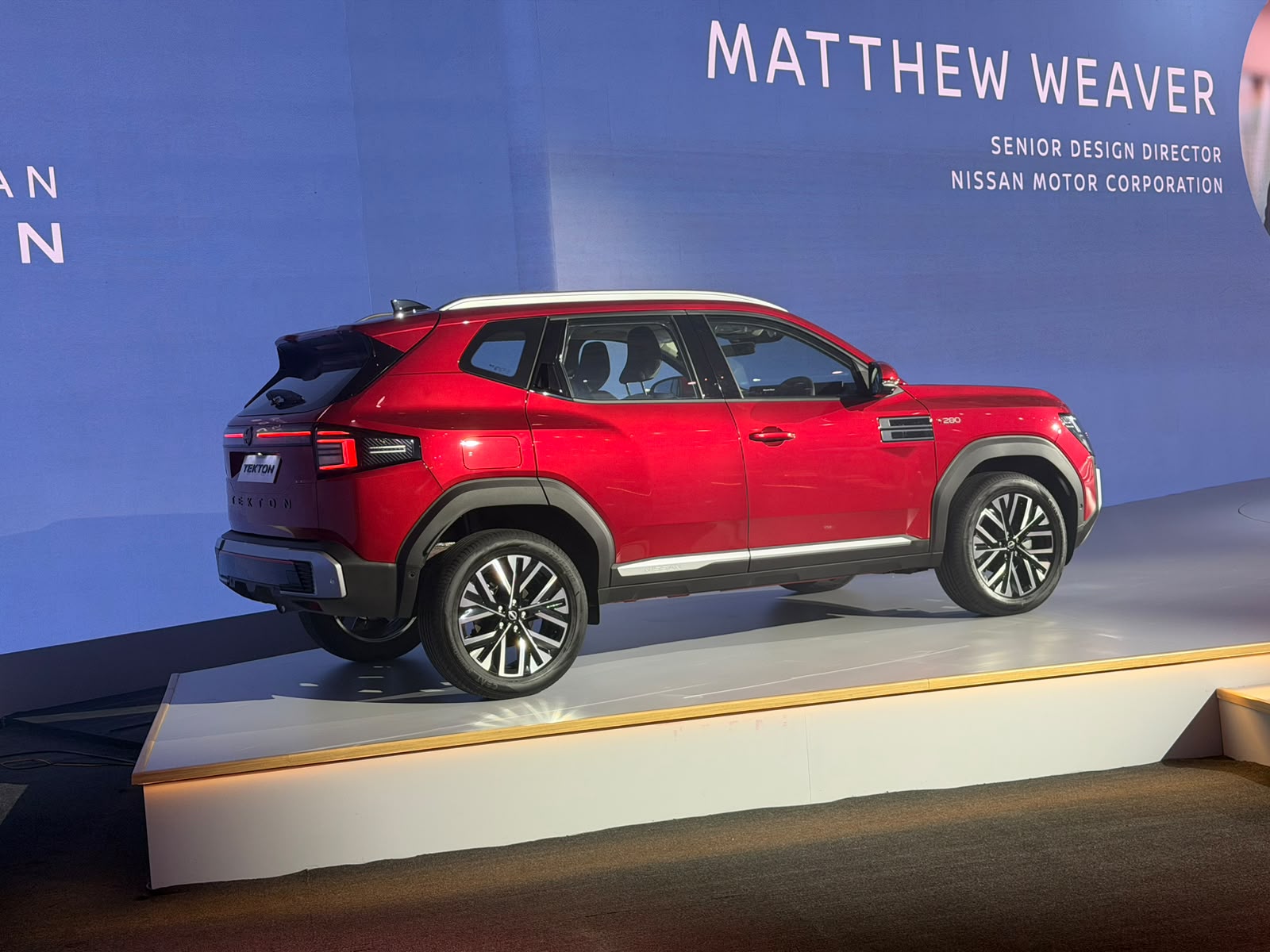
The Nissan Tekton has now emerged as one of the most important midsize SUV launches in India, and its variant structure is designed to cover a wide range of buyers, from value-focused customers to premium SUV shoppers. The lineup begins at ₹10.49 lakh and stretches to ₹18.59 lakh, giving Nissan a competitive spread against rivals like the Hyundai Creta, Kia Seltos, Maruti Grand Vitara, Toyota Hyryder, Renault Duster, Tata Sierra, Honda Elevate, Skoda Kushaq and Volkswagen Taigun. The variant range is built around two turbo-petrol powertrains, multiple transmission choices, and a clear ladder from basic essentials to fully loaded luxury.
Variant structure
The Tekton is offered in six main trim levels: Visia, Visia+, Acenta, N-Connecta, Tekna, and Tekna+. Each step up adds more comfort, technology and convenience equipment, while the higher trims also pair with the stronger T280 engine and DCT automatic. The strategy is simple: keep the lower trims accessible, then use the higher variants to attract buyers looking for a richer and more premium driving experience.
Entry variants
The base variant is the Tekton Visia T160 MT at ₹10.49 lakh, followed by Visia+ T160 MT at ₹11.14 lakh. These are meant for buyers who want the Tekton badge, SUV styling and turbo-petrol performance without stretching to higher prices. The T160 engine in these trims makes 100 ps and 166 Nm, paired with a 6-speed manual gearbox and a claimed 19.4 kmpl.
Moving slightly up, the Acenta T160 MT is priced at ₹11.79 lakh and the N-Connecta T160 MT at ₹13.69 lakh. These mid-entry trims should appeal to families who want a better mix of comfort and value, while still keeping the manual transmission and the smaller T160 engine. For many buyers, this is likely the sweet spot if they want an affordable midsize SUV but do not need the most powerful engine or automatic transmission.
Mid variants
The Tekton’s middle zone is where Nissan starts to balance price and feature content more aggressively. The Acenta T280 DCT is priced at ₹14.99 lakh, while the N-Connecta T280 MT also comes in at ₹14.99 lakh. Nissan is clearly using this bracket to target buyers who are moving up from compact SUVs and want more punch, more road presence and a more premium cabin.
The T280 engine is the stronger of the two powertrains and produces 163 ps and 280 Nm. It can be paired with a 6-speed manual or a 6-speed wet DCT automatic, and the claimed efficiency figures are 17.8 kmpl and 18.5 kmpl respectively. This engine is likely to be the preferred choice for highway users, long-distance families and buyers who want more effortless performance in city traffic as well.
Higher variants
At the upper end of the range, Nissan offers the Tekna T160 MT at ₹15.39 lakh and the Tekna+ T160 MT at ₹16.49 lakh, which suggests that even the smaller engine is available with more premium equipment for buyers who want features over outright power. But the real premium positioning comes with the T280 automatic trims. The Tekna T280 DCT is priced at ₹17.79 lakh, while the top-spec Tekna+ T280 DCT sits at ₹18.59 lakh.
These variants are expected to carry the most complete equipment list and will likely be the most desirable versions in the lineup. Based on launch details, the Tekton includes features such as a 10.1-inch touchscreen, a 10.25-inch digital instrument cluster, panoramic sunroof, wireless charging, ventilated front seats, powered tailgate, six airbags, Level 2 ADAS, 360-degree camera with blind-spot assist, front and rear parking sensors and an electronic parking brake.
Engine choices
The Tekton is not launching with a hybrid, which is an important distinction. Instead, Nissan is focusing on turbo-petrol engines: the T160 for efficiency and the T280 for stronger performance. This also means the variant split is closely tied to the engine line-up, with the lower trims aimed at economy-minded buyers and the upper trims aimed at performance and feature-led customers.
From the image you shared, the T160 and T280 branding is clearly visible, which reinforces the idea that Nissan is placing heavy emphasis on powertrain identity. The launch visual also shows the engines and their claimed outputs, helping buyers immediately understand the difference between the two families.
Cabin and features
Nissan appears to have designed the Tekton’s variants in a way that makes the higher trims feel meaningfully better rather than simply more expensive. The top-spec cabin is expected to get a dual-tone rose gold and burgundy theme, leatherette upholstery and a more upscale dashboard layout. Even in the lower trims, the Tekton should retain its core SUV appeal with practicality, a five-seat layout and strong safety packaging.autocarindia+1
The safety angle is especially important. The Tekton is built on the same platform as the Renault Duster, and that structure has already received a five-star Bharat NCAP rating. Nissan also says the SUV has the capability to achieve a five-star Global NCAP rating, which could make safety one of the Tekton’s biggest selling points across all variants.
Which variant fits whom
If you want the most affordable entry into the Tekton range, the Visia T160 MT is the starting point. If you want better value without jumping too much in price, the Acenta or N-Connecta T160 MT trims make sense. If you want stronger performance and an automatic gearbox, the T280 DCT variants are the ones to look at, especially the Tekna and Tekna+ versions.
In simple terms, the Tekton variant strategy is built to cover three kinds of buyer: the budget-conscious SUV shopper, the feature-focused family buyer, and the premium midsize SUV customer. That makes the model much more flexible in a crowded market, and the breadth of the range may be one of Nissan’s strongest tools when it begins deliveries.