




























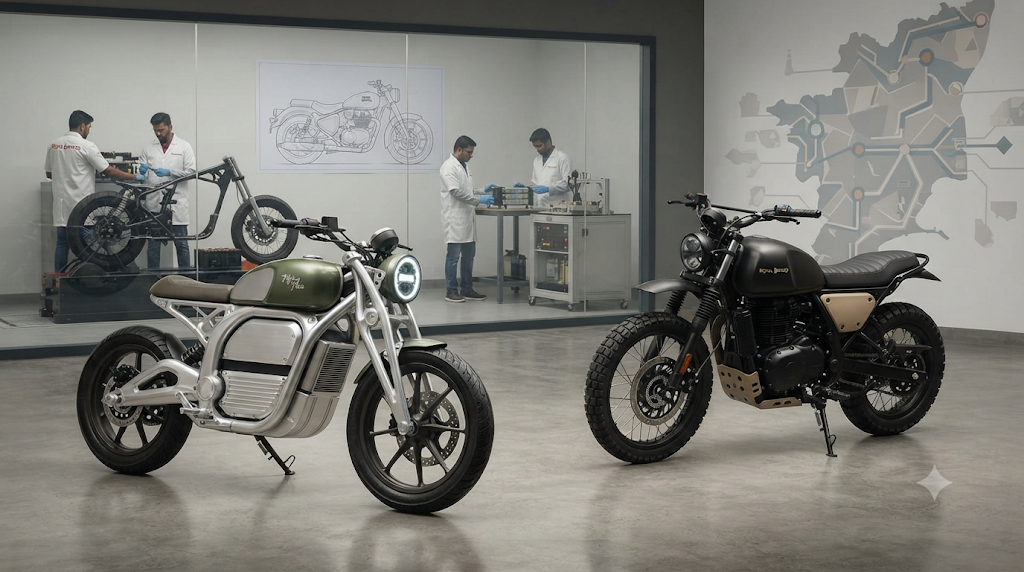
Royal Enfield has entered into a Memorandum of Understanding (MoU) with Government of Tamil Nadu and plans to invest Rs 1,000 crore over seven years to further establish Royal Enfield’s electric vehicle (EV) ecosystem.
It is set to utilise this sum for the development, as well as enhancement of EV technology and the establishment of production processes where necessary.
News of this investment, communicated on November 25 2026, continues Royal Enfield’s transformation into an EV company. Although Royal Enfield has already launched one EV under the Flying Flea brand, it seems that further EV models will emerge in the near future.
Rs 1,000 crores to be invested
Royal Enfield, which operates under parent company Eicher Motors, has entered into a non-binding MoU with the Tamil Nadu government. Over the next seven years, the company will invest Rs 1,000 crore. This provides Royal Enfield with sufficient time to further develop new technology and increase production to allow for additional EV models to be produced.
Royal Enfield will chiefly use the investment to continue to develop its EV ecosystem. For example, this will involve the further development of new EV models and also enhancing EV battery and drivetrain technologies. Production may also be increased.
Whilst Royal Enfield has not yet revealed how many new EV models it will be introducing and what level of production it is seeking to achieve, its desire to further develop products and production facilities undeniably demonstrates that it is set to broaden its range of EV models.
Flying Flea
It is anticipated that Royal Enfield’s investment will greatly influence its Flying Flea brand. This is Royal Enfield’s EV-only motorbike brand and signifies the company’s foray into the high-end electric two wheeler market.
In April 2026, the first Flying Flea model (the C6), together with the brand’s initial retail outlet in Bengaluru, was launched. Thus Royal Enfield took its first step into the EV world. It appears that the investment will support the brand’s future by allowing for further Flying Flea models to be developed.
It is reported that the investment may help to speed up the creation of new Flying Flea models, in addition to those currently being developed such as the C6. Consequently, Royal Enfield is likely to offer additional EV models in future. These may also fall into distinct market segments and provide differing performance and range characteristics.
Production in Tamil Nadu
Tamil Nadu is already a key location for Royal Enfield’s production processes. The investment will further enhance Royal Enfield’s position within Tamil Nadu. It is anticipated that the sum will be utilised to develop EV production within the state.
Importantly, Royal Enfield will be establishing its first EV production initiative within India. Up to 500 people are expected to be directly and indirectly employed as a result of this investment.
Furthermore, Royal Enfield’s investment follows its previous Rs 958 crore pledge to expand brownfield production at its existing Tamil Nadu-based Cheyyar plant. With this investment, Royal Enfield sought to increase overall production capacity to 2 million units per year.
Areas of investment
Royal Enfield will utilise the Rs 1,000 crore across a variety of areas relating to its EV operations. Predominantly, however, the investment will be allocated towards the further development of EV models and their underlying technology.
Other aspects of technology that may be enhanced include batteries, motors and power electronic systems as well as computer software, communications and recharging infrastructure. Continuing to improve these will be crucial in ensuring that Royal Enfield is able to produce highly-performing, well-ranged and dependable EV models.
Production will also be an area of investment. Royal Enfield may choose to both enlarge and upgrade its production processes, so that it can manufacture EV models. Additional production lines may therefore be established. Likewise, Royal Enfield may seek to further optimise its supply chains and develop suitable facilities for mass EV production.
Employment and economic effects
Up to 500 individuals are anticipated to be directly and/or indirectly employed as a result of this investment. Jobs may be available across a broad spectrum of areas such as production, R&D, supply chains, sales and after-sales services.
In addition, Royal Enfield’s investment is viewed as positively affecting Tamil Nadu’s status as a leading centre for high-end motorbike EV production. Indeed, the Tamil Nadu government has been keen to entice automotive and EV related investment into the state. Royal Enfield’s investment is thus adding to a steadily increasing number of high value investments in the area.
Overall, Royal Enfield’s investment is expected to promote the socio-economic development of Tamil Nadu. Apart from providing new employment, it will also aid the development of a local EV ecosystem. This encompasses businesses involved in EV supply chains and ancillary industries.
Royal Enfield’s approach to EVs
As previously mentioned, Royal Enfield is taking steps to adapt to the future of two wheeled transport. Although the company is famed for its petrol motorbikes, in recent years it has also progressively developed its EV expertise.
Royal Enfield’s Flying Flea brand plays a key role in this. Rather than simply offering an electric scooter, Flying Flea delivers electric motorbikes that embody the style and riding experience for which Royal Enfield is renowned. Having launched the C6 as its first Flying Flea model, Royal Enfield appears keen to further develop its EV motorbike range.
Royal Enfield will benefit from the investment in that it will be able to further develop new model platforms and technologies. Moreover, it will be able to boost production volumes. These actions may then enable Royal Enfield to successfully compete in the fast-developing global and Indian EV two wheeler markets.
Read this- Bajaj Pulsar 125 Neon to be revived
Market implications
Whilst the Indian electric two wheeler market is expanding quickly, at present the electric motorbike sub-sector remains much smaller than that of electric scooters. Royal Enfield’s involvement and growth in this sector may therefore help to stimulate uptake of electric motorbikes, especially amongst those consumers who favour larger and high-performance two wheelers.
Royal Enfield is well placed to enter the EV market due to its strong brand, distribution and production networks. Royal Enfield’s investment will further reinforce this strength by further optimising its production and product development procedures.
Equally, investors have welcomed news of the investment. Following the announcement, Eicher Motors’ stock price saw an upward trend, signifying positive sentiment regarding Royal Enfield’s long-term EV strategy.
Looking ahead
Although Royal Enfield has yet to detail any new models or release dates, the investment unambiguously indicates that Royal Enfield is looking to further diversify its EV range. Consumers can therefore anticipate an increase in Flying Flea models. These may differ in terms of battery size, performance and cost.
Royal Enfield may also incorporate novel technology into its EVs. This may involve innovation in battery efficiency, recharging and communications, alongside driver support features. Such technology will be key in ensuring that Royal Enfield’s electric motorbikes are increasingly viable and attractive options for consumers.
Royal Enfield’s Tamil Nadu based Rs 1,000 crore investment highlights the company’s substantial dedication to the future of EVs. It will be used to further develop EV models, technology and production over the next seven years.
Having successfully launched the Flying Flea brand and its initial model (the C6), Royal Enfield is now moving to further diversify its EV motorbike range. As a result of the investment, Royal Enfield could develop several fresh EV models, boost production facilities and generate up to 500 new jobs within Tamil Nadu.
Watch this-