









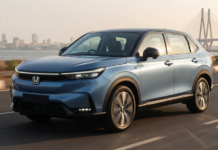















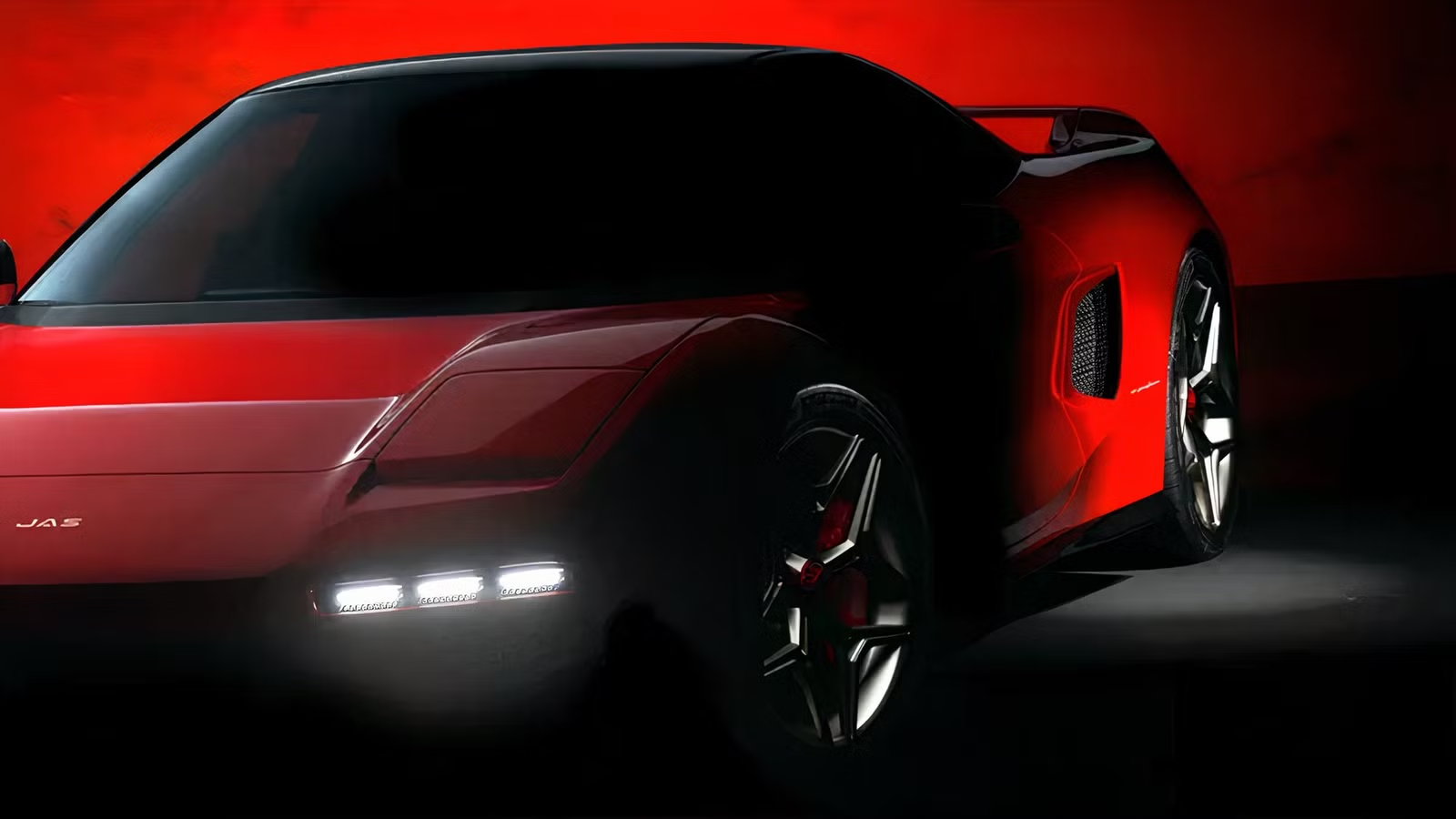


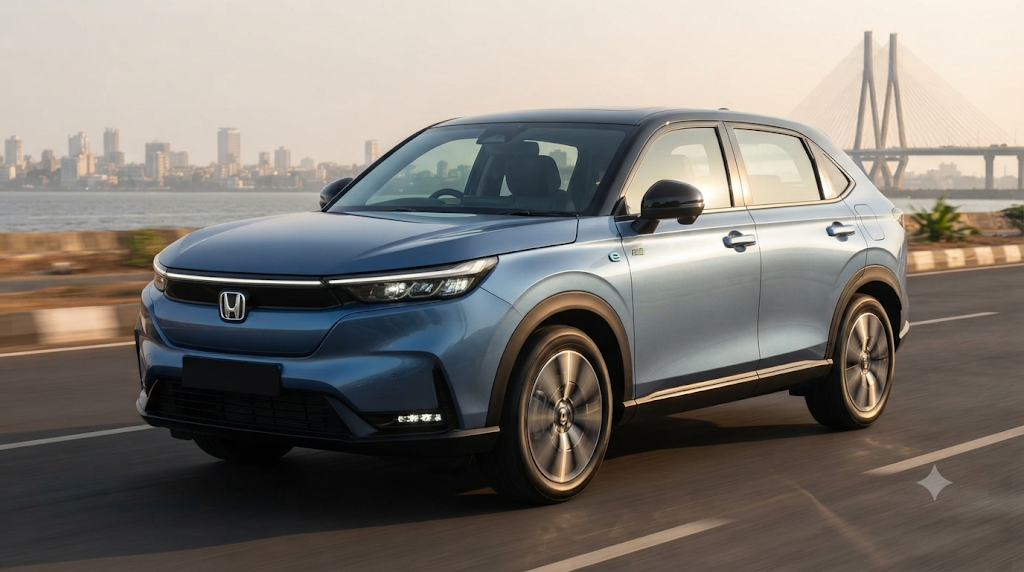
Honda has shared production design visuals for its upcoming Alpha e-SUV.
They show the exterior and five seater interior of the brand’s first Indian-made electric SUV. On December 2 2026, the Alpha will be launched globally and in India.
The visuals were developed at Honda’s Design Centre in Japan. They depict a 3/4 front view of the Alpha and also illustrate the interior. This confirms that Honda has progressed to production stage, and is not merely developing a fresh concept car.
Design
Overall, the Alpha has an MPV-like shape but also exhibits an SUV style. Its windscreen has a sharply sloping angle and the roof section is fairly high – this should allow for good interior room, particularly in the back.
The rear pillars are also notably large in width, possibly for strengthening purposes and to further enhance the SUV style. Furthermore, the door mounted exterior rear-view mirrors are situated beneath the level of the windows. This may improve a driver’s view and also limit wind intrusion.
Honda has largely maintained the front end of the 0 Alpha prototype which was shown in Tokyo in October 2025. Between the headlights a new logo is displayed on a dark panel; this links the left and right hand sides of the front section of the car.
The Alpha has alloy wheels with a triangular silver detailing. This adds a contemporary feel. Beneath the front bumper, there is a dedicated air inlet. Black wheel arch linings continue onto the sills, and again add to the SUV style.
Interior
As shown in the design visuals, the Alpha has a five seater interior. Again, good space, comfort and functionality have been emphasised. The dashboard is set quite low in comparison to the windscreen – this should further enhance the driver and front passenger’s view.
Whilst Honda has divided the driver’s instruments from their central screen, it has still provided a central interactive screen. Below this screen there is a strip of physical buttons, and this is likely to facilitate ease of access to common functions.
A centre console is available and contains a tray for holding items under the dashboard. This is a convenient way to store commonly used articles such as mobile phones, wallets and keys.
The rear seat is covered in light coloured fabric. It also has three head restraints and a collapsible middle section. With upright front seats and a flat floor it may be especially advantageous for three people in the back of the car, particularly on extended journeys.
To further elevate the interior, purple ‘mood’ lights illuminate the dashboard and the door sections just underneath the windows. Mood lighting is now frequently found in electric cars and can enhance the feel of the interior.
Indian development and testing
Honda commenced a national testing phase of the Alpha in March. Testing started at the company’s Tapukara site in Rajasthan. By June, a ‘tester’ version of the Alpha had even been driven to Manali. This shows that Honda is testing the Alpha in a variety of geographical and climatic settings.
During the development process, different levels of road quality, climate and access to charging points throughout India are taken into consideration. This suggests that Honda is adapting the Alpha specifically for Indian roads and use.
As well as testing in Rajasthan and Manali, Honda seems to be assessing the Alpha in hot and cold environments. Furthermore, it is examining both India’s motorway and urban road networks as well as more mountainous areas. Comprehensive testing of this nature is essential in order to ensure the Alpha can consistently function well in India’s various driving environments.
Read this- Bajaj Pulsar 125 Neon to be revived
Production and launch
Honda plans to manufacture the Alpha in Rajasthan for both local and international sale. Sales are anticipated to commence in 2027 so the vehicle will then be made available to consumers following its launch events and global launch date.
Indian production of the Alpha demonstrates Honda’s dedication to the Indian market. Manufacturing in India may also aid in sustaining competitive pricing and so further boost the Alpha’s appeal to Indian consumers.
It is anticipated that the Alpha will be marketed as a luxury electric SUV. Manufacturing in Rajasthan will be integral to Honda’s overall strategy for establishing electric vehicles within India.
Battery and range
There are indications that the Honda Alpha may be available with two lithium iron phosphate (LFP) batteries. These are thought to have a capacity of approximately 65kWh and 75kWh. However, this information remains unconfirmed.
LFP batteries are recognised for being robust, heat resistant and economical. Providing consumers with two battery choices – one cheaper and one for greater range – may therefore be something Honda does.
Whilst precise range information for the 65kWh and 75kWh batteries has yet to be disclosed, the Alpha is likely to provide a competitive range. This should be appropriate for both city and motorway driving.
Price and competition
It is anticipated that the Alpha will be supplied from around Rs 16 lakh (ex-showroom), and so will fall within the mid-segment of electric SUVs. Thus, it should appeal to a broad consumer base.
Within this sector, the Alpha will face competition from several existing Indian electric SUVs. Foremost among these are likely to be the Hyundai Creta Electric, Mahindra BE 6, Tata Sierra EV and Maruti Suzuki e Vitara.
This is highly competitive area. Each brand provides a different selection of range, features, and performance, alongside differing pricing. Honda must therefore strategically position its Alpha to effectively compete.
December 2 expectations
On December 2, Honda will globally launch the Alpha. At this stage, full information regarding the vehicle will be provided. This will encompass details about the precise battery choices, range, powertrain and features. Honda is also likely to specify the precise launch schedule and potentially even vehicle configuration at this event.
Although the pre-launch design visuals provide much information about the Alpha, there may be further elements and improvements implemented in the production model. Consumers and car fans will keenly observe how the Alpha matches up with competing vehicles in terms of design, features and value.
Prior to its global launch in India on December 2, production design visuals have illustrated that the Honda Alpha e-SUV is a contemporary, stylish and spacious electric SUV. With a five seater cabin, functional interior and SUV-style exterior, the Alpha is looking set to be a strong player in the mid-segment of electric SUVs.
Due to its prospective price point and planned Indian production, the Alpha has the potential to be a key addition to Honda’s Indian offering. Its level of success will hinge upon how successfully it can rival existing models such as the Hyundai Creta Electric, Mahindra BE 6, Tata Sierra EV and Maruti Suzuki e Vitara.
Read this-