

























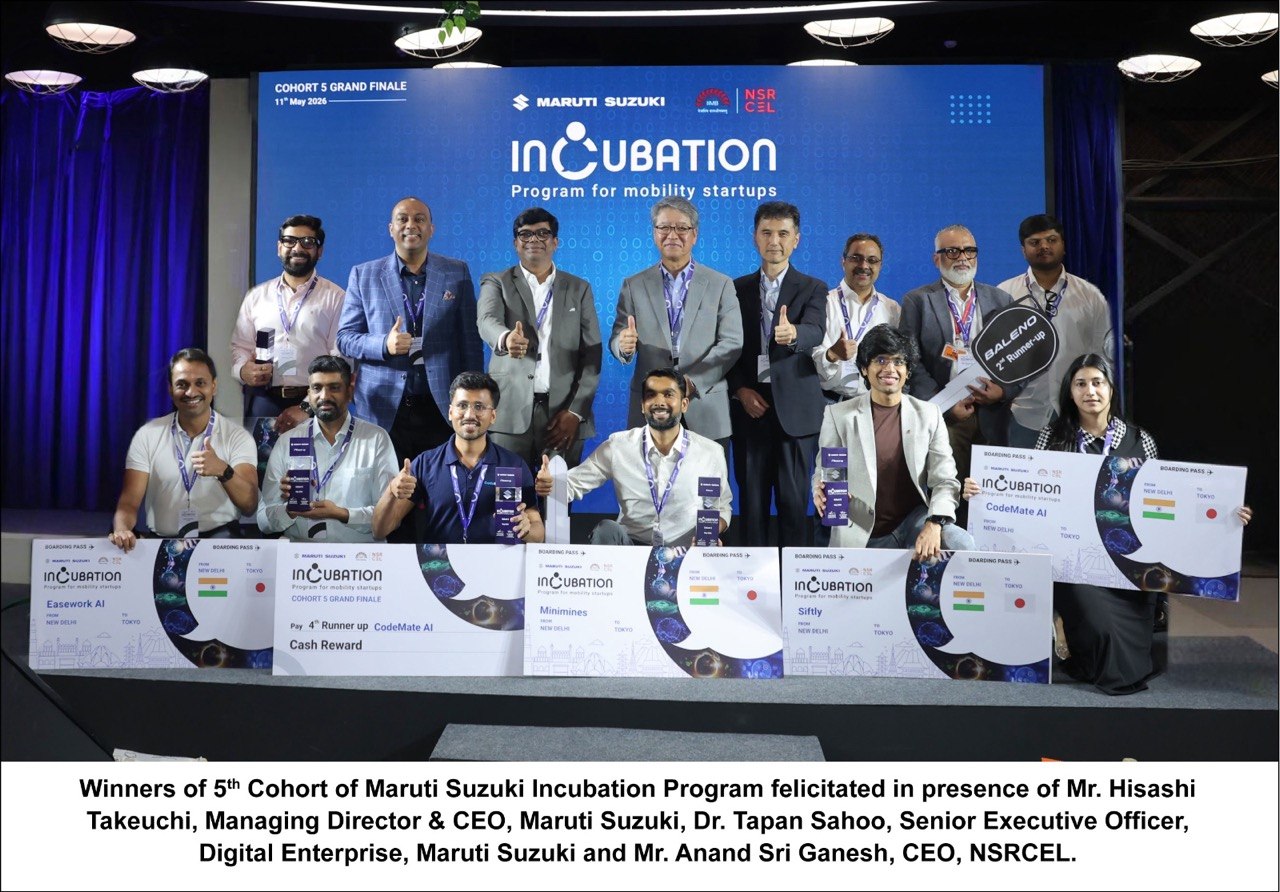
Maruti Suzuki India has taken another big step in its innovation journey by onboarding five startups to co-create practical solutions across key business areas. The selected startups are MiniMines, Easework AI, Sarvam AI, Siftly, and CodeMate AI, and each will work on a different challenge tied to operational efficiency, customer experience, or sustainability. The move highlights how automakers are increasingly turning to startups for fresh thinking and faster problem-solving.
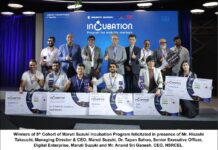
The five startups were chosen as winners of the fifth cohort of the Maruti Suzuki Incubation Program, also known as MSIP. The program is run in partnership with NSRCEL, the incubation and entrepreneurship hub at IIM Bangalore. Through this collaboration, Maruti Suzuki is not only scouting for innovation but also giving early-stage companies a platform to build real-world solutions that can be deployed inside a large automotive business.
According to Hisashi Takeuchi, Managing Director and CEO of Maruti Suzuki India, the company has been actively working with startups to address real business challenges through practical innovation. He said the company is delighted to collaborate with five more startups, adding that MiniMines will support the safe recycling of end-of-life batteries, while the other four startups will help improve customer engagement and efficiency across business operations. That message captures the broader purpose of the initiative, which is to make innovation useful, scalable, and directly connected to business needs.
MiniMines is focused on an especially important sustainability challenge. Its solution is aimed at environmentally friendly recycling of end-of-life lithium-ion batteries and the extraction of precious materials from them. This is significant because battery recycling is becoming a major issue as electric mobility grows in India. Efficient recycling can help reduce waste, recover valuable resources, and support the circular economy. For an automaker like Maruti Suzuki, this kind of work can be important for future readiness even as the company expands its mobility strategy.
Easework AI is working on end-to-end workflow automation for the procurement process related to indirect consumables using agentic AI. In simpler terms, it is meant to help streamline internal operations by making routine purchasing and workflow steps faster and more efficient. This kind of automation can reduce manual effort, improve accuracy, and free up employees to focus on higher-value work. For a large company with complex supply requirements, even small gains in procurement efficiency can add up to major savings over time.
Sarvam AI is developing GenAI agents with multilingual support to improve customer interaction across all touchpoints. This is particularly relevant in India, where customer communication often needs to happen in several languages depending on the region. Multilingual AI tools can make interactions smoother, more inclusive, and more accessible. For Maruti Suzuki, which serves a wide and diverse customer base, this could help strengthen engagement at dealerships, service centers, and digital contact points.
Siftly is using generative AI to enhance brand visibility. That suggests a focus on smarter communication, improved content strategies, and more effective outreach. In a crowded automotive market, brand visibility matters just as much as product quality. AI-driven marketing support can help a company reach the right audience more efficiently and keep its messaging sharper across platforms.
CodeMate AI is working on using AI for faster development of software applications used in business processes. This can help Maruti Suzuki speed up the creation and improvement of digital tools used across the company. Faster software development means the business can adapt more quickly to changing operational needs, customer expectations, and internal process requirements. In a highly competitive industry, speed in digital execution can be a real advantage.
Maruti Suzuki’s startup engagement is not a new experiment. The company says that over seven years, around 7,400 startups have been screened, more than 250 have been engaged, and 38 have already been onboarded as partners delivering value to the business. Those numbers show that the company’s innovation programs have moved far beyond symbolic collaboration. They have become a structured pipeline for identifying useful technology and bringing it into the organization.
The company currently runs several programs to support this ecosystem. The Maruti Suzuki Accelerator, launched in January 2019, works with growth-stage startups in mobility and manufacturing. The Maruti Suzuki Incubation Program began in August 2020 to nurture technology-enabled startups in the future of mobility. The Mobility Challenge, launched in June 2021, helps mature-stage startups showcase cutting-edge solutions. Nurture, started in 2023, supports idea-stage startups in partnership with IIM Calcutta Innovation Park. Most recently, FundRays was launched in September 2025 as an investment-readiness program for alumni startups in partnership with ISB Hyderabad.
Together, these initiatives show that Maruti Suzuki is building a broad innovation pipeline rather than relying on a single program. By working with startups at different stages, the company can tap into ideas ranging from early concepts to deployable business tools. That approach helps create a culture of open innovation while also solving practical problems inside the organization.
This latest collaboration reflects how the future of automotive growth may depend as much on digital and sustainability partnerships as on vehicle engineering. Maruti Suzuki’s work with MiniMines, Easework AI, Sarvam AI, Siftly, and CodeMate AI shows a clear strategy: use startup energy to improve operations, enhance customer experience, and prepare for the evolving demands of mobility.