
































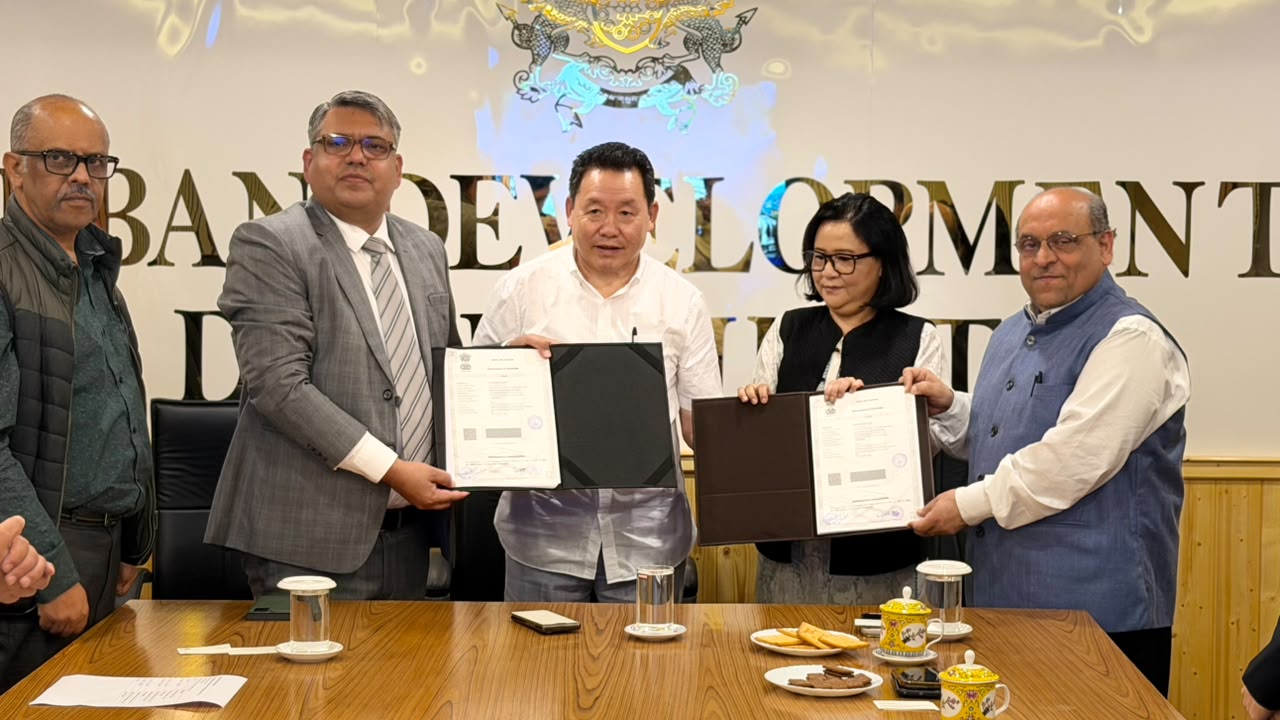
Toyota Kirloskar Motor (TKM) has signed a Memorandum of Understanding with the Urban Development Department, Government of Sikkim, to support the elimination of manual scavenging in the state through the deployment of mechanized sewage and solid waste management solutions. The initiative reflects TKM’s CSR commitment to creating safer and more sustainable communities and aligns with the Government of India’s Swachh Bharat Mission and its national goal of eliminating manual scavenging by 2030.
The MoU was exchanged in Gangtok in the presence of senior government officials and TKM leadership, including Bhoj Raj Rai, Hon’ble Minister for Food and Civil Supplies Department and Urban Development Department; Jitendra Singh Raje, IAS, Commissioner-cum-Secretary, Urban Development Department; Yogeetha Rai, Secretary cum Principal Chief Architect, Urban Development Department; Giridhar Lal Meena, IAS, Joint Secretary (Municipal Affairs), Urban Development Department; and Toyota Kirloskar Motor representatives Vikram Gulati, Nao Uzawa and Sachin Sharma. The collaboration highlights a shared intent to bring safer, technology-enabled sanitation systems to one of India’s most geographically challenging states.
Sikkim faces unique sanitation challenges because of its terrain and climate. The state receives nearly 5,000 mm of rainfall annually and is located in high-risk seismic and landslide zones, making sewage infrastructure particularly vulnerable. Rapid urban growth and rising daily waste generation have further increased the load on sewage systems, leading to frequent blockages caused by solid waste entering sewer lines. In the absence of adequate mechanized infrastructure, sanitation workers have often had to enter manholes and carry out manual sewer cleaning in unsafe conditions, exposing themselves to serious health and safety risks.
To address these issues, TKM will support the Urban Development Department with a range of mechanized sewage and waste management equipment. This includes suction-cum-jetting machines, mini jetting units, robotic sewer cleaning devices, manhole desilting machines, drain cleaning crawler machines, mini excavators, mini tippers, chain saws, rock breakers, close body garbage trucks and rear end loading compactors. These tools are intended to reduce manual intervention, improve operational efficiency and protect workers from direct exposure to hazardous waste.
The initiative is expected to significantly improve sanitation delivery across the state. With mechanized operations in place, sewage rectification timelines are expected to reduce from several days to roughly one day. More importantly, the programme aims to completely eliminate direct human contact with sewage and waste handling operations by 2027. That timeline gives the state a clear pathway toward safer sanitation practices while also improving public health and reducing service disruptions for residents.
Speaking on the partnership, Bhoj Raj Rai said sanitation infrastructure is one of the most pressing needs for Sikkim’s rapidly growing urban areas. He said the collaboration with Toyota Kirloskar Motor will help the state bring modern mechanized solutions to its sewage management system, reduce disruptions for citizens and protect the dignity and safety of sanitation workers. He also emphasized that the Urban Development Department is committed to working closely with TKM to ensure the initiative delivers lasting impact.
Vikram Gulati, Country Head and Executive Vice President, Corporate Affairs at Toyota Kirloskar Motor, said humanity is central to the company’s values and that the initiative reflects Toyota’s belief in promoting a safe work environment while delivering essential public services. He said that by supporting the deployment of mechanized sewage management systems in Sikkim, TKM aims to contribute to more efficient and resilient sanitation services. According to him, the partnership supports Sikkim’s vision of becoming a manual scavenging-free state while also promoting safe and sustainable livelihoods for sanitation workers.
Beyond the immediate deployment of equipment, the programme is designed to create a long-term sanitation model for the state. It has the potential to position Sikkim as a model for safe and mechanized sanitation systems, joining other states that have advanced efforts to eliminate manual scavenging and improve worker safety. The initiative also shows how public-private partnerships can help bridge infrastructure gaps in sectors where technology, social responsibility and governance must work together.
For TKM, the collaboration adds to its broader social and community-focused initiatives. The company, which has a major manufacturing footprint in India, continues to position itself as a partner in sustainable development, not only through mobility solutions but also through CSR programmes that address public welfare challenges. In Sikkim, that commitment takes the form of practical support for sanitation modernization, worker protection and public health improvement.
The MoU represents more than a procurement of equipment. It is a step toward transforming sanitation infrastructure into a safer, more resilient and more dignified system. If implemented successfully, it could help Sikkim emerge as a benchmark for mechanized sewage management in India.