

































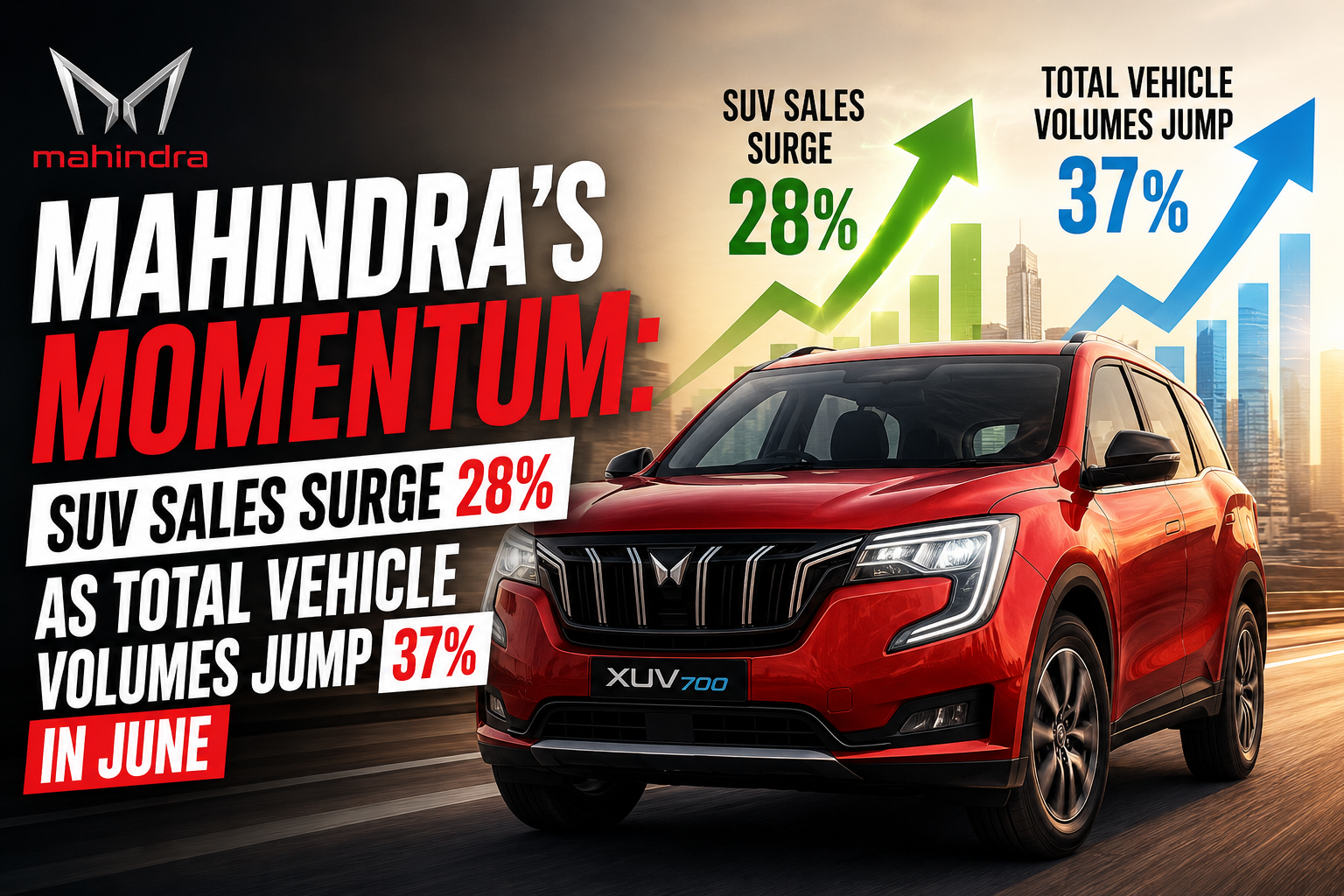
Mahindra & Mahindra Ltd. posted a commanding performance in June 2026, driven by strong demand across its utility vehicle (UV), light commercial vehicle (LCV) and three‑wheeler portfolios. The company reported total vehicle sales of 1,06,207 units for the month a 37% year‑on‑year increase with domestic SUV sales at 60,393 units, up 28% from June 2025. Exports also contributed to the performance, helping underline broad‑based recovery and market traction across Mahindra’s product lineup.
Utility Vehicles remain the backbone of Mahindra’s automotive division. Domestic UV sales of 60,393 units in June were up 28% from 47,306 units a year earlier, while cumulative UV volumes for the fiscal year to date reached 1,74,745 units, a 15% gain over the prior year. Including exports, total UV volumes for the month stood at 61,504 units. Nalinikanth Gollagunta, CEO of Mahindra’s Automotive Division, attributed the month’s results to robust demand across SUVs and the <3.5‑tonne LCV segment, noting that the company delivered “all‑round demand traction across the portfolio.”
The commercial vehicle side also showed healthy growth. Domestic LCV sales under 3.5 tonnes performed strongly: the 2‑3.5T segment recorded 22,568 units in June a 35% increase while the sub‑2T LCV segment rose 36% to 3,508 units. These gains reflect rising last‑mile logistics and intra‑city freight demand, sectors that have been expanding as e‑commerce, retail distribution and small‑business logistics continue to scale up operations nationwide.
Three‑wheelers delivered an especially notable performance, with domestic sales of 13,820 units in June a 63% jump year‑on‑year and year‑to‑date volumes of 36,255 units, up 76% from the prior period. This surge includes both conventional and electric three‑wheelers sold by Mahindra and its subsidiary Mahindra Last Mile Mobility Limited, signaling sustained demand for cost‑efficient urban mobility and goods‑carrying solutions.
Export momentum has been a standout feature of the month. Mahindra’s total export volumes for June were 5,918 units, a sharp 125% increase over June 2025, while cumulative exports for the fiscal year rose 64% to 15,888 units. The export uptick reflects the company’s expanding international reach and the competitiveness of its product mix in overseas markets.
Several factors likely contributed to Mahindra’s strong month. First, the company’s diversified portfolio spanning SUVs, LCVs, and three‑wheelers, including electric variants lets it capture demand across multiple segments and use cases. Second, improving rural and semi‑urban incomes following a buoyant farm sector and policy support are helping keep SUV and utility vehicle purchases healthy. Third, the growth in last‑mile logistics and e‑commerce has stimulated demand for versatile LCVs and three‑wheelers, while Mahindra’s wide dealer and service network ensures timely deliveries and after‑sales support.
Analysts also point to product continuity and refreshes that keep Mahindra’s models relevant across price and usage brackets. The company’s UV line-up, long associated with ruggedness and high resale value, continues to win buyers looking for utility, space and durability. In parallel, Mahindra’s focus on electrification via Mahindra Electric Automobile Limited provides optionality for fleet buyers and municipal operators seeking lower operating costs and compliance with evolving emissions norms.
Operationally, Mahindra will need to maintain supply‑chain efficiency and dealer readiness to sustain the momentum. Vehicle makers across India face challenges tied to semiconductor supplies, commodity inflation and localized logistical constraints. Mahindra’s ability to translate strong order books into deliveries while keeping inventory, finance schemes and service uptime in balance will determine whether the June surge can be extended into the coming quarters.
For stakeholders and fleet owners, the June numbers suggest favourable conditions: higher sales volumes typically support aftermarket business, spare parts demand and used‑vehicle liquidity, creating a positive feedback loop for the brand. For investors, the combination of domestic growth and expanding exports could underpin revenue visibility, though margin implications will depend on mix, incentives and input cost management.
Looking ahead, Mahindra’s focus will likely be on capitalizing on rural demand ahead of festive seasons, scaling exports into growth markets, and continuing product improvements including electrified options to meet varied customer needs. The company’s broad portfolio and distribution strengths position it to benefit if macro conditions remain supportive.
In short, Mahindra’s June 2026 performance a 28% rise in domestic SUV sales and a 37% jump in total vehicle volumes signals robust recovery and demand diversification. If sustained, these trends could bolster the company’s leadership in the utility vehicle segment while accelerating its expansion in commercial and export markets.