












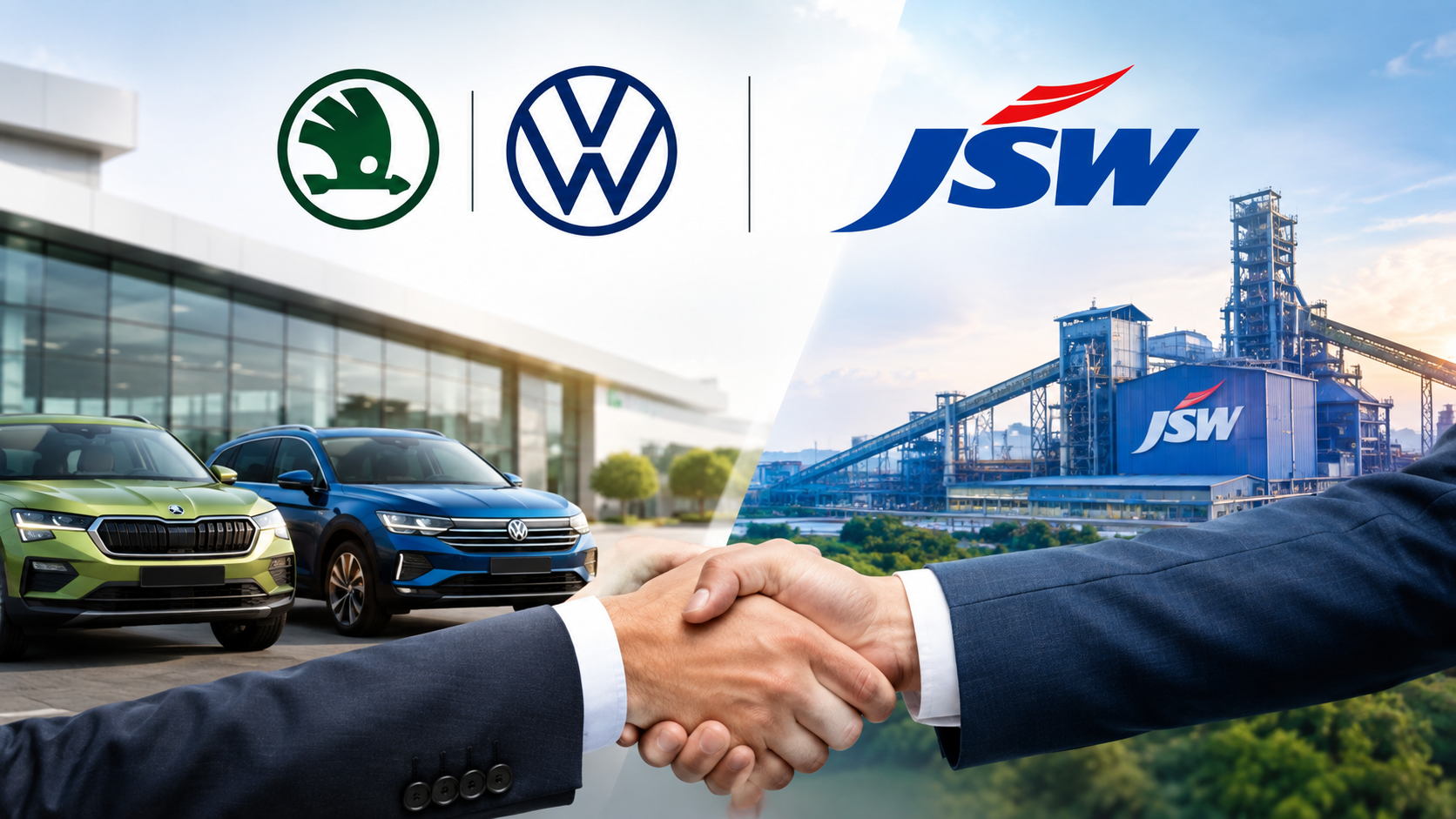
Skoda Auto Volkswagen India (SAVWIPL), the Gotha-based German carmaker, has taken a huge step toward expanding its local presence with a strategic partnership. An MoU has been signed between the German carmaker and JSW Group to explore establishing a joint venture.
According to the statement released to Autocar Professional, the MoU, which is non-binding, marks the start of official talks between the German carmaker’s Indian arm and one of India’s largest industrial conglomerates.
“This follows a month of speculation regarding a prospective collaboration. In early July 2026, reports had emerged that the joint venture was in the closing stages of its talks and a non-binding MoU would soon be signed to establish a joint venture and specify the terms for the proposed partnership,” said the statement.
Joint control, undefined shareholding – for now
“This potential new partnership would be based on joint control, with ‘clearly defined roles and mechanisms for swift and effective decision-making’, although no details have yet been shared regarding shareholding or proposed investment,” reads the statement.
Previously, reports had suggested that one of the option on the table was a 51:49 joint venture with JSW on the higher side. The new statement confirms that joint control is on the cards, but does not confirm which party will be in the driving seat.
Details regarding equity, investment, and decision-making mechanism are said to be in the final stages of the negotiations roadmap. Both sides have yet to agree on definitive agreements and the necessary regulatory approvals.
The MoU, however, remains non-binding, which means that either party may abandon the talks if the terms are not satisfactory. However, the fact that both sides have chosen to make a public statement indicates a higher degree of seriousness on both sides.
Why Skoda-VW needs a local partner
Skoda Auto Volkswagen India has struggled to make much of a mark in one of the most competitive automotive markets in the world. Even with a decent portfolio of cars the Kushaq, Kylaq, Slavia, Kodiaq and Octavia RS the German brand, has found it tough to move beyond single-digit market share.
High localisation requirements and small economies of scale;
Intense competition in the mass and premium mass segments;
Tough regulations and emissions norms requiring significant R&D investment;
The need for a stronger dealership and service network, especially in Tier-2 and Tier-3 towns
A partnership with JSW could potentially address many of these headwinds.
JSW’s entry could inject much-needed capital into expanding the brand’s product portfolio, building more local content, and developing electric vehicles.
Moreover, JSW’s extensive policy and government lobbying network could come in handy in smoothing the path for Skoda-VW through complex regulatory environments.
Additionally, JSW’s large-scale supply chain and logistics network could dovetail with Skoda-VW’s needs, particularly in steel supply and component sourcing.
With JSW’s support, Skoda-VW could potentially expand its dealership and service network significantly, particularly in smaller cities and towns.
A partnership with JSW could be the catalyst that propels Skoda-VW from a niche European brand to a mainstream player in India’s booming SUV and EV segments.
Why JSW wants a car business
The proposed partnership fits right into JSW’s broader ambitions regarding the automotive industry in India. JSW, which has a significant presence in the steel and industrial equipment manufacturing sectors, has long sought to diversify into passenger vehicles as well.
Beyond its stake in MG Motor India – which is one of the fastest-growing automotive companies in the country – JSW is now looking to expand its presence in the passenger vehicle segment.
A partnership with Skoda-VW would enable JSW to:
Expand its automotive offerings – beyond MG’s SUVs and EVs – to include premium European cars
Leverage Skoda’s engineering capabilities and powertrain technologies (including potential EVs)
Build on its reputation as a major automotive player in India, with multiple brands and segments
Use the partnership to localise production and reduce costs through its vast supply chain network
JSW’s deep knowledge of managing large-scale automotive operations can be put to good use here as well. Having built up MG’s presence in India over the years, JSW can learn from its experience and apply it to a potential Skoda-VW joint venture, helping to localise production processes, reduce costs, and improve overall operational efficiency.
What this could mean for Skoda and VW products in India
A partnership with JSW can potentially have a significant impact on the range of Skoda and VW products available in India as well as their competitiveness compared to other players in the premium mass and premium segments.
1. Expanded and faster product launches
JSW’s support can enable Skoda-VW to accelerate the rollout of new models and potentially offer a wider range of products – including sub ₹10 lakh SUVs and sedans – targeting the premium mass segment in India.
The partnership can also lead to the introduction of more locally developed products – potentially extending the MQB and MEB platforms – and possibly even fully electric models under the Skoda and Volkswagen brands.
2. Higher localisation and lower costs
Localisation norms and cost reduction – particularly in aspirational segments such as SUVs – will be crucial in helping Skoda and VW compete with established local and international players such as Maruti Suzuki, Hyundai and Tata Motors. JSW’s strength in local materials, particularly steel, combined with its experience in cost reduction in its current operations, can play a major role in enabling Skoda-VW to get ahead of the curve in these areas.
3. Broader dealer and service network
One of the biggest challenges for Skoda Auto India has traditionally been the dealer network. Compared with mass-market players, its network was comparatively small and unable to keep pace with the growth in demand, especially in Tier-2 and Tier-3 cities.
However, with JSW’s experience of building up a dealer network for MG Motor India, Skoda Auto has the opportunity to significantly expand its dealer footprint across these markets.
4. Leveraging the EV revolution
While electrification is accelerating globally – and India’s ambitions to transition to electric vehicles make that prospect very real in the next decade – Skoda-VW needs a credible local partner to navigate the complexities around technology sourcing, R&D, and manufacturing.
JSW’s partnership has the potential to provide Skoda-VW with the ability to localise its electric vehicle production and R&D, taking advantage of the Group’s extensive supply chain and logistics network. It can also help the joint venture tap into the electric vehicle consumer base that JSW’s MG Motor India has been targeting.
Regulatory and approval hurdles ahead
The next step forward in the partnership would be approvals from both the Volkswagen Group in Germany and the governmental and regulatory departments in India. There are a number of challenges that either side may face ahead of the partnership finally moving forward.
The proposed partnership would have to obtain the necessary approvals from the company’s headquarters in Germany and the relevant governmental and regulatory departments in India before it could move forward. Moreover, there are also likely to be disagreements ahead of approvals, particularly regarding brand positioning, product strategy, and exit strategy
What’s next?
Both sides have indicated that the next phase will involve in-depth negotiations on shareholding, investment, and other agreements before final agreements and regulatory approvals are put in place. Ahead of any approvals, both sides will have to agree on the key components of the potential joint venture.
Should negotiations be successful, we could see a landmark partnership in the premium mass and premium segments in India, which would bring local depth that neither of the companies possesses at the moment.
For ordinary Indians, it could mean a wider range of higher-quality premium vehicles at more attractive prices backed by a broader dealer network and cutting-edge electric vehicle technology.
Watch this-