






























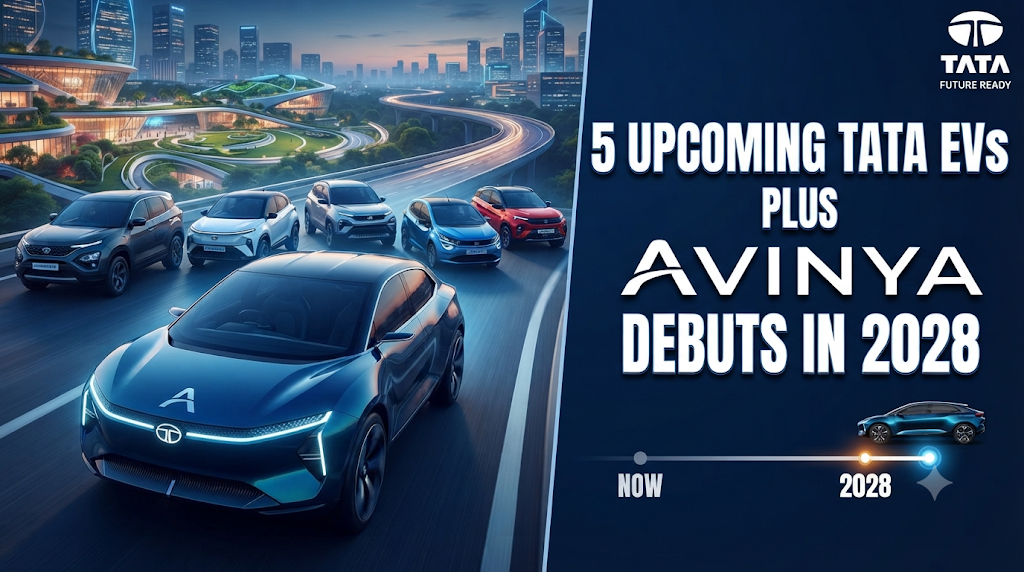
Tata Motors is preparing one of the biggest electric vehicle line ups for India as it will have five new EVs hitting the road between early 2027 and 2028.
These will include the Safari.ev, next generation Nexon.ev, first production Avinya, Kuno and Scarlet. This will allow Tata to add more compact, mid-size and premium EVs to its expanding electric vehicle range and enable its goal of doubling its sales to 1.2 million units per year by FY2031.
Tata EV Expansion Plans:
Tata Motors Passenger Vehicles wants to increase its sales to 1.2 million units by FY2031 from 6.4 lakh in FY2026. To do this it will bolster its electric and CNG range. TPEM will be the main driver to this as it will have a range of new EV launches, updates and fully redesigned EVs in the Tata and Avinya brands.
The variety of new EVs will cover a range of price points and will give Tata a three row flagship SUV, new generation compact EV, premium D-segment SUV, large volume EV MPV-SUV and compact SUV. This should help Tata compete for its leading position in the Indian EV market.
Tata Safari.ev:
The Tata Safari.ev is set to be launched in early 2027 and will mark Tata’s first three row EV SUV. It will go up against the Mahindra XEV 9S and MG Hector Tomahawk EV.
It will likely come in both 6 and 7 seat variants. Customers can expect to get a standard range RWD model, extended range RWD model and extended range AWD variant. The extended range RWD variant will have a range of around 600km. However, this will depend on what battery pack and range testing Tata use.
Like most of Tata’s EVs, the powertrain, battery packs and core components such as the independent rear suspension will be shared with the Harrier.ev. However, it will have an improved triple screen layout with a touchscreen for the front passenger. The tripe row EV will also be seen to be more tech focussed in spy shots.
Next Generation Tata Nexon.ev:
Tata’s Nexon.ev is their best selling EV but is nearly seven years old. They have begun developing a new generation Nexon.ev with the codename Garud. Early prototypes are already being tested.
We can expect a full redesign of the EV and it could use a shortened version of the Sierra.ev’s ARGOS platform. This will allow Tata to improve upon its efficiency, software, charging capability and overall driving experience.
It is set to be unveiled during the second half of 2027. If Tata keeps the Nexon’s competitive pricing then it could prove to be one of the most important EVs in India’s compact EV market.
Read this- 2027 Volkswagen Virtus Facelift Officially Teased And Will Be Launched Shortly
First Production Avinya Model:
Tata’s first production Avinya EV will be a D-segment SUV. It was teased with the Avinya X concept at Auto Expo 2026 and will be launched during the fourth quarter of 2027.
It will be based on an updated version of the new multi-energy platform that came out of the Chery Jaguar Land Rover joint venture under the Freelander brand. This means Tata will be able to utilise some advanced EV features.
As it will be above the Safari.ev it seems like Tata wants to go into the top end of the EV SUV market. It could go up against other brands such as Mahindra, MG, Hyundai and more who are going into larger, more premium EV SUVs.
Tata Kuno:
Tata will launch an electric SUV under the codename Kuno. It will fall between the Nexon.ev and Sierra.ev and will be around 4.3 meters long. This makes it a practical mid-size SUV for Indian families.
It will rival the MG Windsor EV, which is the best selling EV in India. Reportedly Tata is aiming to sell 80,000-1 lakh units per year, meaning it will be in high demand and could be priced aggressively.
It will be produced at Tata’s Sanand plant in Gujarat and will launch in 2028. As it falls between the Nexon.ev and Sierra.ev it could prove to be one of Tata’s most important volume sellers.
Tata Scarlet:
Another new EV SUV will be the Tata Scarlet. It will be codenamed Scarlet and is said to be a mini version of the Sierra. It will have a boxy design with high ground clearance to give it an authentic SUV feel.
It will be under four meters long and could be based on the same platform as the next generation Nexon.ev. This means Tata will be adding more compact EVs to its range with an SUV design.
With it being under four meters long, it will have less tax and could be more affordable. If Tata positions it well it could be a strong contender in the compact EV market.
What Does This Mean For Tata?
This shows that Tata are not putting all their eggs in one basket. They will have a family orientated EV with the Safari.ev, update their volume selling Nexon with the next generation model, go up market with the Avinya, compete in the high volume mid-size market with the Kuno and improve their compact SUV range with the Scarlet.
With the Indian EV market advancing so quickly, customers now expect more from their EVs. They expect longer ranges, faster charging times, advanced features and a premium experience. All of Tata’s new models must meet these criteria.
What To Expect:
Between 2027 and 2028 Tata will have five new EVs launched. These will be the Safari.ev, next generation Nexon.ev, first Avinya, Kuno and Scarlet. They will be very varied with a range of different prices, sizes and uses.
The most important models will likely be the Safari.ev and Kuno as they will target the popular family markets. The Avinya will be important for Tata wanting to go up market and the next generation Nexon.ev and Scarlet will help Tata keep its compact EV customers.
Watch this-