































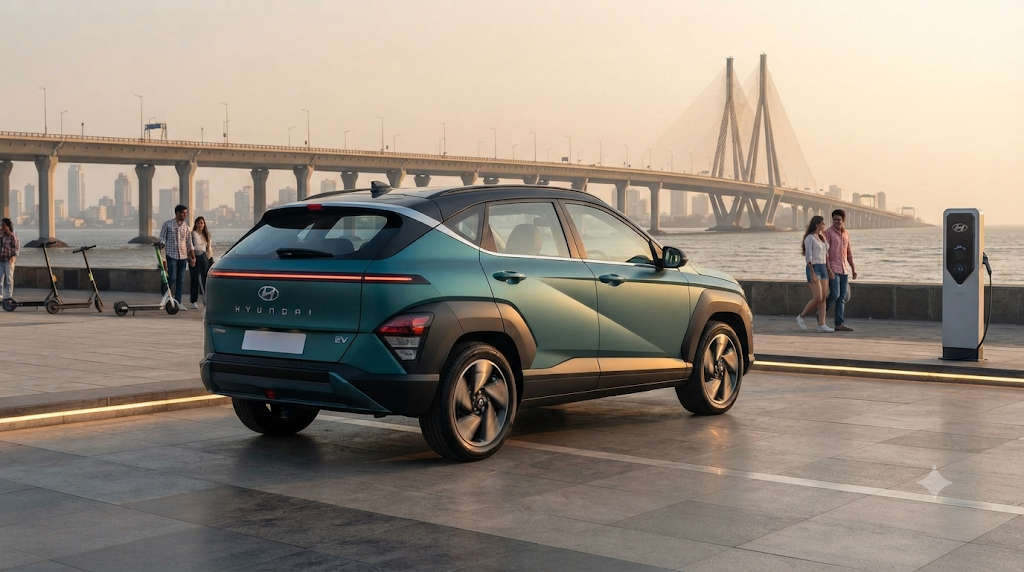
Hyundai is drawing nearer to launching its new compact EV. The model, currently codenamed HE1i, is due to be officially named the Hyundai Ioniq P.
It is likely to be launched on January 16, 2027. It will represent Hyundai’s first compact EV for the Indian market. It is also anticipated to fall into a category lower than that of the Creta Electric.
Given the increasing popularity of cost-effective EVs, the new Hyundai compact EV has the potential to prove to be a significant model for the company. With a compact size, advanced technology and a competitive price, it may prove popular with new and existing Hyundai customers.
When will it be launched?
Hyundai has stated it will launch the new compact EV by the end of 2026. As mentioned above, it is now expected to be officially launched on January 16, 2027. It is likely that it will be showcased at the 2027 Bharat Global Mobility Expo, in February.
It is also likely that the vehicle will then be launched for the market by March 2027. Again, however, Hyundai has yet to officially state when it will be launched. Further information regarding the car’s specs, trim levels and price is anticipated to be released nearer to the official launch day.
Whilst development of the new compact EV has been ongoing, Hyundai has already shared some information regarding its expected specification. It is currently codenamed HE1i and is set to be a sub-four metre compact electric SUV, tailored for India’s roads.
Range and battery
As previously mentioned, a key area of interest for the Hyundai compact EV is its expected range. There are reports that it may be available with two different battery sizes and thus provide a range in excess of 500km.
It is anticipated that the entry-level model will be fitted with a 42kWh battery. The extended range model may be equipped with either a 49 or 51.4kWh battery. Referring to the Inster, the entry-level model is likely to provide a range of approximately 300km, whereas the extended range model could provide a range of up to 355km.
Nevertheless, there are reports that the India-specific model may actually have an even greater range. It is said that it could achieve a range of 443km for the 42kWh battery and 526km with the 51.4kWh battery. However, this information remains unconfirmed.
Furthermore, the new compact EV is also anticipated to be equipped with DC fast charging functionality. This is particularly useful for quickly recharging a vehicle for extended journeys. For the India-specific model, Hyundai is expected to source batteries from local Exide suppliers. This is again potentially beneficial for maintaining cost-competitiveness.
Technology and features
Level 2 advanced driver assistance system (ADAS) functionality is set to be included in the new Hyundai compact EV. This is likely to encompass technologies including adaptive cruise control, lane keeping and automated emergency braking, amongst other driver assistance innovations.
Additionally, the compact EV is anticipated to include cutting-edge in-car entertainment. It may utilise Hyundai’s Pleos Connect system, which is already present in some of the company’s more recent models. This is expected to provide enhanced connectivity, together with a superior interface. It will also support wireless Android Auto and Apple CarPlay.
Further likely features include a panoramic roof, air-con front seats, wireless charging, connectivity, rear air vents, automatic temperature control and airbags. There are also reports that it may include rear air-con seats and two wireless charging points. Again, this information has yet to be officially confirmed.
The new compact EV is also expected to incorporate two displays – one for the digital dashboard and another for the in-car entertainment. Such a dual display format is increasingly typical for new EVs and is thought to enhance the driving experience.
Price
Alongside its specification, the price of the new Hyundai compact EV will play a key role in determining its desirability. It is estimated that it may be sold for between Rs 10 lakh and Rs 15 lakh (ex-showroom), dependent upon trim level and battery size.
There are additionally reports that it may be priced between Rs 12 lakh and Rs 17.5 lakh. However, once again, this information is still speculative and has not yet been officially confirmed by Hyundai. Ultimately, pricing will be influenced by the battery size and specification, as well as the trim levels provided.
Provided that Hyundai can successfully price the new compact EV, it has the potential to be a strong player within the cost-effective electric SUV segment. As noted, it is anticipated to be sold at a lower trim level than the Creta Electric and so should therefore remain accessible for many customers.
Read this- Royal Enfield launches Flying Flea in Goa and opens three showrooms
Indian market competition
Hyundai’s new compact EV will face stiff competition within the Indian market. Chief among its prospective competitors are the Tata Nexon EV, Mahindra XUV 3XO EV, Kia Syros EV and MG Windsor EV.
These models all provide varying range, technology and pricing. The Tata Nexon EV benefits from a strong brand and extensive servicing infrastructure. The Mahindra XUV 3XO EV is anticipated to provide a more luxurious driving experience. Both the Kia Syros EV and MG Windsor EV are also expected to be formidable competitors.
In order to successfully compete, Hyundai must effectively market its new compact EV. Its Level 2 ADAS, innovative technology and hopefully competitive pricing should enable it to do so.
Aesthetic
Although Hyundai has not officially disclosed the car’s aesthetic, spy images and reports suggest that it will adhere to the marque’s contemporary styling principles. With its compact size, the vehicle should also prove well suited to city driving.
It is anticipated that the car will boast an eye-catching front fascia, stylish headlights and modern rear styling. Overall, its design is likely to conform to Hyundai’s worldwide approach to EV aesthetics, which centres on simplicity and futuristic styling.
Being compact will also ensure that the Hyundai compact EV is simple to drive and park in typically busy Indian cities, where both traffic and parking can often be problematic.
What to expect
Customers seeking a contemporary, reasonably priced and high range electric SUV will be keenly awaiting the launch of Hyundai’s new compact EV. Its Level 2 ADAS functionality, innovative technology and hopefully competitive pricing may render it a desirable choice.
Should its expected range in excess of 500km be confirmed, then it would undeniably be a considerable benefit. Customers would then be able to use their new Hyundai compact EV for both regular and longer distance travel, whilst not needing to concern themselves excessively with recharging.
Nevertheless, customers should await confirmation of the car’s specification and pricing. Hyundai is anticipated to provide full details regarding the new compact EV on the day of its official launch, which has now been predicted for January 16, 2027. Following this, the vehicle is likely to be officially launched in early 2027.
Hyundai is nearing the official launch of its new compact EV, which is now anticipated for January 16, 2027. It is set to include Level 2 ADAS and advanced in-car entertainment alongside an expected range in excess of 500km.
With a predicted price tag of between Rs 10-15 lakh, the Hyundai compact EV has the potential to be a strong entrant to the cost-effective electric SUV market. It will compete against recognised models such as the Tata Nexon EV, Mahindra XUV 3XO EV, Kia Syros EV and MG Windsor EV.
Ultimately, Hyundai’s success with its new compact EV will hinge upon its ability to effectively manage the interplay between its range, technology and pricing. Should it succeed in doing so, then the model could prove to be a key one for the company within India’s burgeoning electric vehicle market.
Watch this-