































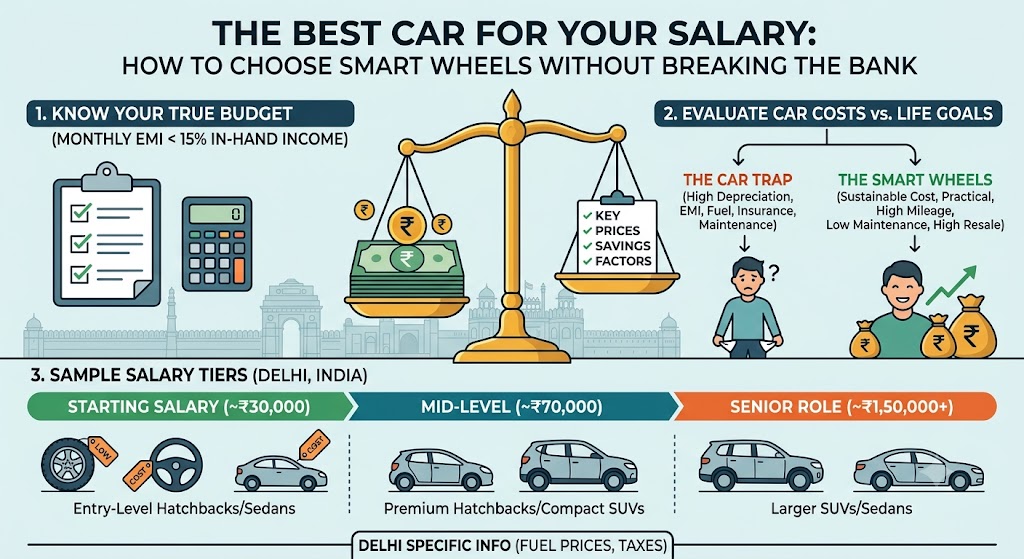
Choosing the “best” car isn’t just about features, mileage or looks—it’s about what fits your salary, lifestyle and future plans without causing financial stress. Instead of chasing what’s popular, thinking in terms of “best car for my income” helps you stay debt‑free, confident and comfortable with your purchase. Here’s a practical way to decide what car works best for you, step by step, and the kind of models you should be looking at in different salary brackets.
Start With A Simple Rule: Don’t Let Your Car Own You
A car should make your life easier, not strain your bank account. A good thumb rule many financial experts use is:
-
The on‑road price of your car should ideally be no more than 50–60% of your annual salary.
-
Your EMI + fuel + maintenance together should not cross 15–20% of your monthly take‑home.
If you go much beyond this, you may enjoy the car but feel constant pressure paying EMIs, insurance, fuel and service bills. So, first calculate your annual salary (in hand) and decide a maximum budget based on it.
Example:
-
Monthly take‑home: ₹30,000 → Annual: ₹3.6 lakh → Safe car budget: around ₹2–2.2 lakh used, or entry‑level new with higher down payment.
-
Monthly take‑home: ₹60,000 → Annual: ₹7.2 lakh → Safe car budget: up to ₹4–4.5 lakh used or ₹6–7 lakh new with proper planning.
Salary Up To ₹25,000: Focus On Value And Necessity
If your take‑home is up to ₹25,000, the priority should be financial stability. In many cases, buying a car at this stage only makes sense if:
-
Your job absolutely requires travel where public transport is not reliable.
-
You are supporting family needs (elderly, children, medical visits) where a vehicle is genuinely important.
At this income level:
-
Prefer a used car with a clean service history over a brand‑new one.
-
Look for small hatchbacks known for low running and maintenance costs.
-
Avoid long‑term, high EMI loans; try to pay a major chunk upfront.
Here, the “best car” isn’t about brand—it’s the car that gets you safely from A to B at the lowest possible total cost.
Salary ₹25,000–₹50,000: Sensible New Hatchbacks
If your take‑home salary falls in this range, you can realistically consider a budget friendly new hatchback without over‑stretching, provided you manage your EMIs carefully. At this level, look for:
-
Good mileage: To keep monthly fuel costs predictable.
-
Reliable brand and wide service network: Lower maintenance headaches.
-
Essential features, not luxuries: Power steering, AC, basic safety (airbags, ABS), but don’t chase sunroofs and fancy gadgets.
The “best car” in this bracket is usually a compact hatchback or entry‑level sedan with:
-
On‑road price within 50–60% of your annual salary.
-
EMI comfortably sitting under 10–12% of your monthly income.
If your work commute is long, mileage matters more than design. If you drive mostly in the city, small size and easy parking become more important.
Salary ₹50,000–₹80,000: Balance Comfort, Safety And Status
With a higher monthly take‑home in this range, you can start thinking beyond basic transport and look at cars that offer:
-
Better safety features (multiple airbags, better crash ratings).
-
More comfort (spacious interiors, better suspension, improved seats).
-
A bit of status or road presence, especially if you frequently travel for work meetings or with family.
Here, the best car for your salary could be:
-
A well‑equipped premium hatchback.
-
A compact sedan with good boot space.
-
A compact SUV in lower or mid variants, if the on‑road price fits your budget.
The trick is to resist going fully premium at once. Avoid top‑end variants with expensive features like panoramic sunroofs or advanced tech if they push your EMI above 15–20% of your income. Choose the variant that gives you core features and safety, not just cosmetic upgrades.
Salary Above ₹80,000: Think Long‑Term And Lifestyle
If your monthly salary is above ₹80,000, you have more flexibility to choose a car that matches your long‑term lifestyle:
-
Do you drive mostly in the city or on highways?
-
Do you often travel with family or alone?
-
Do you want a car that you’ll keep for 8–10 years or upgrade in 4–5?
At this level, the “best car” might be a compact SUV, mid‑size sedan or a well‑equipped premium hatchback, depending on your preference. But even here, smart planning matters:
-
Don’t exceed 70–75% of your annual salary on car price unless your other finances (investments, emergency fund) are strong.
-
Factor in higher insurance, maintenance and possibly loan interest for costlier cars.
Sometimes, a mid‑range, feature‑rich car that is cheaper to maintain is a better choice than a flashy, expensive one that drains you over time.
Other Factors That Matter As Much As Salary
Salary is just one part of the decision. You should also ask yourself:
-
How stable is my income? If your job or industry is uncertain, be conservative.
-
Do I have an emergency fund? Ideally, 6 months of expenses before taking a big loan.
-
Do I have other EMIs (education loan, home loan)? Total EMIs shouldn’t cross 30–35% of your take‑home.
-
How much do I drive? High usage → prioritize mileage and reliability. Low usage → maybe a used car is more sensible than a new one.
The genuinely “best” car is one you can comfortably afford, maintain without stress, and use happily without regretting the monthly payment.
The Ideal Approach: Don’t Just Buy A Car, Buy Financial Peace
Instead of asking, “What is the best car according to my salary?” ask:
-
“Which car lets me live freely, without cutting back on essentials or savings?”
-
“If I lost my job for three months, would this car still be manageable?”
If the answer is yes, you’re probably looking at the right price bracket. Once you set that bracket, shortlist cars that offer:
-
Strong safety and reliability.
-
Good fuel efficiency.
-
A brand with easy service access in your city.
-
Features you’ll actually use every day.
Your salary should guide your budget, not your ego. A slightly simpler car that keeps you financially secure is always better than a flashy one that silently pushes you into stress. The best car, ultimately, is not just the one in your parking spot—but the one you can afford without worrying every month.