


















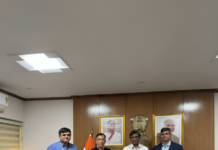













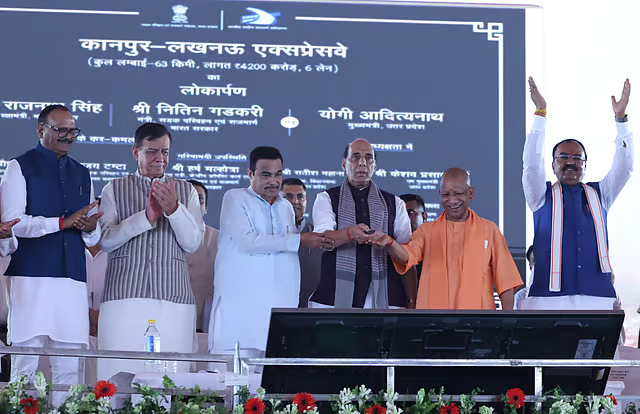
Uttar Pradesh is pushing ahead with an ambitious plan to build world-class road connectivity, with equal emphasis on safety, environment, and economic growth. In a high-level review meeting held on July 13, 2026, Chief Minister Yogi Adityanath and Union Minister for Road Transport and Highways Nitin Gadkari reaffirmed the shared commitment of the Centre and the state to accelerate National Highway and road infrastructure projects across Uttar Pradesh.
World-class connectivity as a top priority
Nitin Gadkari described Uttar Pradesh as a key driver of India’s economic growth and said that developing world-class road connectivity in the state is one of the Central Government’s highest priorities. He directed officials to fast-track all ongoing and proposed projects by ensuring timely completion of land acquisition, forest clearances, utility shifting, and other departmental processes.
Chief Minister Yogi Adityanath underlined that modern road infrastructure forms the foundation of a “Viksit Uttar Pradesh” and will give a strong push to investment, industry, agriculture, tourism, trade, and employment. He stressed that high-quality roads are essential for turning Uttar Pradesh into a one-trillion-dollar economy.
Unprecedented expansion of National Highways
Since 2014, National Highway development in Uttar Pradesh has gained unprecedented momentum. During this period, around 10,204 kilometres of National Highway projects have been awarded, and construction of approximately 9,329 kilometres has already been completed. Between April 2025 and May 2026 alone, 606 kilometres of new projects were approved and 1,010 kilometres were completed.
An investment of nearly ₹1.94 lakh crore has been made in National Highway projects across the state, including around ₹23,445 crore in the financial year 2025-26. Initiatives such as forming a task force under the Chief Secretary, providing royalty-free soil for Greenfield projects, sharing land acquisition costs for ring roads and bypasses, and making government land available free of cost have significantly accelerated project execution, which Gadkari praised as a model of effective Centre–state coordination.
Key projects strengthening regional and interstate links
Officials informed that several major projects are progressing as per schedule. These include the Mathura-Bareilly-Sitarganj four-lane project with an investment of about ₹13,980 crore, the Agra-Aligarh four-lane project worth around ₹5,904 crore, the Agra-Gwalior-Jhansi-Nagpur Economic Corridor, the Kanpur Ring Road, six-lane connectivity to Noida International Airport at Jewar, and the Moradabad-Kashipur four and six-lane project.
These projects will further strengthen connectivity between the National Capital Region, western Uttar Pradesh, Uttarakhand, and key industrial and logistics hubs. The Centre has also agreed to support the development of the North-South Corridor, which will connect different parts of the state through a high-capacity road network and promote balanced regional development.
Focus on eastern, central and Bundelkhand regions
The meeting reviewed projects aimed at boosting connectivity in eastern, central and Bundelkhand Uttar Pradesh. Work is progressing rapidly on the Sonauli-Gorakhpur four-lane project, the Ghazipur-Ballia-Bihar border National Highway, the Prayagraj Southern Ring Road, and the Prayagraj-Jaunpur-Azamgarh-Doharighat corridor. These routes will strengthen links with the India–Nepal border, the Buddhist tourism circuit, eastern Uttar Pradesh and Bihar, thereby enhancing trade, tourism and freight movement.
Detailed Project Reports (DPRs) are being prepared for future projects such as the Ayodhya-Gonda and Rewa-Ranchi four-lane National Highways, along with a proposed 742-kilometre four-lane access-controlled National Highway from Shamli to Gorakhpur. The Chief Minister said this ambitious corridor will redefine connectivity between western and eastern Uttar Pradesh and play a vital role in industrial growth, investment and the agriculture-based economy.
Boost to religious and cultural tourism
Another major focus area is religious and cultural connectivity. The Ayodhya Ring Road is being developed to provide seamless access to the Shri Ram Janmabhoomi Temple, Maharishi Valmiki International Airport, and other important religious sites, while reducing congestion within the city.
Construction is progressing rapidly on the Ram Van Gaman Marg, Ram Janaki Marg and the 84 Kosi Parikrama Marg. These roads will provide modern connectivity to Ayodhya, Chitrakoot, Prayagraj, Kaushambi, Janakpur in Nepal and other key pilgrimage destinations. Yogi Adityanath stated that these projects will not only enhance road connectivity but also give fresh momentum to India’s cultural heritage, religious tourism and local economies.
The Centre is also supporting ropeway projects at Vrindavan and Prayagraj through National Highways Logistics Management Limited, aimed at integrating religious and spiritual tourism with modern transport facilities.
Development with environmental responsibility
During the review of the Bareilly Bypass project, Nitin Gadkari emphasised that development must go hand in hand with environmental protection. He directed that instead of cutting trees, they should be transplanted using modern technology wherever possible. Maintaining a balance between infrastructure growth and environmental conservation, he said, is the need of the hour.
This approach reflects a broader commitment to sustainable development, with careful planning to minimise ecological impact while delivering large-scale road projects.
Road safety as a central priority
Gadkari stressed that reducing road accidents must receive equal priority alongside road construction. He instructed that every National Highway project should incorporate safe design, scientific rectification of accident-prone black spots, modern signage and strict adherence to road safety standards.
Discussions in the meeting also covered strengthening road safety measures more broadly, including better engineering, awareness and enforcement, so that the rapid expansion of road infrastructure does not come at the cost of increased accidents.
Future plans and comprehensive connectivity
The review covered expansion of the National Highway network, phased upgradation of two-lane and narrower roads, and providing full four-lane connectivity between Lucknow and districts that currently lack such access. Plans to develop four-lane National Highways connecting 33 district headquarters were discussed, along with proposals for ring roads in Moradabad, Aligarh, Devipatan, Jhansi, Mirzapur and Saharanpur, and bypasses in Farrukhabad, Shravasti and Maharajganj.
The Uttar Pradesh government also presented long-term proposals such as a new bridge parallel to the Naini Bridge in Prayagraj, a permanent policy for restoring state roads damaged during highway construction, and the North-South Corridor. Financial support, attractive entry gateways at interstate borders, and modernisation of road infrastructure were part of the broader agenda.
Yogi Adityanath reiterated that providing high-quality road infrastructure to every region of the state remains a top priority. He expressed confidence that with coordinated efforts from the Centre and state, all National Highway projects will be completed within stipulated timelines, positioning Uttar Pradesh as a leading state in modern, safe and world-class road infrastructure.