
































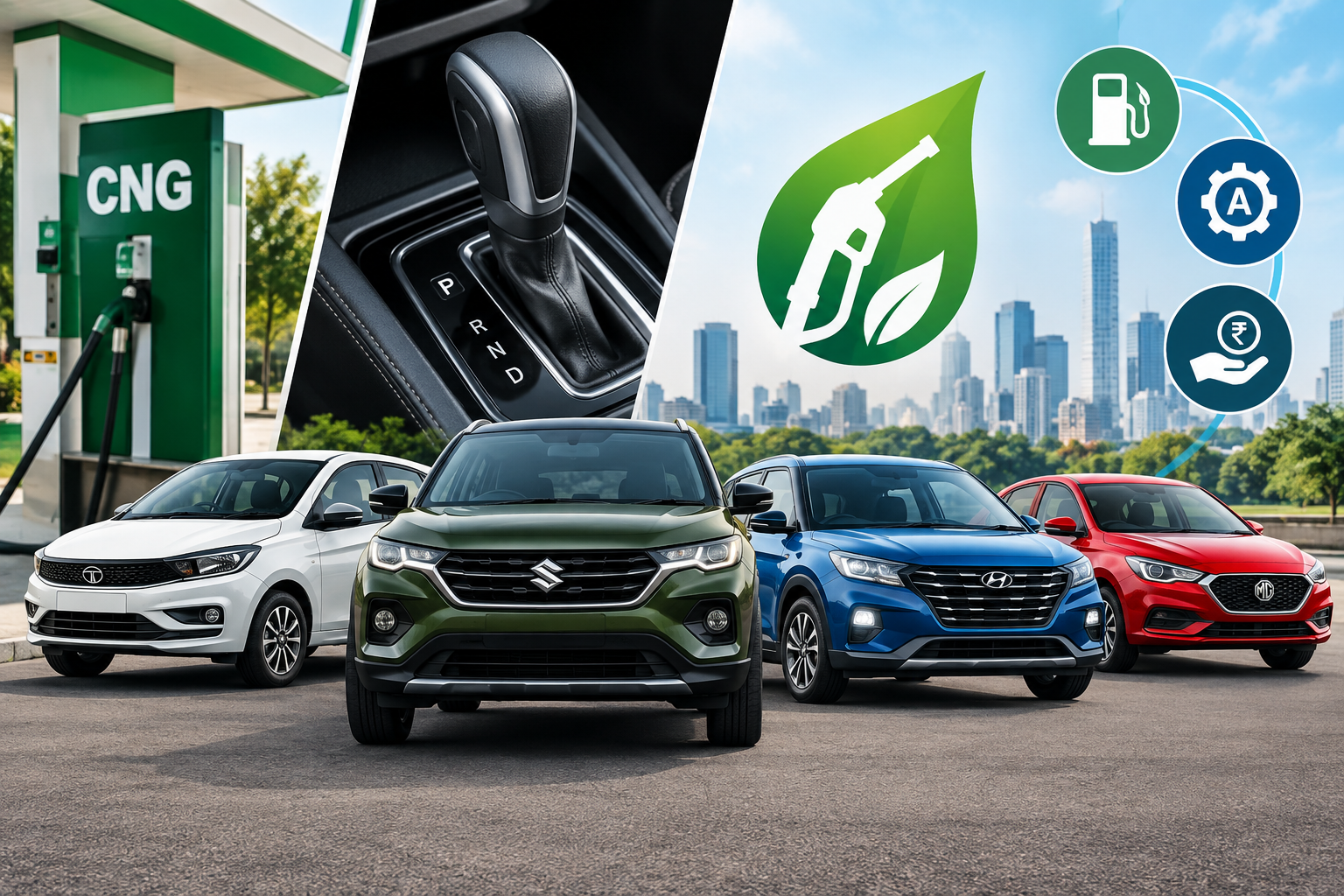
Previously, Indian car buyers were faced with a dilemma: CNG or automatic transmissions, because only petrol-powered automatics were available.
That is no longer the case, as the CNG automatic segment has graduated to a mainstream status for high-mileage urban commuters in the last year or two.
CNG automatics are a good buy
For one, CNG provides a cost advantage over petrol by 30-40% per km depending on prevailing prices. Coupled with the convenience of an automatic gearbox, makes a CNG automatic a compelling proposition for a buyer who covers high mileage in a city.
Moreover, prior to Maruti’s aggressive push, there was very limited choice in terms of automatics with CNG engines — most models were AMT (Automated Manual Transmission). Maruti’s recent Auto Green Mission launch has significantly doused the appeal of the AMT drivetrains among buyers.
Maruti’s Auto Green Mission: Swift, Dzire, Baleno CNG AMT variants
Maruti launched 5-speed AMT-equipped S-CNG variants of its popular Swift, Dzire, and Baleno models in September 2026:
Maruti Swift S-CNG AMT prices start at Rs 7.92 lakh (ex-showroom)
Maruti Baleno S-CNG AMT prices start at Rs 8.32 lakh
Maruti Dzire S-CNG AMT prices start at Rs 8.53 lakh
The engine is the same 1.2L Z12E three-cylinder petrol engine with Dual VVT and Idle Start-Stop, calibrated for LPG/CNG use:
Power in CNG: 51 kW (approx 69-70 bhp)
Torque in CNG: 102 Nm
Transmission: 5-speed AMT
CNG tank: 55-litre water equivalent, mounted at the rear beneath the boot
The claimed mileage figures are:
Swift CNG AMT: 35.34 km/kg
Baleno CNG AMT: 34.47 km/kg
Dzire CNG AMT: 36.47 km/kg (claimed to be the most fuel-efficient sedan in India)
These claimed mileage figures would significantly reduce the monthly fuel cost if the owner drives more than a 1,000 km per month with minimal inconvenience of an automatic gearbox.
Prior to Maruti’s entry into the fray, Tata Motors and Nissan were the only automakers to offer CNG automatics (mostly AMT variants):
Tata Tiago CNG AMT
Tata Tigor CNG AMT
Tata Punch CNG AMT
Tata Tiago NRG CNG AMT
Nissan Magnite CNG AMT
All of the above variants are powered by a 1.2L three-cylinder petrol engine with a CNG kit and a 5-speed AMT gearbox, and develop around 70-73 bhp (petrol) and 100-110 Nm of torque (CNG).
The approximate ex-showroom prices start at:
Tiago / Tigor CNG AMT: Rs 7.5-8.5 lakh (depending on the variant)
Punch CNG AMT: Mid-eighties of a lakh
Magnite CNG AMT: Rs 6.9-7.5 lakh (one of the most affordable CNG automatics)
These cars are ideal for buyers who want the image of an SUV (Punch, Magnite) or a well-equipped hatchback/sedan (Tiago, Tigor) while enjoying the combined benefits of a CNG engine and an automatic gearbox.
Read this- EV Scooters Double in Sales While SUVs Dominate: Inside India’s August Auto Record
What kind of automatic is it?
CNG automatics are mostly AMT (Automated Manual Transmission) in India and not torque-converter automatics or CVTs. AMT uses a conventional manual gearbox, but employs computer-controlled actuators to operate the clutch and change gears automatically. On the steering wheel, the driver finds P-R-N-D-S (or similar) and there is no clutch pedal.
Pros: Lower cost and better mileage than torque-converter automatics; easy to service.
Cons: Shifting can be less smooth than torque-converter or CVT automatics, especially under heavy acceleration.
In practice, for city commuting and relaxed cruising on highways, AMT is perfectly adequate and offers a light, frugal drive. Only enthusiasts who want to experience the smoothness and power of a torque-converter or CVT automatic will find AMT lacking, but those are in very short supply (if any) when it comes to CNG automatics.
Who should buy a CNG automatic?
A CNG automatic is a good value proposition for:
People who drive largely in the city with the benefit of an automatic gearbox.
High-mileage commuters (1,000 km or more per month) who benefit from the cost advantage of CNG.
People who have access to CNG fuel at home, the office, and along their commute.
People who want a family car with the convenience of an automatic for multiple drivers who may not be comfortable with a manual gearbox.
However, if the buyer’s mileage is low, or they often take long drives on highways with a full load of luggage, a CNG automatic is not the best value proposition. Reduced boot space (due to the CNG cylinder) and reduced range between CNG fills should be taken into account.
Trade-offs of a CNG automatic
Boot space: Factory-fitted CNG cars tend to mount the gas cylinder at the rear of the car, which reduces the boot space and often denies the option to fit a spare wheel.
Power: CNG variants of cars deliver less power and torque than their petrol counterparts due to the combustion characteristics of CNG, and hence 0-100kmph times and overtaking performance will not measure up to a petrol variant with a similar specification.
Price: While the choice is limited compared to a CNG manual, a CNG automatic will command a premium of around Rs 40,000-100,000 over a similar CNG manual car, depending on the model.
Resale and perception: Since the segment is new, the secondary market value will only be known once these cars have been driven through a complete ownership cycle.
The bottom line: More choice and better value proposition
Maruti’s entry into the CNG automatic segment has improved the choice on offer to urban commuters for cars that combine the benefits of a CNG engine with the convenience of an automatic gearbox. The value proposition is clear: buyers who drive more than 1,000 km per month and have access to CNG fuel have a compelling reason to buy a CNG automatic in this price range.
Watch this-