





























Pune Plant Opens With 1.7 Lakh Capacity – And It’s About To DOUBLE By 2030!
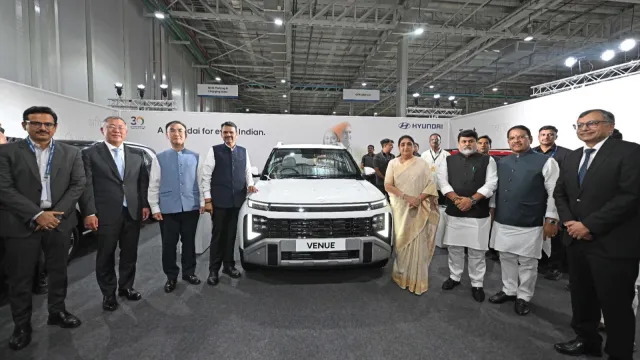
Hyundai Motor India Limited (HMIL) has inaugurated its manufacturing plant in Talegaon, Pune. Hyundai has announced investing up to Rs. 11,000 crore by 2030, to expand production, strengthen its R&D, and support emerging mobility technologies.
The Pune plant opens with an annual production capacity of 1.7 lakh vehicles. Hyundai plans to expand this to 3.2 lakh by 2030. The plant was inaugurated by Maharashtra Chief Minister Devendra Fadnavis in October 14, 2026.
This is Hyundai’s first major expansion in manufacturing other than Tamil Nadu. Hyundai’s existing manufacturing operations in India are located in Chennai, Tamil Nadu. The Talegaon plant represents Hyundai’s first major manufacturing expansion beyond Tamil Nadu, and gives the company a second production base in India.
The Pune facility was acquired from General Motors India, which has since been upgraded and prepared for Hyundai’s own vehicle production. The inauguration of the Pune plant marks the beginning of a new era in Hyundai’s India manufacturing strategy.
The plant will support Hyundai’s domestic sales, exports, and future model line-up in India. Hyundai will also gain a stronger presence in western India, with Maharashtra being one of the most important automotive manufacturing hubs in the country.
Hyundai to invest Rs. 11,000 crore in Pune facility, in phases, by 2030
Hyundai will invest up to Rs. 11,000 crore at the Pune facility in phases by 2030. The investment will not be limited to expanding the vehicle production capacity at the plant.
60% of the funds will go towards expanding production
20% will go towards new technologies
20% will go towards research and development
The investment will support manufacturing expansion, R&D facilities, and Hyundai’s emerging mobility businesses. This includes future technologies, software-defined vehicles, electrification, and advanced manufacturing systems.
Hyundai Motor Group Executive Chair Euisun Chung said the investment reflects the group’s long-term commitment to India. The company sees India as a key market for both domestic growth and global exports.
Read this- VOLVO INDIA DEALS A HUGE BLOW TO PHEV BUYERS
Capacities to rise from 1.7 lakh to 3.2 lakh
The Pune plant currently has an annual production capacity of 1,70,000 units. Hyundai plans to expand this in phases up to 3,20,000 units by 2030. This means a growth of 1.5 lakh units annually, or nearly 90%.
Hyundai will gain a larger capacity in India for meeting the growing demand for its vehicles. It will also be able to boost its exports from the Pune plant.
Hyundai has targeted combined production of nearly 11.4 lakh units of passenger vehicles across its Pune and Chennai plants by 2030. This would make it one of the largest passenger vehicle manufacturers in the country.
Engine shop at Talegaon plant
The Talegaon plant also has an engine shop, which has an annual capacity for producing 1.5 lakh engines. Local engine production will help reduce reliance on imported powertrains.
Local production of engines will support Hyundai’s cost control and localisation strategy. It will also open up more opportunities for suppliers and component manufacturers in Maharashtra.
Jobs and supplier ecosystem
The Pune plant will generate significant employment in Maharashtra. Hyundai has claimed that its supplier ecosystem, including tier-II vendors, has already generated more than 18,000 employment opportunities in the state.
The plant will benefit factory workers, local suppliers, logistics partners, and businesses in tier-1 and tier-2 locations around Pune. This will also strengthen Pune’s position as a major automotive manufacturing cluster.
Maharashtra Chief Minister Devendra Fadnavis welcomed the investment, and invited more Korean companies to invest in the state. He noted that Hyundai had increased its planned investment from an initial Rs. 7,000 crore to Rs. 11,000 crore.
Why Pune plant matters for Hyundai
Hyundai has faced increased competition in India in recent years from Tata Motors and Mahindra & Mahindra in the SUV segment. The new Pune plant will allow Hyundai to have more capacity to roll out models like its i20 Active and its Creta SUV, while also reducing waiting periods.
The plant could help Hyundai develop its future product strategy, including SUVs, hybrids, and electric vehicles. With the growth of the SUV and electrified vehicle segments in India, additional manufacturing capacity will be critical.
Hyundai recently unveiled the India-spec Bayon, which is set to launch on October 26, 2026. The company is also investing in connected-car and AI-based technologies, which makes local manufacturing capacity even more important in support of future growth.
Exports and global role
India is a key export hub for Hyundai. The company exports vehicles and components to several global markets. The Pune plant can help Hyundai boost its exports, and serve markets more efficiently.
With additional capacity in Pune, Hyundai can balance its production between Chennai and Pune, and reduce supply-chain risks. It will also gain more flexibility in responding to demand in India and overseas.
Maharashtra’s automotive growth
Maharashtra is home to some of the biggest automotive manufacturers, and a strong supplier base. Hyundai’s Rs. 11,000 crore investment will further boost the state’s automotive ecosystem.
The Talegaon plant should encourage more suppliers to come in and set up or expand in the region. It will also generate additional indirect employment.
HYUNDAI to open manufacturing plant in Pune, Maharashtra – With a Rs. 11,000 crore investment, and capacity to produce 1.7 lakh vehicles annually
Hyundai’s inauguration of the manufacturing plant in Talegaon represents a major milestone in its India strategy. With an initial capacity of 1.7 lakh units, expansion to 3.2 lakh by 2030, and an investment of up to Rs. 11,000 crore, Hyundai is preparing itself for the next step in its journey in one of the world’s largest car markets.
The investment will support expansion of production capacity, new technologies, R&D, and employment generation. For Hyundai, the Pune plant will give it the capacity it requires to be a bigger player in the fast-changing passenger vehicle market in India. For Maharashtra, it will strengthen Pune’s position as one of the most important automotive manufacturing hubs in the country.
Watch this-