
































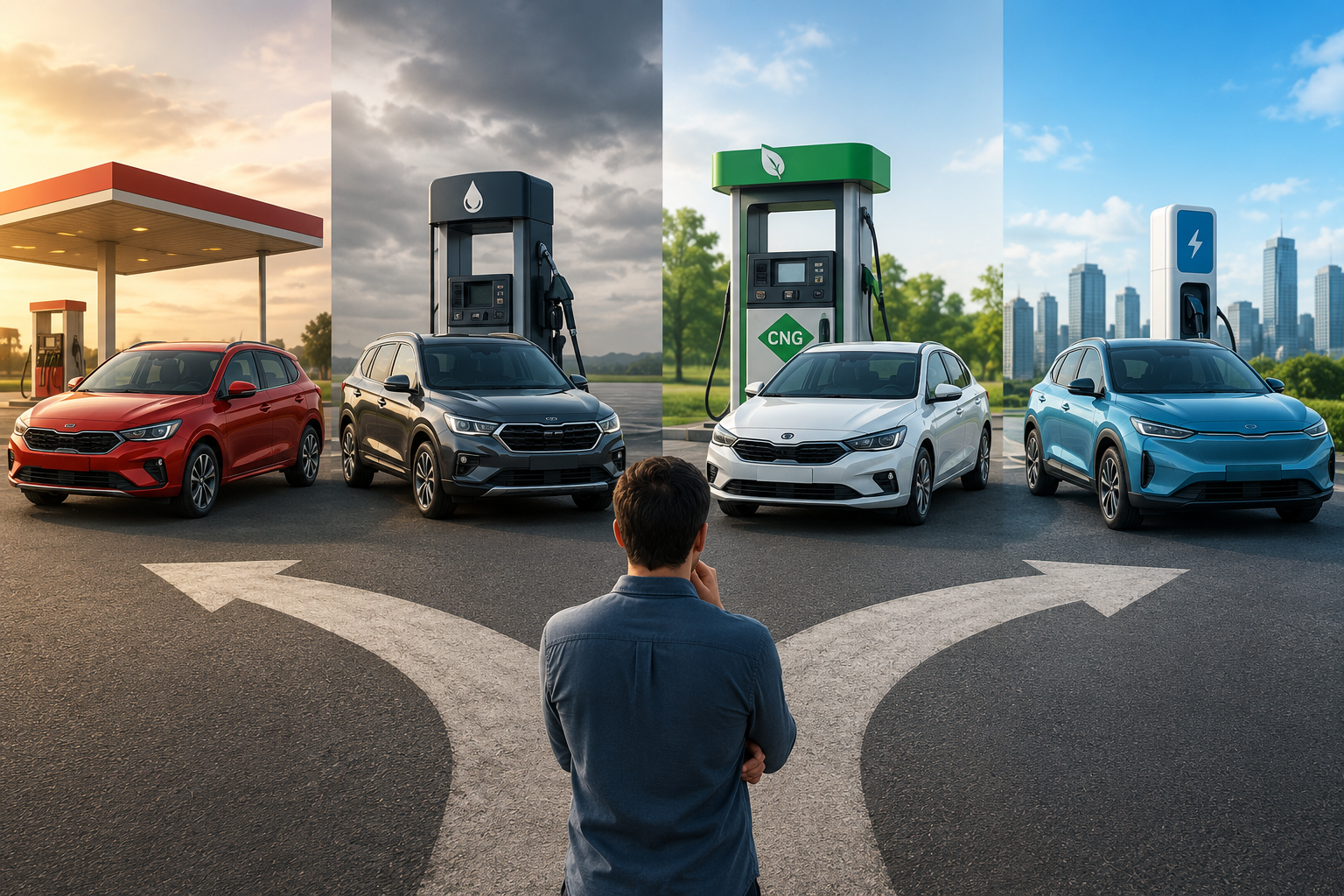
While buying a car in 2026, the first decision any first-time buyer will have to take is about fuel-type. Be it petrol, diesel, CNG or EVs, all have their pros and cons and the best fit depends on how much one drives, their annual budget, city-highway break-up, etc. This buyer’s guide compares petrol, diesel and CNG engines to help you decide the powertrain option that will deliver the best value for money.
Petrol Cars: The default choice
Petrol cars still remain the default choice for most first-time car buyers in India. They are most suited for city driving with less than 1,000-1,200 km of monthly driving.
Petrol Cars: Who should buy?
City driving with less than 200 km of highway every month
Looking for a first car with low purchase price and wide choice of variants
Desire for comfort and refinement in a petrol engine
Pros
Lower purchase price compared to diesel and most EVs
Petrol engines tend to be refined and quiet in smaller cars
Wider choice of models in petrol from 5-25+ lakh price range
No range anxiety with easy accessibility of fuel
Cons
Highway mileage tends to be lower compared to diesel and CNG variants
Running cost per km is higher than diesel, CNG and EVs
City mileage dips in traffic
Petrol cars are a good value proposition for most first-time buyers who have a lower mileage budget per month.
Diesel Cars: For people who drive more on highways
Diesel has been phased out for small cars, but continues to be popular in compact and mid-size SUVs, and premium cars.
Read this- 5 reasons why you should buy the Kia Sorento
Diesel Cars: Who should buy?
More than 1,500-2,000 km of driving every month with good amount of highways
Need for better torque for overtaking and towing
Long-term ownership (5+ years)
Pros
Much better mileage on highways compared to petrol cars
Lower cost per km driven, if you run diesel cars on a regular basis
Mid-range torque helps with overtaking and towing
Better resale value for diesel cars, particularly in premium and SUV segments
Cons
Purchase price is higher by INR 1-2 lakh compared to petrol cars
Higher maintenance costs over time
Diesel cars tend to be noisier and have more vibration, especially in small cars
Uncertain future as some cities continue to ban diesel vehicles
Diesel Cars are best suited for those with high mileage budget and who spend considerable amount of time on highways.
CNG Cars: Budget-friendly but popular in metro cities
CNG cars have become mainstream in the past few years, with Maruti, Hyundai, Tata, Honda offering factory-fitted CNG cars.
CNG Cars: Who should buy?
Predominant city driving with some weekend highway driving
Looking for lowest possible running cost with availability of CNG in your area
Mileage budget of 1,000-2,000 km per month
Pros
Lower running cost per km compared to petrol or diesel cars
Factory-fitted CNG system offers better safety and reliability
Good mileage in CNG cars compared to petrol or diesel
Lower emissions
Cons
Fewer car options in CNG compared to petrol
Lower boot space due to CNG cylinder
Petrol engines may offer better performance and refinement
CNG availability can be a problem on some occasions
CNG cars are the most cost-effective option for people who do mostly city driving with some highway driving on weekends.
Electric Cars (EVs): The future is EV
EVs continue to be the future of personal mobility, but make for a good choice for select buyers on a budget.
EVs: Who should buy?
Fixed, daily commuting with predictable distance (office-school-shopping) within 150-250 km
Availability of charging stations at home or office (society parking with EV charging or wallbox)
Monthly mileage of 1,000+ km to make EVs economical compared to petrol/CNG cars
Looking for lowest possible running cost and zero tailpipe emissions
Pros
Best value proposition for those who can charge their cars at home or office
Super low maintenance cost, compared to petrol or diesel
EVs offer best performance in terms of torque and acceleration, combined with zero tailpipe emissions
Many states offer incentives for buying EVs and provide free/cheap charging
Cons
Higher purchase price compared to petrol/CNG cars of similar segment
Range anxiety in case of long-distance highway travel
Time-consuming to charge even at fastest DC chargers (30-60 mins to gain 80+ percent charge)
EVs are still too new and range anxiety, charging infrastructure and battery technology are concerns for most buyers looking to buy a used EV.
Petrol vs Diesel vs CNG vs EV: Quick decision making guide
Choose petrol if
Most of your driving is done in city with less than 1,000-1,200 km of driving per month
Looking for maximum choice of variants on a lower budget
Choose diesel if
You do a lot of highway driving
Most of your driving is done in city with more than 1,500-2,000 km of driving per month
You are looking to purchase a car for long-term (5+ years)
Choose CNG if
Most of your driving is done in city with 1,000-2,000 km of driving per month
You are looking for lowest running cost without switching to EV
CNG is available in your city or town
Choose EV if
You have access to home/office charging (society parking with EV charging or wallbox)
Most of your driving is predictable and done within city or within 150-250 km range
You are looking for lowest possible running cost and maintenance
EVs have higher purchase price so are suitable for buyers who are not in a hurry to change vehicle every few years
There is no one-size-fits-all solution when it comes to choosing between petrol, diesel, CNG and EVs. Most buyers should use this buying guide as a reference and match their requirements against the pros and cons before purchasing a car. City driving with low mileage means petrol is the best choice, while diesel engines make more sense for those with higher mileage budget and who spend a lot of time on highways. CNG cars offer the best value for money for people who drive mostly in cities but also have to take up long drives on weekends. EVs are the most viable option for those who have access to home or office charging and drive mostly within city on a predictable route every day.
Watch this-