
































Tata Motors is set to accelerate its electric vehicle (EV) push by introducing 4 new EVs between late 2026 and 2027. The company is targeting to witness over 30% EV sales as a percentage of Tata’s passenger vehicle sales by fiscal year 31, with 2-3x range and 3x faster charging than its current vehicles.
The 4 new EVs that Tata is planning to launch in India
As per reports and some unofficial hints, Tata is looking to introduce a combination of new and existing models for its 4 new EVs:
Sierra EV – Tata’s boxy mid-size SUV gets an electric powertrain and will be launched in the country in June 30, 2026. The variants with dual-motor AWD (all-wheel drive) will be known as “QWD” in Tata lingo and are expected to come with 65 kWh (base) and 75 kWh (AWD) battery packs to offer a range of over 500 km on a single charge.
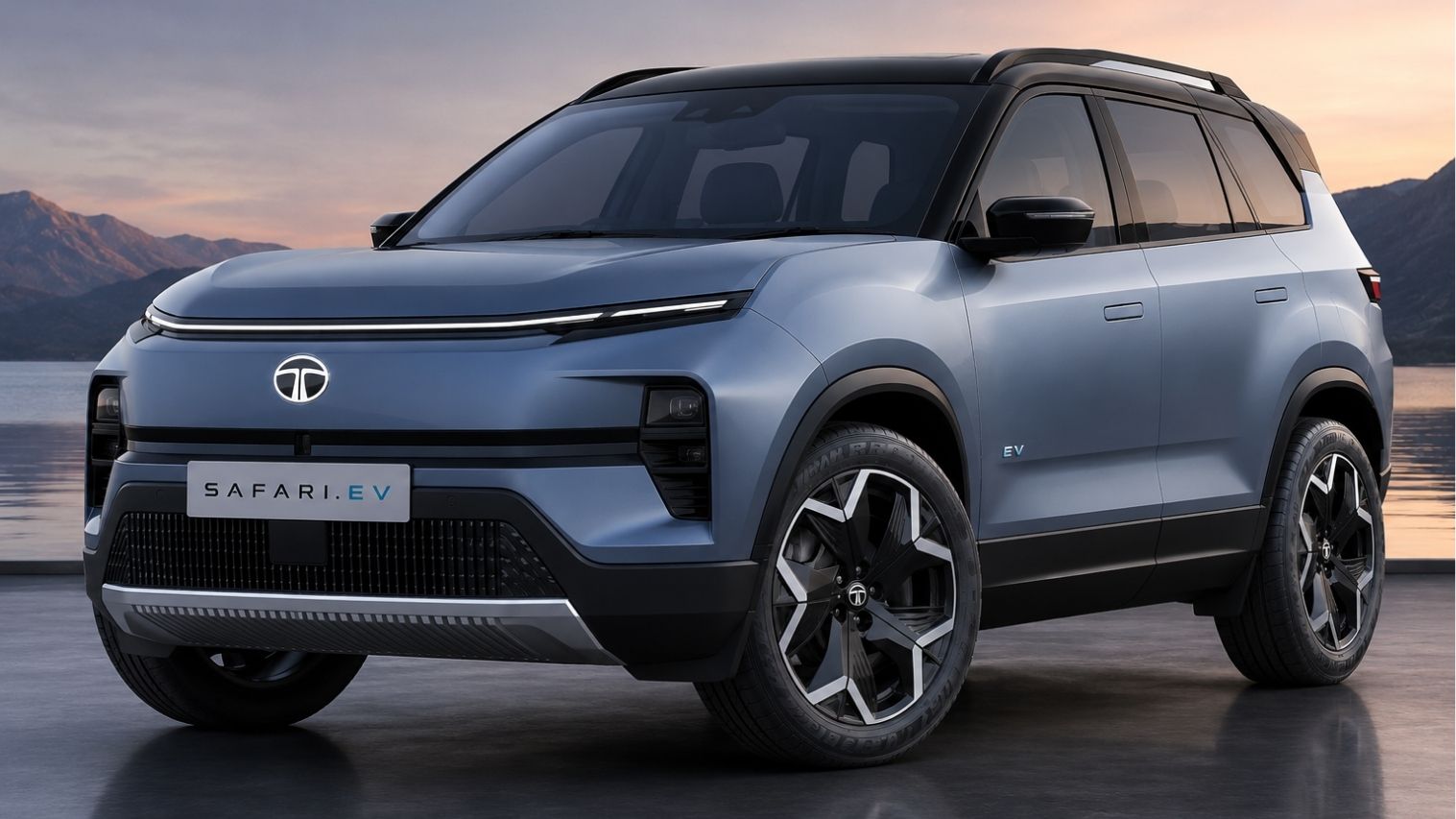
Safari EV- On the higher end, Tata is working on its flagship 7-seater EV that is expected to enter the market in the Diwali 2026 window. Expected to take on the competition from Mahindra XEV 9e, the electric Safari will utilize a rear-biased platform with independent rear suspension and is likely to share the powertrain from the upcoming Harrier EV. Offering similar battery pack sizes, the claimed range is likely to be between 600 and 627 km.
Avinya-based premium EV- The first production car from Tata’s upcoming dedicated Avinya EV brand is expected to launch in Q1 2027. Set to begin sales in mid-2027, the car will be based on a futuristic EV (Gen-3) architecture and is likely to offer a larger interior space and cutting-edge features to target the premium EV segment.
Next-gen mass-market EV (Nexon/Altroz/Tigor family)- Tata’s chairman has hinted that the company is working on 4 new electric cars within a span of 12-18 months. Sources suggest that these could be the next-gen Nexon EV, Altroz EV, and Tigor EV, which will complement the entry-level EV segment in India and compete with the likes of Maruti Suzuki’s electric offerings and other EVs from Hyundai and Kia. The upcoming models are likely to position themselves in the price range of ₹12-20 lakh, offering improvements over their battery range and faster DC charging speeds, along with a more refined design.
The details regarding the battery sizes, range, and pricing for the entry-level EVs are yet to be revealed, so anything mentioned before is purely speculative.
Read this- Bike News India September 2026: New Himalayan 440, Jawa 42 All Stars, Hero 125R & Kawasaki Fire Sale
Why are these launches so important for Indian EV buyers?
Tata has had the lion’s share of the Indian EV market, but with the entry of competitors like Mahindra, Hyundai, Kia, and others, it is looking to strengthen its position in the market. With the introduction of these 4 electric cars, Tata is poised to do just that:
It will give buyers an extensive range of EVs to choose from, from the compact hatchback/sedan segment to the premium 7-seater segment. Not only that, there is also a possibility of a new sub-brand being launched with the Avinya-based EV.
With the claimed range of over 600 km on a single charge for the Safari EV and extensive battery sizes for the other 3 EVs, concerns about limited driving range will be a thing of the past.
With the new Gen-3 architecture for Avinya-based EVs, buyers can also expect faster charging speeds, as well as more tech features that are likely to be rolled out in the future.
What to expect from these new EVs?
While details are scarce, we can draw quite a few conclusions from the details about the current generation of Tata’s EVs:
On battery range and size:
The battery sizes for the Sierra, Safari, and Avinya-based EVs are expected to be in the range of 55-75 kWh, with claimed ranges between 450 and 600+ km on a single charge.
On performance:
While the base variants are likely to be RWD (rear-wheel drive) and offer a good balance of performance and efficiency, the higher trims of the Sierra EV, and potentially of the other 2 EVs as well, are likely to feature dual-motor AWD (all-wheel drive) to offer better control and power.
On charging and tech:
Faster DC charging speeds of over 100 kW are likely to be available for these EVs with tweaks to their software and hardware to offer reduced charging times as compared to the current crop of EVs.
On cost:
The on-road prices for the Sierra EV and Safari EV are likely to be between ₹20-30 lakh for most variants, while the Avinya-based EV could potentially cost between ₹25-35 lakh or more depending on the features. The next-gen entry-level EVs (Nexon/Altroz/Tigor family) are likely to be priced between ₹12-20 lakh.
When to expect these EVs?
Sierra EV – June 30, 2026.
Tigor EV facelift, and Tigor EV (possibly Safari EV as well) – Diwali 2026 (October-November).
Avinya EV brand debut, and first Avinya EV – Q1 2027.
Sales of Avinya EVs to begin in mid-2027 and more new EVs from the Nexon/Altroz/Tigor family to launch by mid-2027.
So if you are someone considering buying an EV from Tata, the next 12-18 months are shaping up to be the most exciting ones.
Watch this-