


































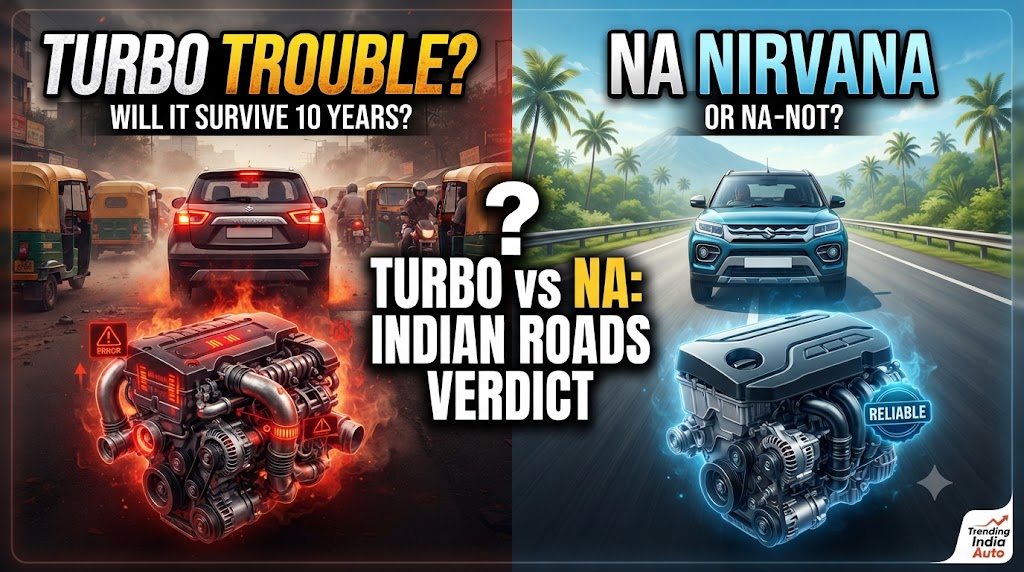
Our road has seen a shift in the power dynamics between engines.
While the Naturally Aspirated (NA) engine has ruled the road for years, the Turbo Petrol engine has come on to the scene offering greater torque in smaller size. Many buyers are now faced with the dilemma of which engine to opt for, given the superior performance of the turbo engines. But will these young guns survive the 10 years on our roads?
The case for NA: The old timer
The Naturally Aspirated engine is known for its reliability. It pulls in air via a throttle valve at the intake manifold and allows the air to enter the cylinders to combust with the fuel. It has lesser mechanical complexities than that of a Turbo engine.
Why does NA fares better on Indian roads?
Lower thermal and mechanical stresses: The NA engine has lesser stress on the mechanical components like piston rings and bearings as it does not have a turbocharger.
Less stringent maintenance schedule: It has a more forgiving maintenance schedule and will not punish you as severely for neglect as compared to a Turbo engine
Linear power delivery: The engine does not have sudden spikes in torque and power.
Easier and cheaper repairs: In case of a mechanical failure, the repair costs and complexity is lesser for the NA engine.
However the downside is that to get more power, you need a bigger engine. The downsizing that we see in the Turbocharged engines is not available in NA engines, which makes the NA engines thirsty and less economical. With the tightening emission norms, the NA engines are being phased out to be used only in entry level cars.
The case for Turbo: The new kid on the block
The Turbo-charged engines use a turbocharger to force more air into the engine. This allows the engine to have a higher specific power i.e. more power from the same sized engine. A 1.2L Turbo engine can perform like a 1.6L NA engine. Turbo chargers are also more economical as they can utilize exhaust gases that would otherwise be wasted. This allows the Turbo engines to meet the tightening emission standards.
Why do Turbo engines fare better in Indian conditions?
Higher torque at lower RPMs: Turbo engines can offer higher torque at a lower RPM, which results in better acceleration from lower speeds, and a more enjoyable driving experience.
Better fuel economy on highways: Turbo engines have a better fuel economy on the highways, compared to NA engines. They also offer the possibility of downsizing without the penalty of reduced power.
Emission friendly: Turbo engines are a better choice if you wish to comply with the tightening emission norms, as they allow manufacturers to keep the engine size smaller while offering the same power as a bigger NA engine.
However with great power comes great responsibility. Turbo engines have to work at very high speeds (exceeding 1,00,000 RPM) and temperatures (exceeding 1000 degree Celsius). A thin film of oil lubricates the turbocharger bearings, which also helps cool it. If the engine oil is not clean, or the engine is switched off immediately after heavy throttle application, the bearings can be damaged. These delicate turbochargers are the weak link in the engine, and the root cause of many warranty claims.
Theory vs Reality
The theoretical reliability of the engine under ideal conditions is one thing, but the real world conditions are more punishing.
Fuel quality: The fuel quality in India may vary, and a poorly refined fuel can damage the Turbocharger. Under these conditions the NA engine is a more reliable choice, as they are less sensitive to the fuel quality.
Stop start traffic: In stop start traffic conditions often seen in our country, the Turbochargers are under added stress. While the Turbocharger runs at very high RPMs trying to build up boost, the car is either standing still or moving at very low speeds.
Dust: The dust content of Indian roads is very high, and can damage the air filters, putting the Turbo engine at further risk.
The Verdict on 10 Years
If we were to project this to 2036, and look at what car would last 10 years into the future; I think the naturally aspirated engine has a slight edge over the Turbo charged engines. It will outlast the other engine type for higher mileages (1.5 lakh+km). However, the difference is not that great. With proper maintenance, a Turbo engine will also last the same time. The NA engine has lesser points of failure, as it is mechanically simpler, but a properly maintained Turbo engine will provide you with more power, fuel economy and better performance.
The Buying Guide
Buy NA if,
You intend to keep the car for more than 10 years
You are driving in higher temperatures and dust
You need lesser maintenance and are not particular about service intervals
You are willing to downshift more often to accelerate.
Buy Turbo if,
You wish to have a more engaging driving experience
You will be doing a lot of highway driving, where the Turbo engines will really shine
You are willing to get the maintenance done as per the maintenance schedule and use proper fuel.
You do not expect to keep the car for more than 8 years, as after this period, the Turbocharger may need servicing, which may not be cost effective.
While the NA engine is the safer option, in the long term, the Turbo engines can also last as long, if they are given the care and maintenance that they need. These engines are like a sports car, they will give you a much better driving experience, but require a more involved maintenance regime. On the other hand, the NA engines will provide you with a less thrilling but more dependable experience. The choice between the two engines boils down to two factors: how long you intend to keep the car, and whether you are willing to do the maintenance as per the maintenance schedule.
Watch this-