







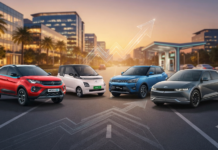

















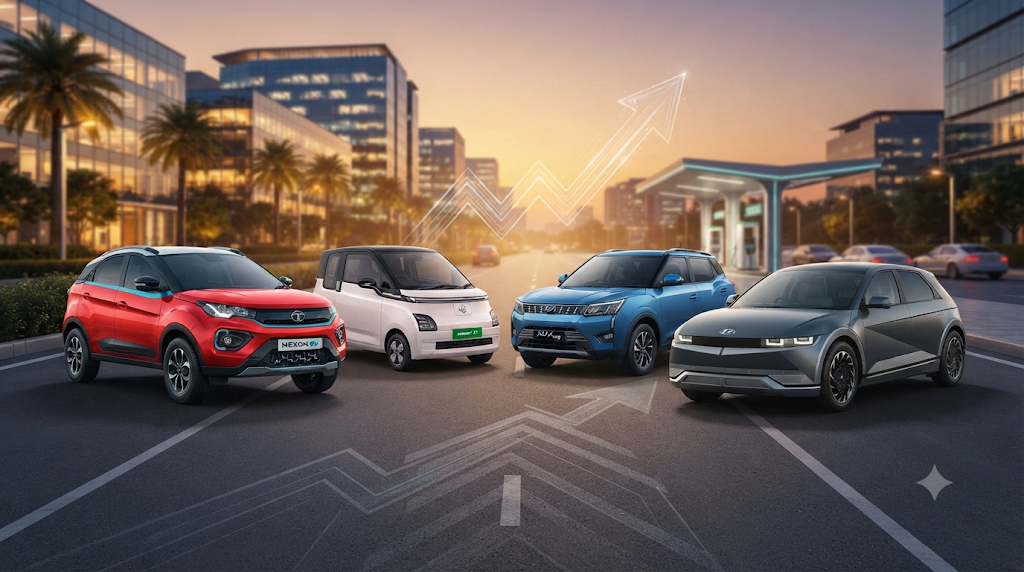
India’s electric car sales have surpassed the 3 lakh unit mark in 2026. As of November 9.
304,701 units have been registered, already surpassing the previous record of 195,571 units in 2025. We expect around 3.25 lakh units to be sold by the end of the full year, meaning that there will be a 66% increase year-on-year.
New Record
Electric car sales in India have risen steadily over the last few years. However, 2026 has smashed this record with 304,701 units already registered as of November 9. This means that sales have increased by 56% in 2026 year-to-date. If we continue at this rate, we can expect around 3.25 lakh units to be sold by the end of the year. This means there will be a 66% increase year-on-year.
This is a huge increase and shows that the electric car market is really taking off and becoming popular.
Monthly Sales
Electric car sales in India have been very strong over the majority of the months between January and October. However, they have been consistently above 30,000 units in the second half of the year.
Sales have been the strongest in September with 38,440 units being sold. This is a 108% increase compared to September 2025. October has also been strong with 37,516 units being sold, this is a 79% increase year-on-year.
Below is a breakdown of the monthly electric car sales in 2026.
| Month | 2026 Sales | 2025 Sales | Increase |
| January | 21,568 | 13,325 | 62% |
| February | 16,300 | 10,481 | 56% |
| March | 25,502 | 14,390 | 77% |
| April | 25,984 | 14,794 | 76% |
| May | 28,416 | 14,695 | 93% |
| June | 33,640 | 15,274 | 120% |
| July | 34,717 | 17,934 | 94% |
| August | 32,587 | 20,182 | 61% |
| September | 38,440 | 18,520 | 108% |
| October | 37,516 | 20,954 | 79% |
| November (until 9th) | 10,031 | 17,435 | – |
| December | – | 17,587 | – |
| Total | 304,701 | 195,571 | 56% |
The numbers show that electric car sales are consistently rising across the months. This is a great sign.
Tata Motors Continue to Lead
Tata Motors continue to dominate in India’s electric car market with 120,895 units being sold between January and November 9. This means that they have a 39.67% market share.
Tata lead due to them having the largest range of electric cars with 7 different models available.
They are performing well which shows that their strategy for EVs is working. With them offering a range of electric cars, they have remained the market leader.
Mahindra Take Over from MG
Mahindra have taken over from JSW MG Motor. Between January and November 9, Mahindra have sold 69,660 units with a 22.86% market share.
This is a big shift from last year where MG were in second. This shows that Mahindra’s strategy for electric SUVs is paying off.
It’s important that Mahindra are doing well as it shows that Indian brands can do well in the EV market. Their increasing range of EVs is helping them take market share.
JSW MG Motor Drop to Third
JSW MG Motor have dropped to third with 59,988 units sold. This gives them an 18.70% market share.
This shows that the EV market is getting very competitive. They will need to improve their range.
Although they are not doing as well as they were, they are still a large player. They are just not doing as well as Mahindra.
Other Big Players
VinFast came in 6th with 15,867 units sold. Maruti Suzuki came in fifth with 12,390 units registered.
Kia sold 7,612 units with a 2.49% market share. BYD sold 6,755 units with a 2.21% market share.
Hyundai had 6,013 units registered. This gives them a 1.97% market share. This shows that the market is getting competitive with many brands involved.
Luxury EVs
The luxury EV market is still quite small. However, BMW have done well with 4,273 units delivered. This makes them the market leader.
Mercedes-Benz have struggled with only selling 1,416 units. This shows that luxury buyers are still wary of EVs.
Tesla sold 1,153 units whilst Volvo Cars sold 383 units. Porsche have only sold 83 units. This shows that the luxury EV market is still in its infancy.
Smaller Brands
Some brands are performing very poorly. Toyota have only sold 762 units. Citroen have delivered 436 units.
Rolls-Royce, Lotus Cars, and Audi have all sold very few electric vehicles. Rolls-Royce had 6 units registered, Lotus had 3 units, and Audi had 2 units. This shows that the luxury EV market is very small.
JLR have sold 4 units between January and November 9. These are unlikely to be retail sales as they have not released any EVs since discontinuing the Jaguar I-Pace two years ago. They may be selling the Range Rover Electric which is set to launch in 2027.
Overall, the Indian electric car market has hit the 3 lakh unit milestone. This shows that EVs are becoming popular.
There are many reasons for the increase in sales. More models, better charging infrastructure, and increased awareness are all helping the market grow.
Tata Motors, Mahindra, and MG are all performing well which shows that Indian brands are leading the EV transition.
Challenges
However, there are still challenges to face. The charging infrastructure, battery prices, and awareness all need to improve.
Some models such as the XEV 9e and BE 6 have shown a decrease in sales. This shows that not all EVs are selling well. Manufacturers will need to focus on quality and customer experience.
The luxury EV market is still very small. This shows there is potential to grow this. More models and better infrastructure will be needed.
India’s electric car market has hit the 3 lakh unit milestone in 2026. We expect sales to increase to around 3.25 lakh units by the end of the year. This means there will be a 66% increase year-on-year.
Tata Motors continue to lead the market. Mahindra and JSW MG Motor are both following closely behind. This shows that the EV transition is really taking off in India.
The challenge will be to keep this increase and grow the market. More models, better infrastructure, and increased awareness will be needed.
Watch this-