





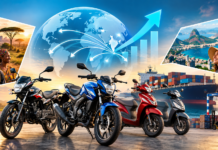



















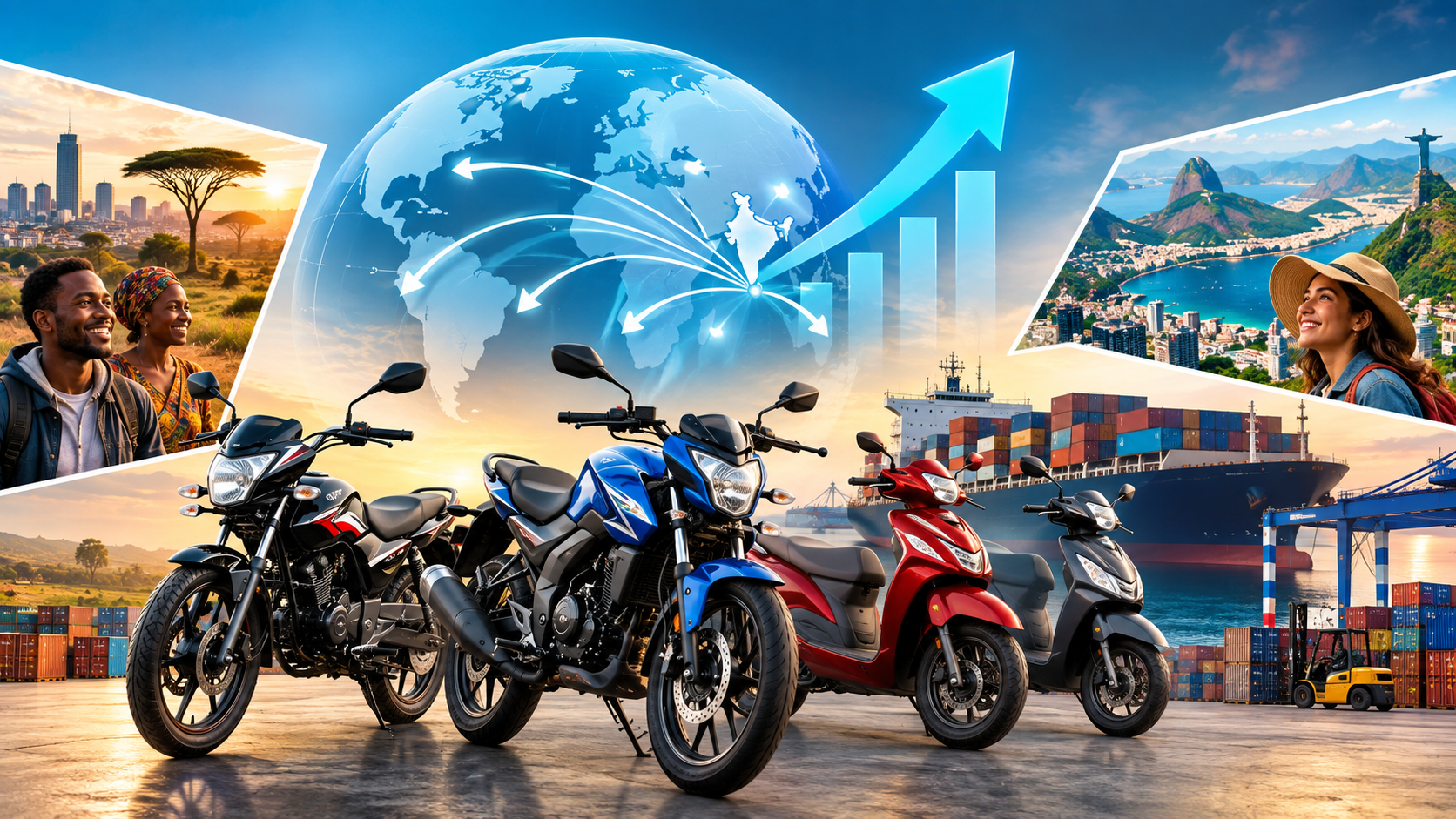
Indian two-wheeler manufacturer Bajaj Auto is continuing its rapid march towards global market leadership, with exports up by 50% year-on-year to 11,00,827 units in the first five months of FY2027, according to reports in April-August 2026.
Bajaj, based in Pune, has maintained its position as the largest Indian two-wheeler exporter and has seen a dramatic shift in demand away from the domestic market and towards key overseas markets in Latin America and Africa.
The jump in exports highlights a growing trend for Indian motorcycle manufacturers: emerging economies are providing substantial growth opportunities for manufacturers selling affordable, reliable bikes to a burgeoning middle class.
The export surge
Of the 11 lakh two-wheelers exported by Bajaj Auto between April-August FY2027, 10,96,009 were motorcycles, up 49% year-on-year. The remaining 4,818 units were Chetak electric scooters, representing the early phases of Bajaj’s electric export efforts.
The company’s broader global business has been equally robust, with total vehicle exports (including three-wheelers and Qute quadricycles) rising 50% year-on-year to 12,66,714 in the five-month period. Three-wheeler exports climbed 48% to 1,60,685 units, while Qute exports soared 206% to 5,202 units, albeit from a smaller base.
The company’s exports during just one month – August – saw two-wheeler deliveries of 2,41,850 units, up 53% year-on-year over 1,57,778 units. Export growth outpaced domestic growth, with overseas business representing a crucial supplement to Bajaj’s domestic sales of 5,35,764 units in August.
The most popular export segment remains the 100cc–110cc category
While Bajaj’s exports of sport bikes and luxury models are also gaining traction, the company’s main growth engine remains the reliable and fuel-efficient commuter bike.
Bikes in the 100cc–110cc segment represented the largest component of Bajaj’s exports during April–August FY2027, with 4,70,362 units shipped, an eye-popping 95% year-on-year increase. This segment accounted for 43% of Bajaj’s total motorcycle exports during the five-month period.
The 110cc–125cc category provided a further 3,04,191 units, up 42% year-on-year to represent 28% of motorcycle exports, and together the two segments accounted for 71% of Bajaj’s total motorcycle exports during the period.
Latin America emerges as Bajaj’s largest export region
Latin America has emerged as Bajaj’s largest export region, accounting for approximately 35% of the company’s overseas shipments, compared to Africa at 30%. Regional leaders Brazil and Mexico have been particularly vital to Bajaj’s success, with Brazil in particular a huge two-wheeler market due to the popularity of two-wheelers for commuting and commercial use. Mexico has also seen a surge in demand for affordable options as alternative modes of transportation and as a response to high fuel and car costs.
Other Latin American markets including Colombia and Argentina are also helping Bajaj to build its presence in the region. These developing economies have been drawn to the value proposition of Indian two-wheelers, which lie in between the basic, low-performance options on local markets and the more expensive but better-equipped offerings from Japanese and European manufacturers.
Read this- Mahindra Thar OG vs Scorpio-N: Who Wins the 3-Door vs 5-Door Lifestyle SUV Battle in 2026?
Bajaj has also benefitted from more favorable market conditions and a strong local dealer network, including easy access to spare parts and vehicles tailored to local commuter needs, which have been critical to its success in these price-conscious markets. Simply putting bikes on the market is not enough – building a lasting brand requires attention to the after-sales support needs of local customers.
Africa sees a recovery in demand
While Latin America represents Bajaj’s largest export region, Africa is the fastest-growing opportunity for the company, with volumes doubling in the first quarter of FY2027 and Nigeria seeing three-fold growth in demand, according to a quarterly report by Bajaj.
Nigeria is an important player in Africa, as motorcycles provide much-needed transportation and logistics connectivity, both for personal use and for commercial applications such as transporting goods or passengers. The recovery in demand there has had a significant impact on Indian two-wheeler exports, with similar tailwinds now expected to come from Uganda and Kenya as well.
The Boxer 125 Heavy Duty is well-suited to the conditions in Nigeria and is popular with commercial users due to its simplicity of design and robustness. This is a prime example of how global motorcycle manufacturers can benefit from tapping into emerging markets.
Why it matters for India
The success of Bajaj is not only a positive sign for the company, but it also demonstrates India’s growing appeal as a manufacturing destination for affordable mobility solutions.
Indian two-wheeler exports have surged following the recovery in demand in Africa, Latin America and parts of Asia. In August, monthly two-wheeler exports exceeded 5.6 lakh units, reflecting a widespread demand recovery across these regions.
For India, this has several benefits, including higher utilization of domestic manufacturing plants, increased foreign-exchange earnings, and greater demand from Indian auto-component suppliers. It also reflects positively on India’s reputation as a manufacturing destination and provides alternative sources of supply for OEMs rather than being solely reliant on domestic demand.
Bajaj and TVS Motor together accounted for 76% of India’s 18.13 lakh motorcycle exports in the April–July FY2027 period, demonstrating how Indian companies are playing a key role in shaping the affordability segment in overseas markets.
Exports are also a boost to Bajaj’s finances, with exports surging 54% to 7.32 lakh units in Q1 FY2027, contributing to the company’s 42% jump in profit and 37% revenue growth for the quarter. Exports can be particularly valuable in improving the product mix, plant utilization and margin profile of a company, and provide a balance to domestic sales, premium motorcycle partnerships and the expansion of Bajaj’s Chetak EV operations.
To satisfy the demand, Bajaj plans to raise its annual production capacity to more than 9 million, up from around 7 million at present, in the coming quarters.
Challenges ahead
While the outlook for Bajaj is positive, the road ahead will not be completely smooth. Currency fluctuations, local inflation, political instability, import regulations and volatile freight rates can all impact export markets, and Africa and Latin America are no exception. Bajaj will need to continue to diversify its export markets and ensure local supply chains and after-sales support are robust in order to thrive in these environments.
Another challenge is competition – other local and international manufacturers are also targeting these emerging markets and vying for the same commuter-bike buyers. Bajaj will need to continue to deliver on quality, pricing and after-sales support in order to preserve its market position.
Bajaj Auto’s 50% growth in two-wheeler exports in FY2027 is a sign of the times for India’s auto industry. With 11 lakh units exported in just five months, soaring demand for 100cc–125cc motorcycles and a booming Latin American market as well as Africa’s recovery led by Nigeria, Bajaj is capitalizing on overseas demand in an impressive manner. For India’s automotive industry, the message is clear – affordable and reliable two-wheelers made in India are finding a much bigger stage, and Bajaj is currently leading the charge.
watch this-