





























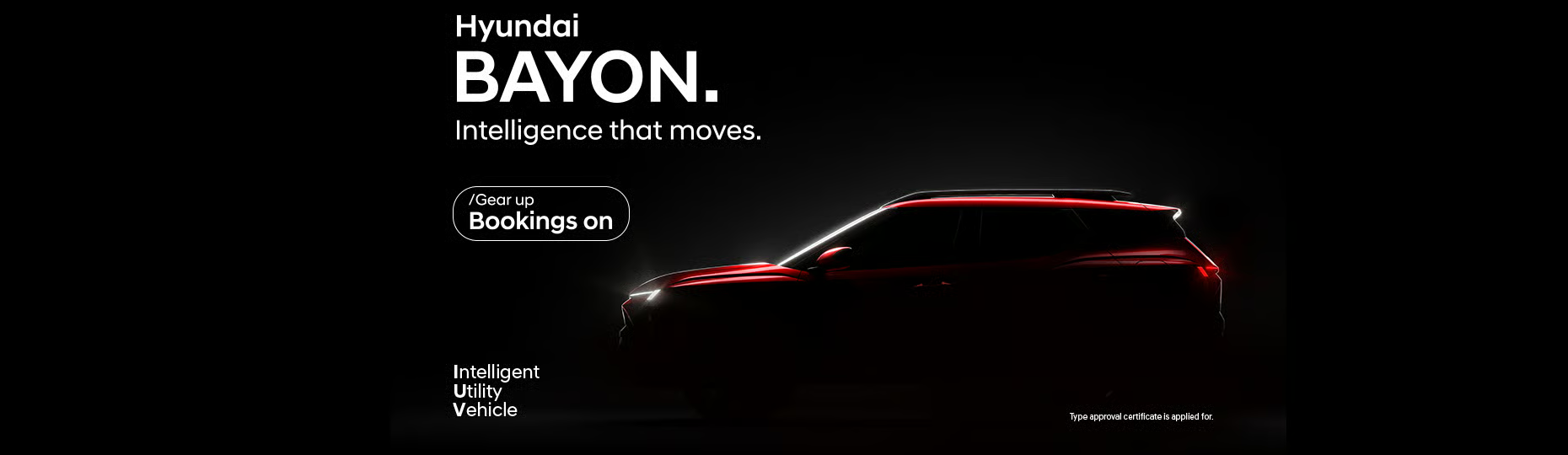
Hyundai Motor India has started the bookings for its upcoming Bayon mid-size SUV, with the first bookings open ahead of a festive season launch.
With an initial booking amount of just Rs 11,000, customers can secure the SUV online via the manufacturer’s website or at any authorised dealer showrooms. The Bayon is set to be built-in between the Venue and Creta in India’s Hyundai product range and be marketed as a technology- and safety-focused 4.2-metre SUV targeted at Indian buyers.
Launch timing & expected pricing
While Hyundai has not unveiled the official launch date yet, there are multiple reports pointing towards a launch in the October-November 2026 time period (coinciding with the festive season buying window around Diwali).
Industry estimates point towards an ex-showroom price range of roughly Rs 9-14 lakh, depending on variant, transmission and optional packs. This would see it directly take on:
Maruti Suzuki Victoris / Grand Vitara
Toyota Hyryder
Kia Seltos (lower variants)
Tata Curvv / Nexon (upper variants)
Platform & safety: engineered for 5-star Bharat NCAP
The talking point of the Bayon is obviously the architecture. The India-spec Bayon is set to be built on Hyundai’s Global K Enhanced Platform (a tweaked version of the new Global K platform developed for the Indian market).
Hyundai has been explicit in stating that this particular platform has been engineered for 5-star Indian safety ratings (Bharat NCAP) based on its internal assessment.
The key elements highlighted relate to:
Stronger body structure using high-strength steel
Improved crash energy management
Better mounting points for advanced driver-assistance systems (ADAS)
Improved pedestrian protection and side-impact safety.
If the Bayon is able to achieve a 5-star Bharat NCAP rating in the official testing, it would become one of the few sub-Rs 15 lakh SUVs offering top-level safety credentials.
Size & packaging: 4.2 metres but spacious inside
The Bayon is set to be just over 4.2 metres in length, and is set to cater to Indian buyers who want the following:
A mid-size SUV stance (but below the 4.4 metre threshold)
Easier manoeuvrability in the tight confines of city traffic
Lower tax implications compared to longer SUVs.
Hyundai has highlighted the intelligent space utilisation to ensure good legroom, headroom and shoulder room for all occupants inside a compact footprint. This would be crucial for families who want the practicality of an SUV but not the footprint of a hatchback-sized car.
Design: futuristic but familiar
As per the available teasers and sketches, the Bayon’s design language is set to draw from Hyundai’s latest global SUVs but with some tweaks:
Sculpted bonnet with strong character lines
Futuristic front fascia with signature H-Edge LED DRLs
Geometric wheel arches and wrap-around door cladding for a rugged feel
Bridge-type roof rails and 17-inch dual-tone alloys
Distictive tail-lamp graphics in line with the new design language for Hyundai.
The overall design is more premium than the Venue but less imposing than the Creta, allowing it to carve its own space.
Powertrain: petrol first, CNG possible
For the Indian market, Hyundai is expected to launch the Bayon initially with a petrol-only line-up with:
1.5-litre, four-cylinder naturally aspirated petrol (same as Creta/Verna)
Power: around 114 bhp
Torque: around 144 Nm
Transmission: 6-speed manual or CVT (IVT).
This will be a tried-and-tested powertrain which prioritises fuel efficiency and everyday driving over pure performance.
Multiple reports suggest the Bayon could become Hyundai’s first over-4-metre SUV to offer a factory-fitted CNG option, potentially relying on a 1.5-litre petrol base with iCNG technology, which would be a big differentiator in a segment where CNG SUVs are still scarce.
Read this- Updated Honda CB350 Line-Up Launched in India: Prices Start at Rs 1.95 Lakh
Features & tech: AI, sunroof, ADAS
Hyundai is set to position the Bayon as a technology-packed SUV, expected to offer features such as:
In-built generative AI voice assistant for more natural language commands
Dual integrated displays (digital instrument cluster + large touchscreen) inspired by the new i20/Creta layout
Wireless Apple CarPlay and Android Auto
Electric sunroof
Ventilated front seats and powered driver’s seat
Automatic climate control, multi-colour ambient lighting
Connected car features with over-the-air updates and remote functions.
On the safety and assistance front, the top variants are expected to offer features such as:
6 airbags, ESP, hill-hold, 360-degree camera
Level 2 ADAS suite (autonomous emergency braking, adaptive cruise control, lane-keeping assist, blind-spot monitoring, etc.)
If these features make it to India-spec model at affordable prices, the Bayon would see its rivals having to beef up their own offerings.
Who is the Bayon for?
The Bayon is clearly aimed at young families who want a spacious, safe and tech-rich SUV but below the 4.4 metre threshold, first-time SUV buyers who want to graduate from hatchbacks or compact SUVs, and customers who are interested in features such as connected car tech, generative AI voice assistant and ADAS safety features. If a CNG variant materialises, it would also see potential for adoption by fleet and ride-hailing operators due to the lower running costs.
Slotting itself in between the Venue and Creta, Hyundai is clearly targeting the burgeoning mid-SUV segment, which is seeing buyers looking for something a little more than a sub-4-metre SUV but not a full-size Creta or Seltos.
Booking details
Interested buyers can book the Bayon by:
Visiting the Hyundai official website (hyundai.co.in) and navigating to the online booking portal
Walking into any of the authorised Hyundai dealers and paying a booking amount of Rs 11,000.
Hyundai has not yet revealed the timelines for delivery, but given the festive season launch window, it is expected that the first units will roll out to customers by late October or November 2026.
The Hyundai Bayon is set to be one of the most awaited SUV launches of the 2026 festive season. With a new platform, focus on 5-star Bharat NCAP-level safety and a technology-rich feature set including a generative AI voice assistant, it is clearly targeting buyers who want more than just a badge and a high seating position.
If Hyundai is able to price it aggressively between Rs 9-14 lakh and deliver on its safety and feature promises, the Bayon could quickly establish itself as one of the top players in the 4.2-metre mid-SUV segment and pose a stiff challenge to the Victoris, Hyryder and lower-end Creta/Seltos variants.
watch this-













[…] Read this- Hyundai Bayon Bookings Open: 4.2m SUV on New Platform Aimed at 5-Star Bharat NCAP […]