


































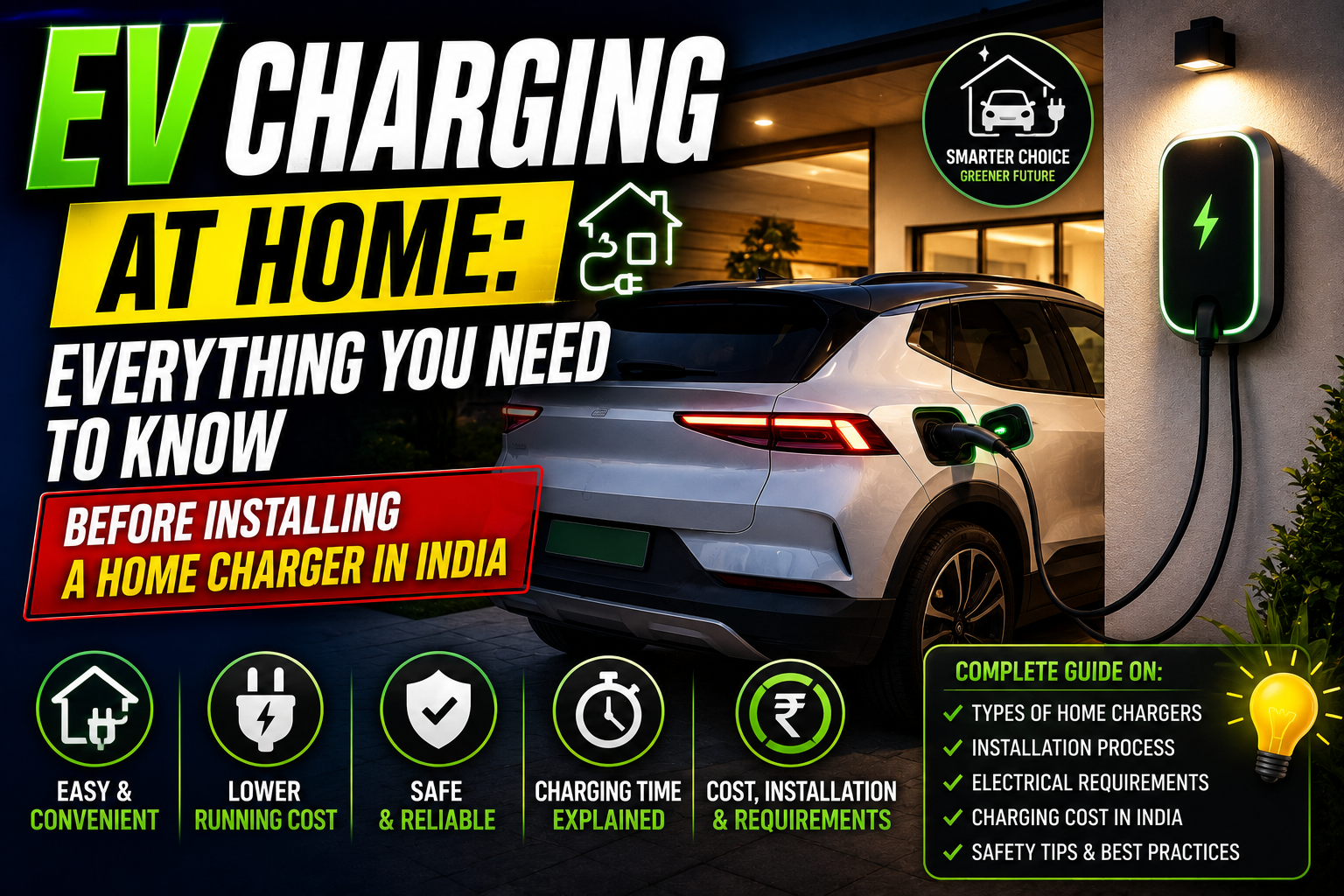
As electric vehicles (EVs) become increasingly popular in India, home charging has emerged as one of the biggest advantages of EV ownership. Unlike conventional petrol or diesel vehicles that require frequent trips to fuel stations, an electric vehicle can be charged conveniently overnight from the comfort of your home.
However, many first-time EV buyers still have questions. How much does it cost to install a home charger? How long does charging take? Is a special electrical connection required? And is home charging safe?
If you’re planning to buy an electric car or already own one, here’s everything you need to know about charging your EV at home.
Why Home Charging Is Important
Industry estimates suggest that nearly 80–90% of EV charging happens at home. For most owners, charging overnight is enough to meet daily driving needs, especially if the average commute is between 30 and 60 kilometres.
Instead of waiting at a public charging station, you simply plug in your vehicle after returning home and wake up to a fully charged battery the next morning.
This convenience is one of the biggest reasons many drivers are switching to electric mobility.
Types of Home EV Chargers
1. Portable Charger (Level 1)
Most electric cars sold in India come with a portable charger that plugs into a standard 15-amp household socket.
These chargers are ideal for:
- Daily commuting
- Apartment residents
- Occasional charging
Charging speed is relatively slow, and a full charge can take anywhere between 8 and 20 hours, depending on the battery size.
Although slower, this option works well for users who drive limited distances each day.
2. Wall-Mounted AC Charger (Level 2)
Many manufacturers also offer a dedicated wall-mounted AC charger with the vehicle.
This charger is permanently installed at your home and provides much faster charging than a regular socket.
Benefits include:
- Faster charging
- Better safety
- Smart charging features
- More efficient energy management
Depending on the charger’s capacity, most EVs can be fully charged in 5 to 8 hours.
Do You Need a Special Electrical Connection?
Not always.
If your home’s electrical wiring is modern and capable of handling the load, the existing connection may be sufficient.
However, before installation, the manufacturer usually conducts a site inspection to evaluate:
- Electrical wiring condition
- Earthing quality
- Available power load
- Parking location
- Distance between the electricity meter and parking space
If required, your electricity provider may recommend upgrading your home’s sanctioned load.
Installation Process
Installing a home EV charger is generally straightforward.
The process usually involves:
- Booking your EV.
- Scheduling a home inspection.
- Assessing electrical infrastructure.
- Installing the charger.
- Testing the charging system.
- Demonstrating safe charging practices.
Most manufacturers complete the installation before or shortly after the vehicle is delivered.
How Much Does Home Charging Cost?
One of the biggest benefits of EV ownership is the lower running cost.
The exact cost depends on:
- Your state’s electricity tariff
- Battery capacity
- Charging efficiency
For most households, charging an EV at home is significantly cheaper than refuelling a petrol or diesel vehicle over the same distance.
Charging during off-peak electricity hours, where applicable, can further reduce operating costs.
Safety Tips for Home Charging
Charging an electric vehicle is generally safe when the equipment is installed correctly.
Keep these tips in mind:
- Always use the charger supplied or approved by the manufacturer.
- Ensure proper earthing.
- Avoid extension cords.
- Keep the charging connector clean and dry.
- Inspect charging cables regularly.
- Do not overload household circuits.
- Protect the charger from excessive water exposure if installed outdoors.
Professional installation greatly reduces safety risks.
Can You Charge an EV in an Apartment?
Yes.
Many apartment complexes across India are now creating dedicated EV charging infrastructure.
If your society does not yet have charging facilities:
- Request permission from the Resident Welfare Association (RWA).
- Coordinate with the electricity provider if a separate meter is needed.
- Use only certified installation professionals.
Several state governments have also issued guidelines encouraging housing societies to support EV charging.
Smart Charging Features
Modern EV chargers are becoming increasingly intelligent.
Many support smartphone apps that allow owners to:
- Start or stop charging remotely
- Schedule charging times
- Monitor electricity consumption
- Track charging history
- Receive charging completion alerts
These features improve convenience while helping optimize electricity usage.
Common Home Charging Mistakes to Avoid
Many new EV owners unknowingly make mistakes that can affect charging efficiency.
Avoid these common errors:
- Frequently using damaged charging cables.
- Parking too far from the charging point.
- Ignoring software updates for smart chargers.
- Leaving cables exposed to extreme weather unnecessarily.
- Blocking ventilation around charging equipment.
Proper maintenance helps ensure reliable long-term performance.
Is Fast Charging Necessary at Home?
Not really.
DC fast chargers are primarily designed for highways, commercial charging stations, and long-distance travel.
For everyday use, AC home charging is healthier for the battery and more than adequate for most driving patterns.
Charging overnight at moderate speeds also helps reduce stress on the battery over time.
Benefits of Home Charging
Charging at home offers several advantages:
- Convenient overnight charging
- Lower running costs
- Reduced dependence on public charging stations
- Better battery management
- Time savings
- Improved long-term ownership experience
For most users, home charging becomes as routine as charging a smartphone.
Home charging is one of the strongest reasons to consider an electric vehicle in India. It transforms the ownership experience by allowing drivers to recharge their vehicles overnight, avoid fuel station visits, and benefit from significantly lower running costs.
Before purchasing an EV, ensure your parking space can accommodate a charger, your home’s electrical system is suitable, and the installation is carried out by certified professionals. While public charging infrastructure continues to expand, a reliable home charging setup remains the most practical and economical solution for everyday use.
As India accelerates toward electric mobility, investing in a proper home charging system is not just about convenience it is about making EV ownership simpler, safer, and more efficient for years to come.