
























Hyundai is not sitting still. The Korean carmaker has laid out an aggressive plan to push volumes in India, and it hinges on a flood of new products over the next few years. The company is targeting 8-10% growth in both domestic sales and exports for FY27, and it’s putting money behind that goal with a capital expenditure of ₹7,500 crore earmarked for the year.
Two Completely New Models in FY27
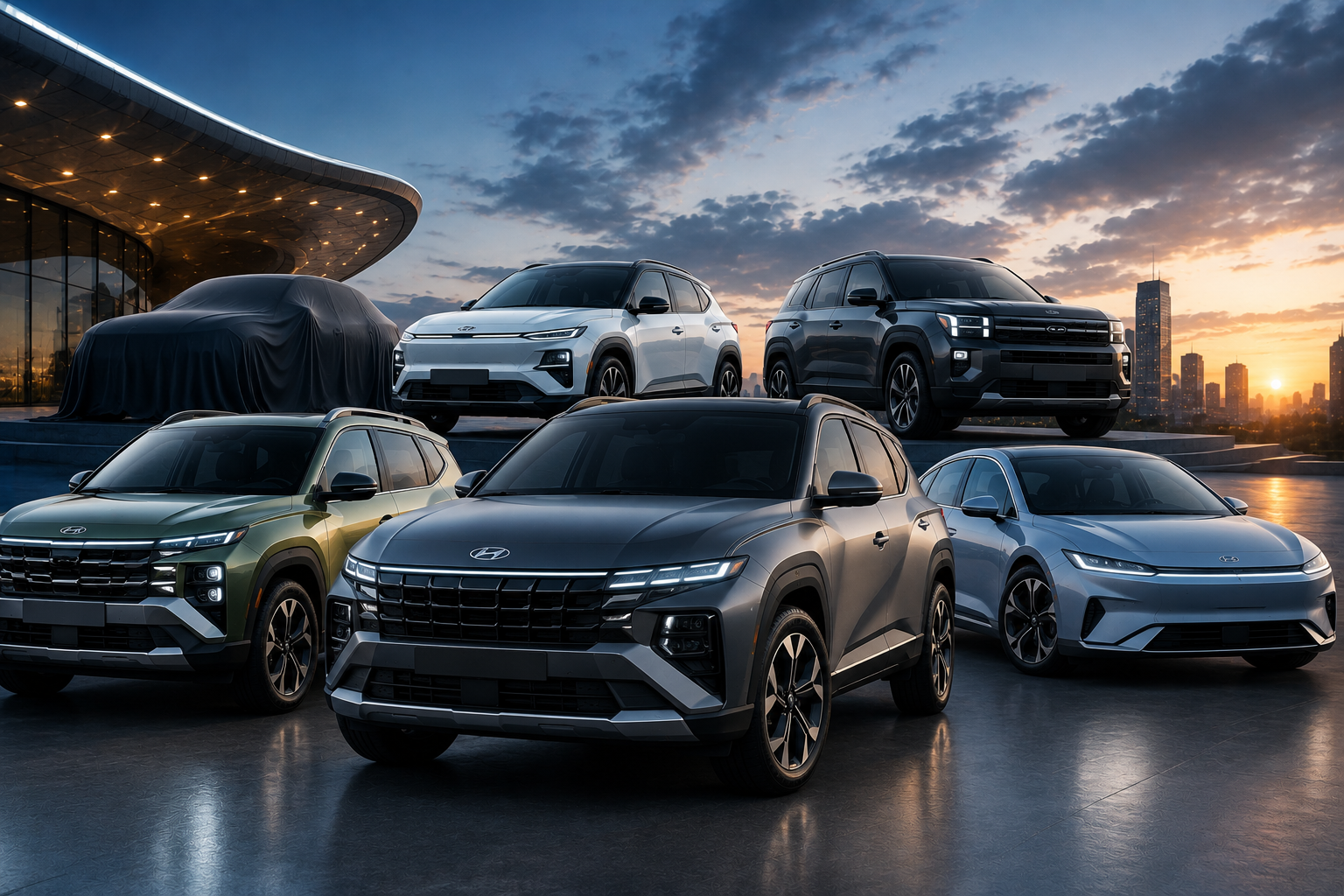
Hyundai’s MD and CEO, Tarun Garg, has confirmed the company will launch two all-new nameplates in FY27. One will be a mid-size ICE SUV think Creta-sized and the other will be a compact electric SUV built specifically for India.
The mid-size ICE SUV is expected to slot into the same segment as the Creta, but with a different design and positioning. This could be the Bayon-based model that’s been doing the rounds in spy shots. Pricing is likely to start around ₹10-11 lakh (ex-showroom), making it a more affordable alternative to the Creta.
The compact electric SUV, on the other hand, will be a India-specific product with heavy localisation to keep costs down. This model is expected to launch towards the end of FY27 and will sit below the Ioniq 5 in Hyundai’s EV lineup.
Read this- Kia Sales Analysis July 2026 – Seltos, Sonet, Carens, Syros, Carnival
26 New Models by 2030
Hyundai’s ambitions go well beyond FY27. The company has announced plans to introduce 26 new models in India by 2030. This includes a mix of SUVs, sedans, EVs, and hybrids across different price points.
The strategy is clear: Hyundai wants to be present in every major segment with multiple powertrain options. Whether a buyer wants petrol, diesel, CNG, hybrid, or electric, Hyundai aims to have an answer.
What’s Coming in 2026
While the big new launches are slated for FY27, Hyundai still has a few products lined up for the remainder of 2026.
-
Exter Facelift: Expected around March 2026, with minor styling updates and possibly some feature additions.
-
Tucson Facelift: Due around June 2026, with updated styling and tech.
-
Santa Fe: The new-generation Santa Fe could arrive around July 2026.
-
Bayon: The global sub-compact SUV is expected to launch in India around October 2026, priced from ₹10 lakh.
-
Ioniq 6: Hyundai’s electric sedan is due around November 2026, with pricing likely above ₹60 lakh.
-
Creta Facelift: A mid-life update for the Creta is expected around December 2026 or early 2027.
Hybrids Are Coming Too
Hyundai has confirmed it’s evaluating hybrid powertrains for India. The company is looking at a hybrid SUV similar in size to the Creta, with a potential launch as early as 2026.
This is a significant shift in strategy. Until now, Hyundai has focused heavily on EVs for India. But with hybrids gaining traction globally and buyers in India showing interest in electrified options without the range anxiety it makes sense for Hyundai to add hybrids to the mix.
EV Push Continues
Hyundai already has two electric cars on sale in India: the Creta Electric (starting at ₹18.02 lakh) and the Ioniq 5 (starting at ₹55.70 lakh). The Ioniq 5 recently got a major update, with a larger 84 kWh battery pack that delivers up to 690 km of range (ARAI certified).
The compact electric SUV due in FY27 will be the third EV in Hyundai’s India lineup, and it’s expected to be more affordable than the Creta Electric. This will help Hyundai compete in the fast-growing compact electric SUV segment, where rivals like Tata and Maruti are also planning products.
Manufacturing and Capacity
To support this product push, Hyundai is investing in its manufacturing facilities. Around 30% of the ₹7,500 crore capex for FY27 will go towards the Chennai and Pune plants, including Phase II expansion at Pune and upgrades at Chennai.
This will ensure Hyundai has the capacity to meet both domestic and export demand as it rolls out new models.
Hyundai’s plan is straightforward: more products, more choices, more growth. The company is betting big on new models both ICE and electric to drive volumes and regain market share.
The two new launches in FY27 will be the first big test. If they hit the mark, Hyundai’s path to 8-10% growth looks achievable. And with 26 new models promised by 2030, the Korean carmaker is clearly playing the long game.
Watch this-