




























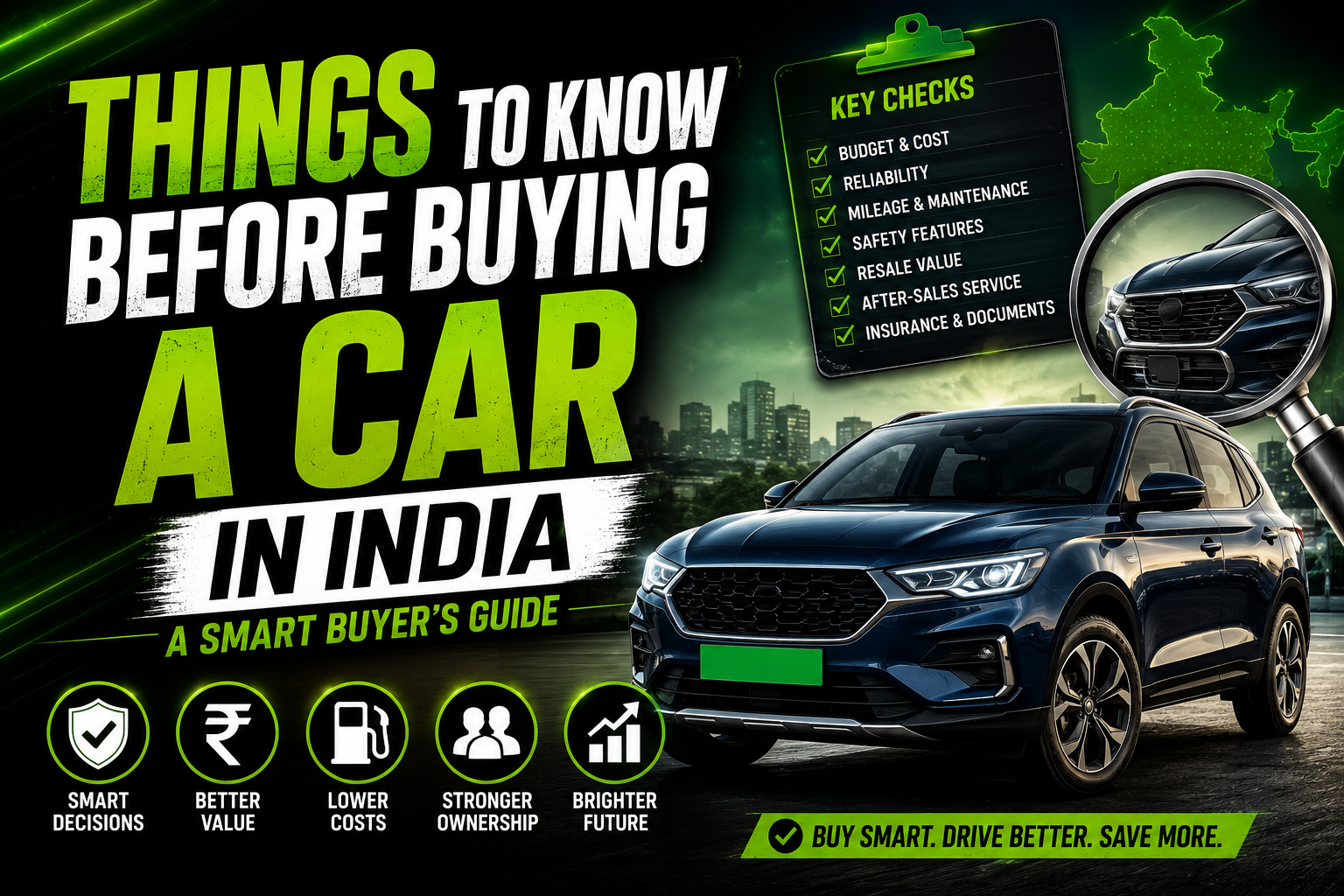
Buying a car is a big decision, and the right choice depends on much more than the showroom price. You need to think about budget, safety, running cost, usage, fuel type, service support and resale value before signing the booking form.
Start with budget
The first thing to understand is that the on-road price matters more than the ex-showroom price. On-road cost includes insurance, registration, taxes and accessories, so a car that looks affordable on paper can become much more expensive in real life.
It is also smart to think beyond the purchase price and calculate the total ownership cost. Fuel, servicing, tyres and depreciation all affect how much you will actually spend over the years.
Match the car to your use
A car should fit your daily life, not just your wishlist. If you mostly drive in the city, a hatchback or compact SUV may make more sense because it is easier to park and use in traffic.
If your family travels often or you regularly do highway runs, a sedan or SUV may be more comfortable and practical. The best car is the one that suits your routine, not the one that simply looks the most impressive.
Choose fuel wisely
Fuel type is one of the biggest ownership decisions. Petrol cars are usually better for lower running, diesel makes sense for high monthly usage, CNG is good for cost-conscious users with nearby filling stations, and EVs suit city buyers who can charge at home.
If your driving pattern is light, petrol is often the simplest option. If you drive a lot every month, you should compare fuel costs carefully before deciding, because the wrong fuel choice can become expensive over time.
Safety should come first
A car should not be chosen only on features and style. Safety equipment such as airbags, ABS with EBD, electronic stability control and child seat anchorages should be checked before you book the car.
Crash-test results are also worth looking at if they are available. A car with a strong safety package can protect you and your family far better than one with only flashy features.
Transmission matters
The gearbox can change your daily driving experience completely. Manual cars are usually cheaper and give more control, while automatic cars are more comfortable in traffic and easier for new drivers.
If you drive in heavy city traffic, an automatic is often worth the extra cost. If you want lower upfront price and do not mind shifting gears yourself, a manual can still be a good value choice.
Check maintenance and service
Before buying, find out how easy the car will be to maintain. A vehicle with a wide service network, reasonable spare-part prices and a good reliability record is usually easier and cheaper to own.
It is also wise to ask about service intervals and warranty coverage. Some cars may look attractive at purchase but become costly later if parts are expensive or the service network is limited.
Test drive properly
A proper test drive is more important than many buyers realise. Drive the car in conditions similar to your daily commute so you can check comfort, visibility, steering feel, braking and low-speed ease.
Do not rush this step. A car may look perfect on a brochure but feel too stiff, too cramped or too complicated once you actually drive it.
Think about resale value
Resale value is another factor that many first-time buyers ignore. Popular brands and models with strong demand usually hold value better when you decide to sell or exchange them later.
This matters because a car is not just a one-time purchase; it is an asset you will probably change after a few years. A strong resale value can save you a large amount in the long run.
Buy with patience
Do not get pushed into a fast decision by discounts or sales pressure. Compare multiple models, inspect the numbers carefully and ask about offers, insurance, exchange benefits and accessories before closing the deal.
The smartest buyers are not the ones who buy the fastest. They are the ones who understand their needs, compare all costs and choose a car that fits their budget, family and daily usage.
Buying a car is easier when you break the decision into simple parts: budget, usage, fuel, safety, transmission, service and resale. If you check these properly, you are far more likely to choose a car that feels right today and stays useful tomorrow.
The best car is not always the most expensive one. It is the one that matches your life, your wallet and your long-term ownership plans.