





























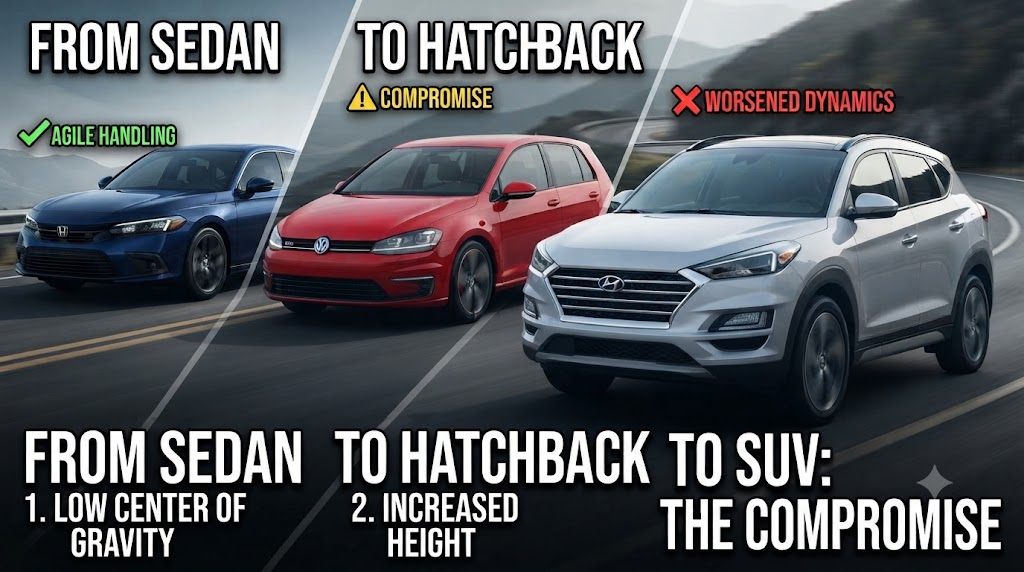
Go to any car showroom in India today, and the salesperson will tell you, “Sir, this is an SUV. It has higher ground clearance, provides a feeling of road presence and height.” He will fail to mention that, under the cladding and roof rails, you are driving a higher ride hatchback with considerable compromises to the driving dynamics.
The auto industry’s move away from sedans and hatchbacks to “crossovers” and “SUVs” has been a masterstroke from a marketing point of view, but a disaster from a driving dynamics point of view. Raising a low-slung car to make it “higher” involves various compromises.
Center of Gravity – What makes the car roll?
The most important factor that determines the behavior of a car is the Center of Gravity (CoG) or the point at which the mass of the car is concentrated. A low CoG is always better as it allows the car to roll less while taking turns. Sedans and Hatchbacks have a much lower CoG compared to their “SUV” counterparts.
When manufacturers create a crossover based on a hatchback platform (Tata Nexon – Kite platform, Hyundai Creta – i20/Aura platform) by raising the body by 50-80mm to claim it as an SUV, they are compromising on the CoG.
Why is this a problem? While taking a turn, the inertia of the car’s mass wants it to continue going straight instead of moving along the curvature of the turn. This causes the car to roll or lean. A higher CoG means that the leverage provided by the inertia is more, thereby rolling the car more.
As a result, while driving a crossover on the highway, the driver feels “tippy” as compared to a similar hatchback/sedan. It also reduces the adhesion of the tires to the road surface, resulting in reduced cornering grip. Most manufacturers compensate for the higher CoG by making the suspension “softer” than the donor model.
While this helps in smoothing the ride over the pot-holed Indian roads, it causes the car to body-roll more during hard braking and acceleration. This compromises the “response” of the car, especially during emergencies such as avoiding an obstacle by quickly steering into another lane. A crossover-based car takes longer to settle down its weight distribution after such inputs, as compared to a low-slung sedan/hatchback. Thus, the driver must wait longer before attacking the front wheels to apply maximum grip.
Weight – Aerodynamics, performance, and fuel economy
The weight of the car is another factor that is compromised while creating a crossover. Apart from the increased weight due to the larger wheels and increased ground clearance, the design features such as cladding, roof rails, etc., add to the weight. Compared to the donor model, a crossover weighs anywhere between half-to-a-tenth of a tonne more.
Performance: The additional weight impacts the performance of the engine. A 1.2L engine in a Baleno feels adequately powerful, but the same engine in the Fronx or Brezza feels comparatively weak. The increased aerodynamic drag and the higher weight also impact the fuel economy. At highway speeds, the engine has to work harder to overcome the air resistance, thus burning more fuel and also generating more noise in the cabin. So, in effect, you have to pay more to drive an SUV than a sedan/hatchback of similar engine size.
Steering – “Heavier” or “Softer”?
In order to compensate for higher weight and rolling tendency, manufacturers modify the steering geometry and weight.
To make the steering “lighter” for convenience while parking, manufacturers make the steering heavier at higher speeds. While this is beneficial in most cases, it impacts the amount of information sent to the driver via the steering wheel. In sporty cars, the driver can “feel” the front tires gripping the road surface while driving on a curve. Heavier steering in crossovers damps out this information, impacting the driver’s ability to drive aggressively. As a result, most drivers tend to slow down while taking turns in a crossover as compared to a sporty hatchback.
Safety and “off-road” capability
The manufacturers claim that an SUV has more safety and off-road capability as compared to a hatchback/sedan. Most crossovers sold in India are Front-wheel drive variants with no capability to tackle rough terrain due to the lack of low-range gearing. The few “off-road” capabilities these crossovers have are limited to navigating through a muddy field or a rocky driveway.
While a higher seating position does offer a sense of security, the CoG of a crossover is much higher than a sedan, making it more prone to rollover in an extreme emergency (swerve to avoid an accident). Modern-day stability programs such as ESP help in countering this problem, but they can only do so much.
The visibility offered by an SUV is much better than a hatchback or a sedan. However, the increased use of pillars to give the car a “boxy” look impacts the visibility offered by the car. Urban driving requires good vision out of all sides of the car, something that a crossover cannot offer due to thick pillars.
Is buying a crossover bad? What you should know about these “hyped up” cars
I am not saying that a crossover is a bad car to buy. Crossovers have benefits over sedans and hatchbacks. With higher ground clearance, they allow easier entry/exit for elderly people, better vision on the road, and a more flexible boot than a sedan.
As an Indian, I understand the need for an SUV in our country due to bad road conditions.
However, I also believe that car enthusiasts who wish to enjoy driving on dual-carriageways and highways should steer clear of crossovers as they are “stylish” cars that compromise on driving dynamics. If you think that you need the ground clearance of an SUV, then consider buying one. If you think you want the “style” of an SUV, consider buying the hatchback variant of the same car. It will accelerate faster, have better roadholding properties, and be more comfortable on the highway.
When it comes to driving dynamics, an SUV is always a compromised experience. The “style” and height of an SUV come at the cost of a poorer driving experience on the road. Any car enthusiast would know that the best cars to enjoy driving are usually hatchbacks or sporty sedans. So, the next time you are at a car dealership, ask yourself, “do I need an SUV or do I just want an SUV?” If it is the former, then go ahead. If it is the latter, you know what to do.
Watch this-