

























Ultraviolette Automotive is set to make 2027 a very interesting year for electric motorcycling.
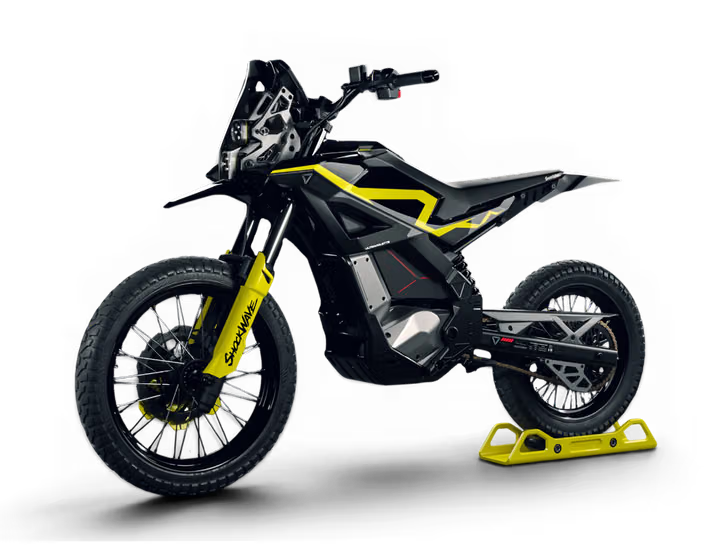
The Bengaluru-based EV maker has confirmed that its upcoming Shockwave electric motorcycle will be launched in the first quarter of 2027 with a new 100V electrical architecture. This new lightweight trail-inspired “funduro” motorcycle promises to offer a blend of instant electric torque, enduro hardware and everyday usability which could carve out a unique niche within India’s growing performance EV scene.
What’s more important, the Shockwave isn’t just getting a revised battery and some cosmetic upgrades. Ultraviolette says that the motorcycle has been re-engineered to the new 100V platform, that will also form the foundation of the upcoming Tesseract electric scooter. The new platform will bring improvements in power delivery, thermal efficiency and charging performance.
A new launch date, a new platform
The Shockwave was originally expected to arrive before this, but Ultraviolette has pushed the customer launch timeline to January-March 2027. The delay appears to be due to the decision to adopt the new 100V platform, rather than launch the motorcycle with the earlier configuration. Production preparations are already underway at Ultraviolette’s existing facility.
What this means for buyers is that rather than rushing the product to market, the company is using this extra development time to make the Shockwave more capable and future-ready.
A higher-voltage system will reduce the current required to produce the same amount of power. Put simply, this can reduce heat from the wires and components, helping improve thermal control. It can also allow faster charging speeds when the battery, motor controller and charging infrastructure are designed to allow. Ultraviolette has not yet disclosed final charging times or updated output figures, but has stated that the new setup will allow stronger power delivery, better thermal performance and faster charging.
What is the Shockwave?
Unlike the company’s F77, which is a fully faired electric performance motorcycle, the Shockwave is tailored for those that want something lighter, more playful and versatile. Ultraviolette has described the motorcycle as a “funduro”, blending fun and enduro elements with road-going usability.
It features a slim body, high front mudguard, upright ergonomics and wire-spoke wheels with dual-purpose tyres. It is not a full hardcore motocross machine, but is designed to tackle bad roads, broken trails, gravel paths and urban commutes in a confident manner compared to a conventional naked bike.
The Shockwave will be available in both single-seat and dual-seat configurations. The single-seat version will appeal to those seeking a focused, dirt-bike-inspired experience, while the dual-seat version will make the motorcycle more practical for customers that need to carry a pillion from time to time.
Expected performance: lightweight electric fun
Earlier announced specifications give a good idea of what the Shockwave is intended to deliver, although Ultraviolette may tweak these figures for the 100V production version.
SpecificationPreviously announced figure
Motor power14.5 bhp / 10.8 kW
Peak wheel torque505 Nm
Battery capacity4 kWh
Claimed IDC range165 km
0–60 km/h2.9 seconds
Top speed120 km/h
Kerb weightAbout 120-125 kg
The claimed 505 Nm torque figure is from the rear wheel, which explains the huge number. What matters in reality is the punch from zero rpm. With a claimed 0-60 km/h time of 2.9 seconds, the Shockwave should feel exceptionally quick in city traffic and on loose surfaces.
The lightweight construction is equally important. At about 120-125 kg, the Shockwave is significantly lighter than many petrol motorcycles in the 250cc-400cc class. A low weight, combined with instant torque, could make it feel more energetic and more manageable on trails than its specification sheet suggests.
However, buyers should treat the 165 km IDC range as a certified test-cycle number. Real-world range will vary considerably with the riding mode, terrain, the rider’s weight, speed and aggressive acceleration. A motorcycle that is used primarily for trail riding and hard launches will obviously deplete its battery much faster than one ridden gently in city traffic.
Built for broken roads and trails
The Shockwave’s chassis and suspension hardware are what define its identity. It uses a steel frame, telescopic front forks and a rear monoshock. The front suspension is listed as a 37 mm cartridge-type fork with 200 mm travel, while the rear gets 180 mm travel.
It rides on a 21-inch front wheel and 17-inch rear wheel, both wire-spoked and fitted with dual-purpose tyres. This makes up the classic enduro wheel combination. The large front wheel can easily roll over potholes, stones and ruts, while the 17-inch rear will provide the motorcycle with usable traction and agility.
The Shockwave also gets 182 mm of ground clearance, making it more capable than most road-focused electric motorcycles when the surface gets rough.
Electronics and safety package
Ultraviolette is not going to treat the Shockwave as a stripped-down, basic EV. The motorcycle will have a comprehensive electronic package:
Switchable dual-channel ABS
Four traction-control modes
Six levels of regenerative braking
Full LED lighting
Multiple riding modes and connected technology, expected to be confirmed closer to launch.
The adjustable regenerative braking will be particularly useful. On descents or in city traffic, stronger regen can reduce the speed of the bike when the rider rolls off the throttle while recovering some energy back into the battery. On loose trails, however, riders will want a lower regeneration setting for better control.
Price, rivals and market potential
The Shockwave was previously announced at an introductory price of around ₹1.75 lakh (ex-showroom), although Ultraviolette has not confirmed if this will change with the switch to the 100V architecture. Final pricing, battery capacity, charging time and performance figures will be announced closer to the Q1 2027 launch.
At this price level, the Shockwave will not have a like-for-like petrol rival. It will sit in between a lightweight trail bike, performance commuter and an electric fun machine. Potential alternatives could include petrol dual-sport motorcycles such as the Hero Xpulse range. Performance-focused EV buyers may also consider the company’s own F77 or future electric motorcycles from established brands.
The Ultraviolette Shockwave could be one of India’s most distinctive electric two-wheelers when it arrives in Q1 2027. Its new 100V architecture, lightweight enduro-inspired design, claimed 165 km range, 120 km/h top speed and long-travel suspension and option of single- or dual-seat layouts gives it a personality that goes beyond everyday commuting.
If Ultraviolette can preserve the original price point while offering faster charging and stronger real-world performance, the Shockwave may prove that electric motorcycles do not have to be silent scooters with a clutchless twist-and-go experience. They can be raw, playful, capable and genuinely fun.
Watch this-