



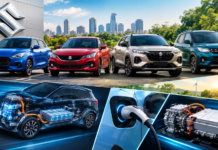









Suzuki Motor Corporation has officially announced its plan to localize hybrid powertrains in India.
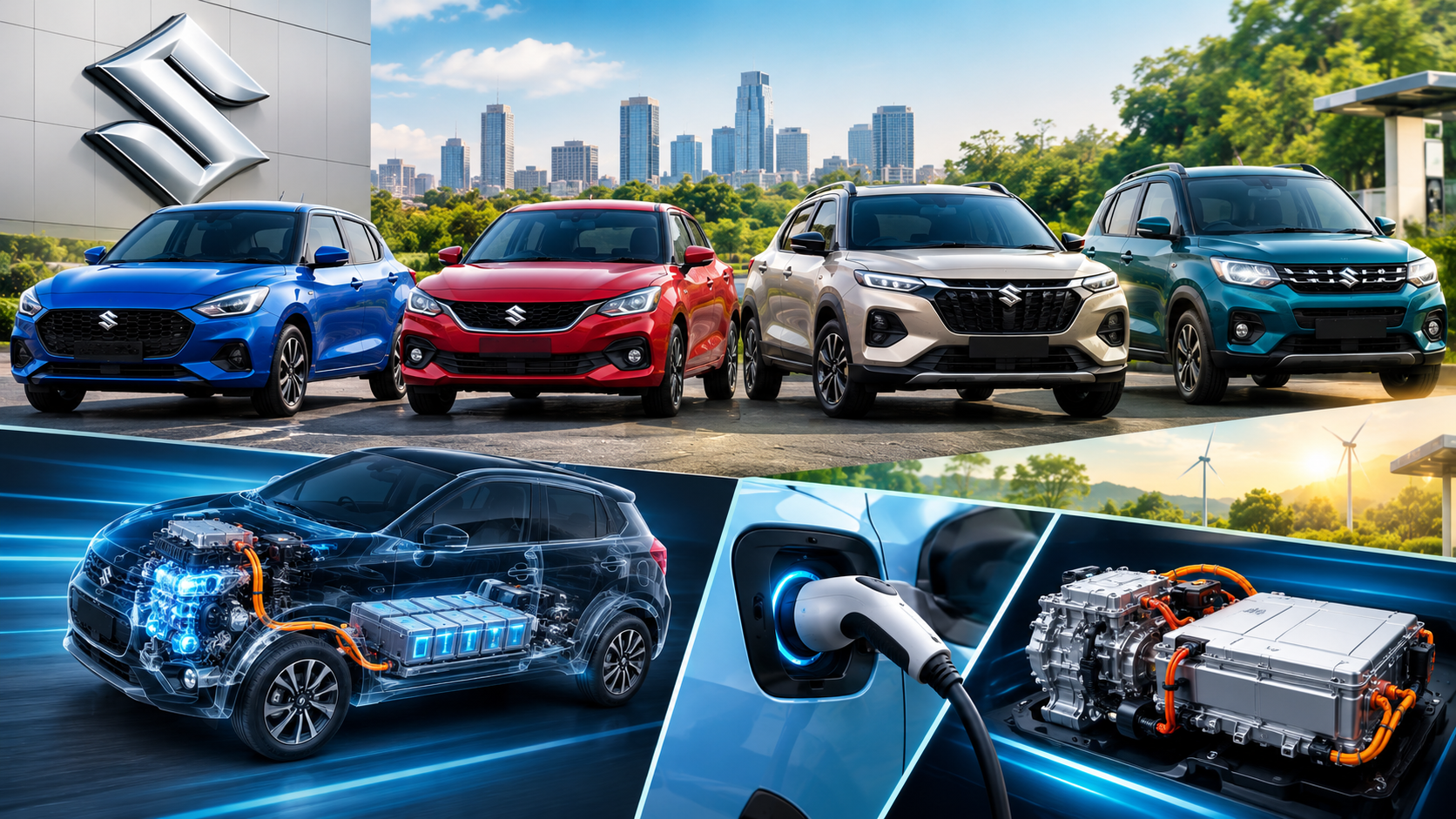
Interestingly, the Japanese automaker has decided to move away from the mild-hybrid setup currently on offer in the Maruti Suzuki cars in India. During a technical briefing in India, Suzuki announced its plans to develop two powertrain technologies for its compact cars – a series-strong hybrid and an improved plug-in range extended version of the “REEV Light” – for its compact cars, as part of its commitment to a “multi-pathway” approach to carbon neutrality in markets where battery electric cars are not immediately feasible.
Series Hybrid First
The series hybrid powertrain is set to be the base for the other technologies. Unlike the parallel hybrid setup offered in the Grand Vitara’s Strong Hybrid, the series hybrid generator produces electricity that runs the car’s electric motor. While the ICE remains on, it can either charge the battery or directly power the electric motor.
The 1.2-litre three-cylinder Z12E petrol engine has been developed to act as the generator, with the expected efficiency gains from operating on a narrow RPM band. The benefits of a series hybrid drivetrain on a compact car like the Baleno or Fronx would be:
Better driving dynamics from the elimination of gear shifts and a direct power delivery from the electric motor.
Improved fuel economy, especially in stop-start city traffic where the ICE can run at optimum RPM to charge the battery.
A more flexible layout due to the elimination of a conventional transmission that connects the ICE to the drivetrain.
REEV Light: The Plug-In Extended Range Hybrid
Suzuki has also announced that it will further develop the “REEV Light” extended-range electric vehicle powertrain. The extended-range version of the series hybrid drivetrain will likely make use of the same petrol engine, generator, and electric motor. The extended-range version will add a bigger battery pack that can be charged on the grid. The REEV Light is set to provide the range assurance that PHEVs like the Toyota Camry and Honda CR-V offer but with far lower costs due to the absence of the large battery needed for longer all-electric ranges.
The “Light” in REEV Light is presumably a reference to the smaller battery capacity on offer. Currently, most PHEVs on sale or announced to enter Indian markets have ranges of around 100 km on electricity. The REEV Light’s battery capacity is likely to be just enough for daily commuting needs. For longer journeys, the petrol engine will be used to supplement the battery, thus eliminating range anxiety.
Toshihiro Suzuki, President of Suzuki Motor Corporation, said, “It will become a ‘REEV Light’ that does not carry an oversized battery yet lets you drive without worrying about the remaining charge.” This is an important feature that directly targets at the high cost of battery electric vehicles currently on sale or in development in India.
Environmental Impact And Fuel Economy Of The New Powertrains
Suzuki estimates that this compact car series hybrid powertrain can reduce CO2 emissions by an impressive 29 percent compared to the 2022 benchmarks. That’s a reduction of almost 300 kg of emissions over 10,000 km driven. While no fuel economy figures for the REEV Light have been announced, it is safe to expect that similar improvements in mileage can be expected. With the electric motor doing most of the work, the fuel economy figures are likely to be in the region of 35-40 kmpl or more, eclipsing even the most efficient petrol cars on the market today.
Read this- Bentley’s First EV Is Here: Torcal Electric SUV Packs 888 PS and 600 km Range
Which Cars In India Are Likely To Get This Technology?
While Suzuki has not officially announced which cars the hybrid powertrain will be fitted in, it is safe to assume that the Baleno and the Fronx are in the running. Baleno is in the highly competitive B-segment hatchback segment while the Fronx is in the B+-SUV segment. The hybrid powertrain would allow Maruti Suzuki to directly fight the competition, including the Hyundai Grand i10 Nios and Tata Altroz, while also appealing to customers who want something bigger than the Wagon R or the S-Presso but do not want to spend as much as on a petrol engine.
The fuel economy and reduced emissions from the hybrid powertrain would also improve Maruti’s image in a market that is rapidly moving towards alternative fuel vehicles. This technology and its associated benefits could also trickle down to smaller cars like the Wagon R or the S-Presso in a much-simplified form.
Why This Announcement Matters To Maruti And Its Customers
Suzuki’s decision to localize these hybrid powertrains in India fits in with its recently announced “Technology Strategy 2026 for 10 Years Ahead,” that sees India as the focal point of its global business. Suzuki aims to ramp up its production capacity in India to 4 million vehicles per year by FY30. As such, Suzuki sees a need to offer a wide variety of powertrains, including CNG, Mild Hybrid, Strong Hybrid, REEV, and BEV.
The REEV Light powertrain announced by Suzuki is a recognition that India’s EV charging infrastructure is not ready for prime-time yet. The REEV Light offers an alternative to conventional petrol cars that do not require frequent visits to fuel stations, have low emissions, and offer the benefits of an electric motor without committing to a fully battery-electric vehicle. This makes it extremely attractive to Indian customers who see owning an EV as a convenience rather than an end goal.
Maruti Suzuki’s announcement of its plans to offer Strong Hybrid powertrains in India marks a new era of competition in the Indian automobile market. With its announcement, Maruti Suzuki has moved beyond simply being a mild-hybrid seller and is now directly in the sights of Toyota and Tata Motors. The Indian customer stands to benefit massively from this competition as they will soon have the option to buy cars that offer the comforts of a petrol car without the emissions or the inconveniences of visiting a fuel station.
Watch this-