



























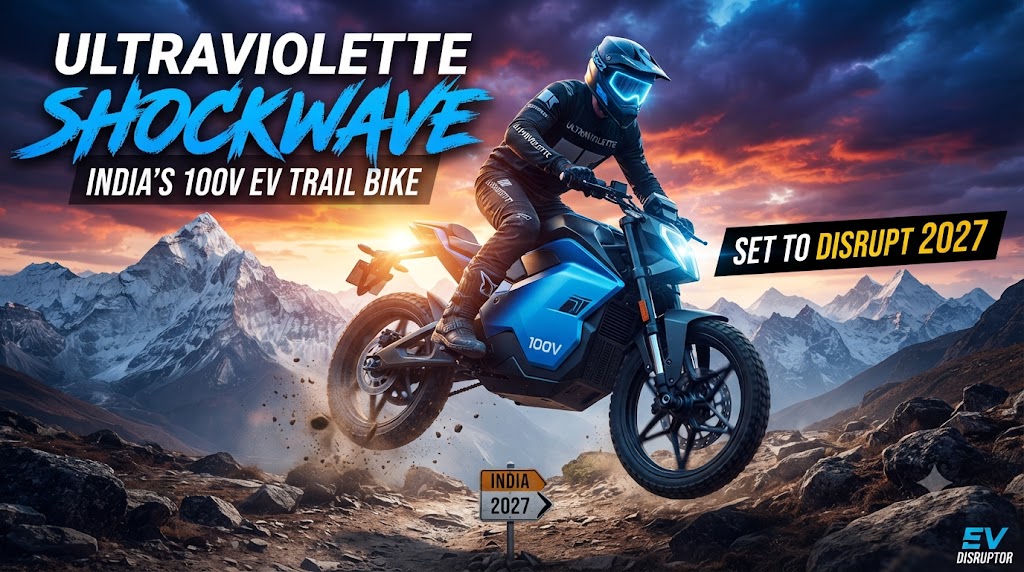
Indian two-wheeler market has a clear dichotomy: utility-focused scooters with limited range or track-focused performance motorcycles with no range.
There’s a gaping hole in between, a niche for an all-round fun machine, with both utility and range, with no compromise on emissions – enter the trail bike.
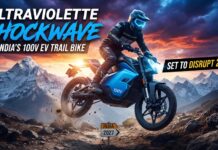
The Bengaluru-based EV startup Ultraviolette is set to enter this niche with their upcoming Shockwave, to be launched in Q1 of 2027, and the 100V voltage architecture on the 2027 model will prove to be the differentiator.
While the company has revealed a few details about the design philosophy, it’s the technical bits, the 100V architecture, and the pricing that will matter.
100V Architecture: Efficiency and Range
The main technical upgrade for the 2027 model is the 100V architecture. 100V will bring in increased efficiency and quicker charging, two aspects which have been a pain point for EV customers in India.
Efficiency and Range
While not providing exact figures, the company has stated that the official Indian Driving Cycle (IDC) range would be about 165 km, and the 100V architecture would ensure that the range doesn’t drop significantly under continuous hard use.
Higher voltage allows more power to be transferred to the wheels without increasing the current flow, thus reducing the losses associated with current flow (I2R losses).
In simple engineering terms, higher voltage makes electric propulsion systems more efficient, and efficient systems mean that your battery can last longer, which is a good thing for range.
Thermal Management
As the 2027 model pushes harder on the power delivery, it’ll also generate more heat, and heat management is vital to prevent power derating (reduced power to protect the motor).
A 100V system has better thermal management characteristics, which would allow the Shockwave to sustain peak power output for longer.
Faster Charging
This is probably the most exciting part for current EV buyers. Faster charging capabilities are a huge pain point for customers, and while the company hasn’t revealed specifics on the charging capabilities of the 100V architecture, it’s safe to assume that the new architecture would support faster charging speeds.
A 100V system is capable of supporting higher charging currents without overloading the circuit, which means that the Shockwave could charge to 80% in under two hours on a 3.3 kW charger, and possibly even faster on a DC fast charger, if the infrastructure allows. This makes the Shockwave extremely practical for day-to-day commuting as well as for off-road adventures.
It must also be noted that the 100V architecture will also power the upcoming Tesseract electric scooter.
Funduro Design: Fun and Enduro
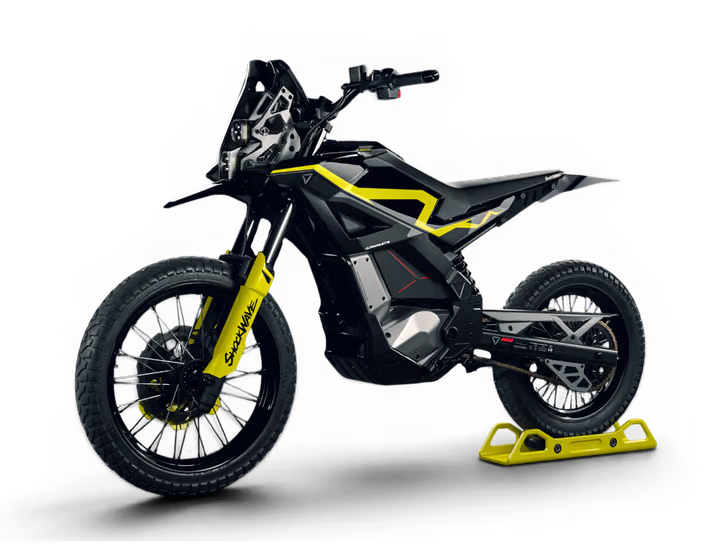
The company has described the design of the Shockwave as a ‘funduro’, a portmanteau of fun and enduro.
Visuals
The motorcycle is set to cut a sharp figure on the roads with its slim fuel tank (that houses the battery), high-mounted front mudguard, and a compact tail section. The LED lights have a unique daytime running light signature, and the overall design language looks mechanical, without relying on plastics as sport bikes typically do.
Ergonomics
Ultraviolette is offering the motorcycle in both single-seat and dual-seat variants.
The single-seat version targets the hardcore trail enthusiasts, who want an ultra-lightweight and nimble machine that can tackle anything from street filtering to serious off-road terrain.
The dual-seat version, on the other hand, is aimed at the utility-focused buyers, which want to carry a pillion occasionally, or have a bigger seat for longer rides. It makes the Shockwave a viable option as a primary vehicle for a couple or a student.
The riding position is upright and commanding, with wide handlebars and the footpegs placed slightly further back, creating a triangle for the rider while standing on the pegs on rough terrain.
Performance: Lightweight and Torquey
Thanks to the instantaneous torque delivery, the powertrain in the Shockwave has been spec’d to deliver thrilling acceleration.
Power figures (expected) Torque figures (expected) 0-60 km/h Top speed Kerb Weight
~14.5 bhp (10.8 kW) 505 Nm (rear wheel torque) 2.9 sec 120 km/h ~120-125 kg
The figure of 505 Nm seems extremely high, and that’s because the torque is measured at the rear wheel. In reality, the motor torque will be closer to 300 Nm, and the 505 Nm is achieved via a 1.7 reduction in gearing.
However, this means that the Shockwave is likely to accelerate faster than any 250cc+ petrol motorcycle on the Indian roads. The 0-60 km/h figure of 2.9 seconds is also incredibly quick for a motorcycle in this segment. The kerb weight is also impressive, as it’s about the same as most 250cc – 400cc petrol motorcycles, and combined with the torque figures, it’ll put the power-to-weight ratio of the Shockwave right up there with the big bikes.
Chassis: For the Broken Roads
While the Shockwave is an electric motorcycle, it’s more focused on conquering the broken roads rather than being a premium city bike.
Read this- Ultraviolette Shockwave: India’s 100V Electric Trail Bike Is Coming to Shake Up 2027
Suspension
The front suspension comprises 37mm, cartridge-type telescopic forks with 200mm travel, and a preload-adjustable monoshock with 180mm travel at the rear.
The adjustability at the rear will allow the rider to customize the damping, depending on whether there’s a pillion rider or not.
Wheels and Tyres
The wheels are a classic enduro setup, with a 21″ front wheel and a 17″ rear wheel. The wheels are wire-spoked and are extremely flexible, allowing the rider to tackle the toughest terrain with ease. The tyres are dual-purpose, and the setup has been engineered to balance the on-road and off-road performance.
Ground Clearance
The Shockwave has an impressive 182mm ground clearance, which makes it extremely capable of tackling the Indian roads. It would easily clear most of the speed breakers, potholes, and uneven tarred/asphalt roads that we encounter in our daily commute.
Electronics: Smart and Safe
Ultraviolette has equipped the motorcycle with a bunch of rider-assistance technologies, including switchable ABS, four-level traction control, and six-level regenerative braking.
ABS
Switchable dual-channel ABS is available on the Shockwave, where the rider can turn off the rear ABS for off-road sliding or retain it for maximum safety on the road.
Traction Control
The four-level traction control will help prevent wheelspin on slippery patches like gravel, mud, and wet grass, making the Shockwave extremely safe and easy to ride for the everyday Indian rider.
Regenerative Braking
The six-level regenerative braking allows the rider to customize the regen, depending on the requirement. Higher levels of regen will help recover more energy and reduce brake wear, while lower levels of regen will provide a more natural feel.
Other Features
There are a bunch of other rider-centric tech features that we can expect on the Shockwave including connectivity to a rider-centric app, which will allow the rider to monitor the vehicle’s vitals, get navigation assistance, and receive OTA (over-the-air) updates to enhance performance.
Pricing and Competitors
While the company hasn’t officially announced the pricing for the 100V version of the Shockwave, the initial announcement mentioned a starting price of ₹1.75 lakh (ex-showroom).
Given the increased spec, it’s safe to assume that the 2027 model would start at around ₹1.90 – ₹2.00 lakh, which still seems extremely reasonable.
Competitors
Petrol: Hero Xpulse 200 4V, Yamaha FZ-X, Honda CB200X
Electric: Ather 450X, Ola S1 Pro, Ultraviolette F77
The Bottom Line: A New Category Creator
The Shockwave is set to disrupt the Indian two-wheeler market, and not just because of the aforementioned upgrades. It targets a very interesting niche – the one for an all-round fun two-wheeler that doesn’t compromise on utility or emissions. The 100V architecture, on the other hand, addresses the pain points of current EV buyers and sets the stage for a new era of electric motorcycles in India.
With its funduro design, the Shockwave offers versatility, and the aggressive pricing makes it a viable option for a first-time two-wheeler buyer. The market is eagerly awaiting more details about the bike, and it’ll be interesting to see what else the company has in store for 2027.
Watch this-