


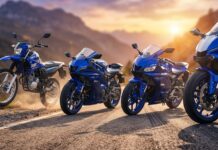
















For long Yamaha India enjoyed the luxury of being the biggest name in the affordable performance two-wheeler space in the country.
From the legendary R15 which captured the hearts of every Indian youngster, to the MT-15 that brought the naked streetfighter philosophy to common masses, Yamaha ruled the roost when it comes to small capacity sportscycles and streetbikes. However, beyond ₹3 lakh, there wasn’t a single motorcycle Yamaha had created that could stand up against Kawasaki (Ninja 300/400), KTM (390 Duke/RC) and BMW (G310 Series). The German and European manufacturers were waging a pitched battle for supremacy in the 250cc-400cc premium segment, while Yamaha India seemed to have given up on the segment.
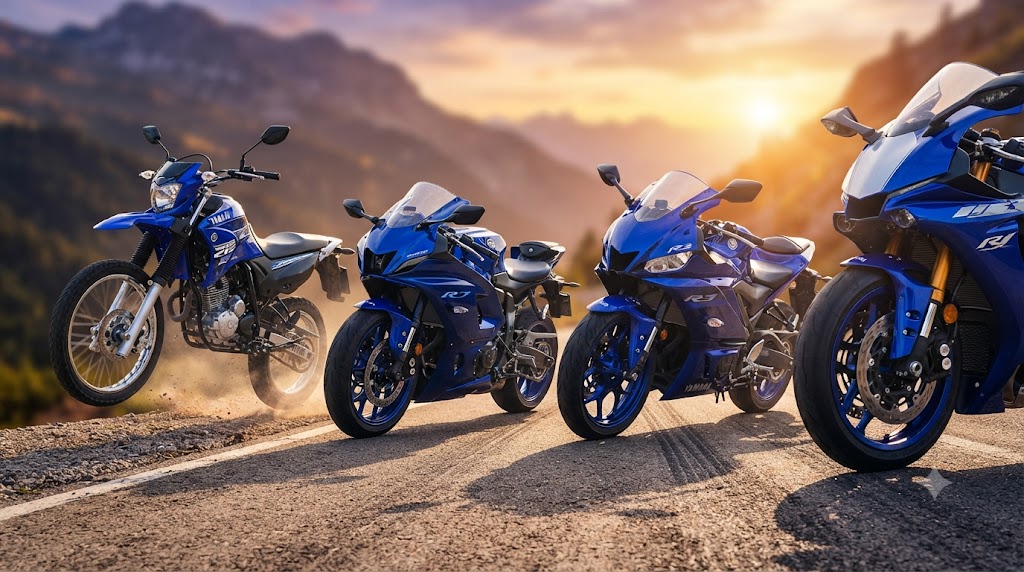
As per recent reports and as stated by Yamaha Motor India’s official representatives, the company is looking to re-enter the fray of big bikes and muscle in on the performance motorcycle space. Besides the already-expected-but-not-officially-confirmed R3, there also are talks of a middleweight R7, a street-oriented MT-03 and the adventure-tourer Lander 250 and Tenere 700. Let’s take a closer look at each of them and their prospective impact on the Indian market.
The Gateway Drug: Yamaha Lander 250
The first and most promising bike in the list of Yamaha’s new bikes is a 250cc adventure-tourer called Yamaha Lander 250. As per the reports, this motorcycle will be a part of the new set of models unveiled at the Bharat Mobility Expo 2025, and is not a faired sports motorcycle. This motorcycle will likely fit right in between the Hero Xpulse 200 4V and the upcoming Royal Enfield Himalayan 250.
Specs and Price Expected:
Engine: 249cc, Air-cooled, Single-cylinder, SOHC, 2-Valve
Power: ~20.9 PS @ 8000 rpm
Torque: ~20.5 Nm @ 6000 rpm
Transmission: 5-Speed gearbox
Suspension: 41mm, Long-travel telescopic forks (220mm) and Preload-adjustable Monoshock (204mm)
Wheels: 21” Front and 18” Rear spoked wheels with Dual-purpose tyres
Seat Height: Tall 880 mm
Expected Price: ₹1.80 Lakh – ₹2.20 Lakh (Ex-showroom)
Expected Launch: Late 2026 or Early 2027
Air-cooled, simple yet powerful engine would make this Lander 250 quite the rival to the mentioned adventure-bikes from Royal Enfield and Bajaj. It can also be expected to find a good chunk of buyers which would be interested in going on adventures, but don’t have the budget or the requirement to buy a high-priced dirt bike.
The Sports Bike Return: Yamaha R3 and MT-03
As mentioned earlier, the most-awaited addition to Yamaha’s line-up for India is the return of the Yamaha R3. The previous iteration of the motorcycle was a huge hit before being dropped due to BS6 emission norms. The new motorcycle will likely be based on the R3 which was recently launched globally and got a complete redesign and engine update.
Expected Specifications of the R3:
Engine: 321cc (Approx), LC4 Parallel-twin, liquid-cooled engine
Power: ~42 PS (Much higher than the 250cc segment)
Design: Angular design language borrowed from Yamaha’s R1 and R7 and a Twin-Led projector headlight
Technology: Expected to get a TFT display, slipper clutch and a quick shifter
Price: Expected to be anywhere between ₹4.5 Lakh and ₹5.0 Lakh in case of an official launch
With the new R3, in conjunction with its naked-streetfighter sibling, the MT-03, Yamaha shall finally have a fighting chance to compete against the might of KTM and the rising star that is Ninja 300/400. The MT-03 will most probably use a similar engine and specification as the R3, but with improved ergonomics to suit the comfort of street riding.
The Middleweight Dream: Yamaha R7
For those who found the R3 a bit too small but still wanted something more than the R1 or MT-07, the holy grail of middleweight motorcycles, the Yamaha R7 shall bring a smile to their faces. This bike is likely to be based on the Yamaha MT-07 (sold in India), but with a slightly longer wheelbase and larger fuel tank. The engine to expect in the R7 is the 689cc CP2 (Crossplane 2) parallel-twin engine. This engine is quite famous for mimicking the sound and feel of a V-twin engine, and is also used in the MT-07 and the MT-10.
Why The R7 Matters:
Engine: 689cc CP2 (Parallel-Twin)
Power: ~73.4 PS
Torque: ~ 67 Nm
Positioning: This motorcycle will perfectly fill the gap between the 300cc-400cc segment and the big bikes. It will not have a direct competitor from Japan.
Competition: It will have no Japanese alternative in the range of around ₹6.0 Lakh to ₹9.0 Lakh, as the closest alternatives will be the Ninja 400, and the ZX-6R.
However, the uncertainity around the launch is still present, as there is a very less chance of this motorcycle entering the Indian market. The price to expect for the R7, if it officially comes to India, is likely to be more than ₹8.5 Lakh – ₹9.0 Lakh. It will not make much sense for Yamaha to bring in this motorcycle unless it serves to boost the sales of the existing MT-07 and to show the world that the company is serious about its big bike game in the Indian market.
The Adventure Contender: Tenere 700
As mentioned before, it will also bring in the Yamaha Tenere 700, which is a rally-tourer motorcycle. It will most probably fill the gap between the Lander 250 and the R7. The engine to expect in the Tenere 700 will probably be the same 689cc CP2 parallel-twin engine that powers the R7 and the MT-07. It will be tuned to deliver torque and power to assist in rallying and touring. The most important features to expect in this motorcycle are:
Rally-Inspired Design: Increased ground clearance, large travel suspension and a narrow seat to allow standing while riding.
Simple Design & Electronics: It will likely not have complex electronics and ride by wire tech that is present in some of the other motorcycles in this segment, allowing for easy repairs and modifications in remote locations.
Target Audience: It will be targeted towards adventure-tourists, who want to travel across the country without any worries about the condition of the road or their bike malfunctioning. It will likely compete against the KTM 790/890 Adventure and the Triumph Tiger 900.
This motorcycle when officially launched in India will provide a direct competition to the already-released Royal Enfield Himalayan 250. It will most probably come in India in a Completely- Built-Unit (CBU) format, and will cost more than ₹10.0 Lakh.
The Strategy: Why Now?
There are multiple reasons why Yamaha now wants to enter this segment again. Some of them include:
Market Saturation: The demand for motorcycles below 150cc and 150cc-200cc is dwindling. The buyers now want something more than just a commute. The existing motorcycles that fill the premium 250cc-400cc segment, such as the Hunter 350 and the Royal Enfield Classic 350, are proof of this fact.
Brand Positioning: Yamaha’s brand image is now that of a performance bike company. The “Revs Your Heart” slogan will not be able to fill the void left by the lack of performance bikes in the company’s portfolio.
Export Potential: The existing Yamaha India manufacturing plant at Surajpur has the potential to export these motorcycles to neighboring countries, which will further boost the economies of scale.
The Challenges:
While entering the big-bike segment may seem like a great move for Yamaha India, there are some challenges which they will have to overcome before officially launching the motorcycles in India. One of the challenges is the price. Due to CBU duties, the motorcycles may have to be priced at a higher rate, to avoid losses. Another important competition in this segment comes from the KTM Duke/RC series and the upcoming Dominar 400 from Bajaj Motorcycles. There is also a likelihood of TVS Apache RR 310 becoming a serious contender in this segment. Another challenge which Yamaha Motorcycle India will face is the requirement of a high level technical skill from dealers and service centers to work on these bikes.
Yamaha’s announcement to re-enter the big-bike segment has surely sent shock waves across the Indian two-wheeler market. With the Lander 250 set to enter this year, the R3, MT-03 and MT-10 set to launch in the coming years and the R7 and Tenere 700 as a possible distant future, Yamaha Motorcycle India has shown that it has more than just words, to back up its claim of being in the big-bike business.
For the Indian buyer, this means more variety and competition in the performance two-wheeler market. And provided Yamaha India can get the pricing right and provide the required technical support, 2027 may very well be the year that Yamaha seizes the big-bike crown from its competitors.
Watch this-