
































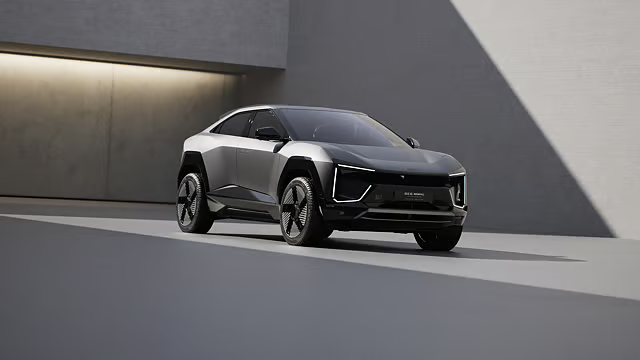
Mahindra has recently disrupted the Indian EV industry with the launch of the BE 6 SPORTEQ and its astonishing ₹11.45 lakh on-road starting price. Well, there is a catch. The aforementioned pricing is applicable in case of the Battery as a Service (BaaS) subscription model. Under such a program, you pay a usage charge per kilometre rather than owning the battery. Let us get to know the details.
What is Mahindra’s BaaS?
In the BaaS program, the customer buys a car with no battery pack installed and subscribes to Mahindra (or its financial partner) for usage of the battery. In the case of the BE 6 SPORTEQ, you will pay ₹3.75 per kilometre.
The important thing here is that it is not just the “pay-per-distance” scheme. According to the Mahindra calculations, you have to pay a monthly subscription regardless of how many kilometres you have driven. You pay for an assumed usage of 60 km per day (approximately 1,800 km per month) for 8 years, even if you did not use the car at all during that time.
Mathematics of the deal
Let us look at the numbers:
The price for the BaaS base variant (with no battery): ₹11.45 lakh (ONE variant, 59 kWh) or ₹12.95 lakh (TWO variant).
Battery usage fee: ₹3.75/km × 60 km/day × 30 days ≈ ₹6,750 per month (the fixed part of the fee).
Additional kilometres: You will pay the extra ₹3.75/km for each kilometre over the estimated 1,800 km/month.
Total cost for 8 years: About ₹6.48 lakh, just for the battery subscription.
By contrast, you will have to pay ₹19.45 lakh for the BE 6 with the battery for the same variant (ONE variant, 59 kWh) about ₹8 lakh extra at once but no additional battery costs.
Who are the BaaS intended for?
Currently, the BaaS subscription is available only for the entry-level variants ONE and TWO, fitted with the 59 kWh battery pack. Therefore, it will appeal most to:
Budget-conscious customers who are ready for the long-term monthly subscription in return for a cheaper initial payment.
Frequent urban commuters whose actual kilometres will comfortably cover the required 60 km/day of usage.
Corporate fleet managers who will appreciate the predictable expenses and perhaps the different taxation of the battery-as-service.
However, for those driving fewer kilometres (let us say, below 1,000 km/month), the effective cost per kilometre can get prohibitively high due to this fixed cost.
BaaS vs outright purchase: Which is better financially?
It will depend on your driving profile and your cash-flow requirements:
Upfront cost: BaaS reduces the upfront cost of buying the BE 6 substantially, by nearly ₹8 lakh.
Total cost over 8 years: Battery subscription alone over 8 years costs in excess of ₹6.5 lakh. In addition to this, consider the interest paid on the loan taken against the vehicle cost and the difference in resale value between outright ownership and BaaS.
Flexibility: You are locked into an 8-year contract regarding the battery through BaaS. This could complicate any early resale of the car because of residual battery obligations and transferability issues.
Many individual users could find the regular battery-included approach more appealing and less complicated to deal with.
Bigger picture: Why Mahindra is pursuing this approach
Mahindra is not the only company among the Indian EV manufacturers trying out such schemes to reduce the sticker price and increase take-ups. The battery cost separation will allow:
To advertise attractive entry-level prices for their vehicles.
To design flexible finance schemes such that the battery loan tenure is longer than that of the vehicle loan tenure.
Maybe to handle battery health, replacement and reuse in a more centralized fashion.
The BaaS approach for Mahindra also fits well into the vision of Mahindra’s move towards becoming a connected, software-defined manufacturer of EVs.
Read this- Mahindra Racing Stuns the World! Historic 3rd Place in 2026 Formula E Teams’ Championship
So should I buy the BE 6 with the BaaS approach?
If you are okay with a long-term monthly payment commitment, drive almost exactly (or more) 60 km a day, and want the minimum upfront cost possible, then go for the BaaS approach. Otherwise, regular battery-included purchase seems to be the better way to go.
Whichever way you decide to go, Mahindra’s BE 6 BaaS scheme is quite a pioneering one – which could change the Indian EV ownership landscape in years to come.
Watch this-