




























40% Tax, Uncertain Demand & A Strategy That Could Keep Plug-In Hybrids OUT Of India!
Volvo Car India has stated that their company is not planning on introducing plug-in hybrid vehicles (PHEVs) in the near future due to their belief that the current tax structure and the uncertainty of customer willingness to pay a premium make PHEVs commercially challenging in the region.
They do, however, believe that they could introduce PHEVs to the Indian market in the future if the regulations, demand, and economics favour.
Why is Volvo holding back?
Volvo has a vast portfolio of plug-in hybrid models across their international markets, most of which are SUVs equipped with variants of PHEV technology. However, the company believes that these vehicles have two major hindrances to their success in the Indian market – taxation, and demand.
In India, PHEVs (anything not within the small-car category) are charged with a 40% GST (goods and service tax), with applicable cesses pushing this number up to as high as 43%. Meanwhile, pure battery electric vehicles are subject to only a 5% GST, and no compensation cess.
This means that there is a 35% tax difference between a plug-in hybrid and a battery electric vehicle, which can easily make a difference in the final asking price of the vehicle. This, combined with a luxury brand premium, can often make electric vehicles the more appealing option for buyers.
Malhotra stated that he believed that, currently, the regulations do not support plug-in hybrids, and that the tax burden was skewed in favour of battery electric vehicles.
Read this- HYUNDAI BAYON IS HERE TO DESTROY THE COMPETITION – Bookings Open at Just Rs. 11,000!
PHEVs are a costly proposition by design.
As the name suggests, a plug-in hybrid vehicle has both a petrol engine and an electric motor capable of driving the wheels. Alongside this, they also feature a larger battery, power electronics, and a charging infrastructure compared to a conventional petrol vehicle.
Due to the complexity of a PHEV’s design, it is inherently more expensive than a petrol variant of the same vehicle class, and much more expensive than a battery electric variant.
Malhotra stated that customers should not necessarily expect the prices of a PHEV and a petrol variant to be on par, as the PHEV would always carry an additional premium due to its complexity, and the tax burden would exacerbate this.
“Are our customers ready to pay that cost is something we are watching very closely,” said Malhotra.
What about the CAFE 3 incentives?
The third iteration of India’s corporate average fuel economy norms (CAFE 3) is set to roll out from April 2027, and promises to incentivise manufacturers to lower the overall emissions of their vehicle fleets.
However, Volvo does not believe that the CAFE 3 incentives will be sufficient enough to promote the viability of PHEVs. Although Malhotra stated that they would help the commercial viability of PHEVs, it would not be enough to overcome the final asking price of the vehicle for the average buyer in India.
Volvo’s India strategy: Going electric and mild-hybrid
In the meantime, Volvo’s India strategy focuses on two technologies: battery electric vehicles (BEVs) and mild hybrids.
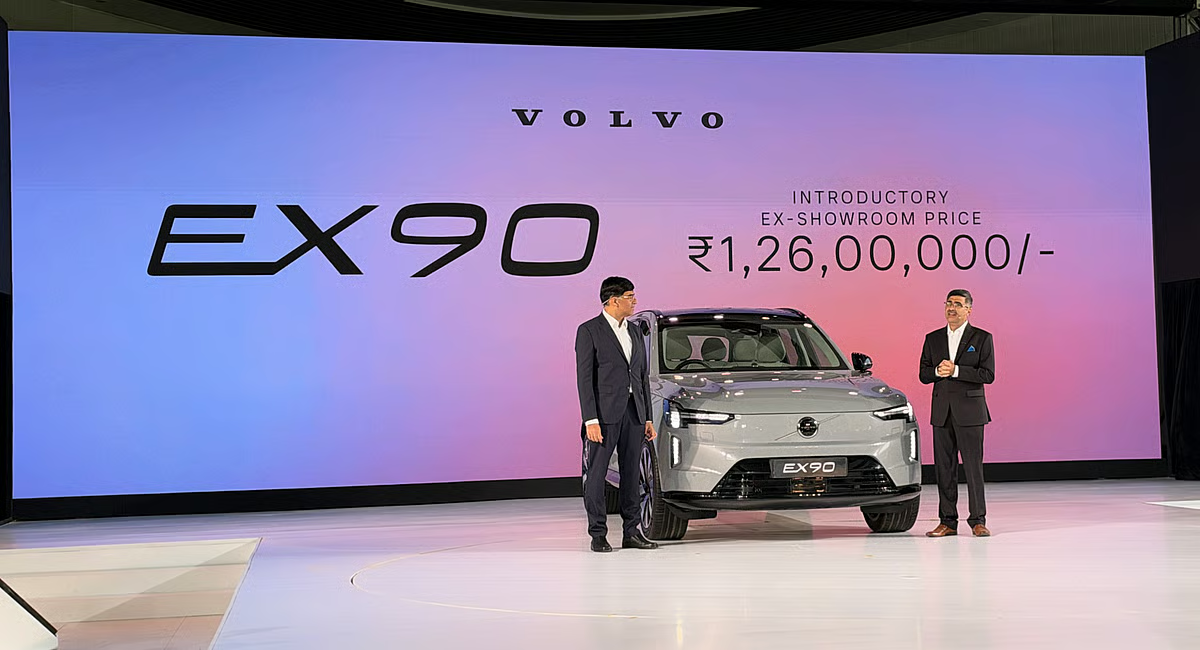
Recently, Volvo unveiled the EX90, their new flagship electric luxury SUV in India, and is set to increase the number of electric vehicles in their lineup over the next three years with three new EVs, one of which is expected to launch every year.
Malhotra stated that their end-game vision remained the same – to become an electric car company. However, they were currently fine-tuning their strategy based on the local conditions of the country.
Could Volvo come around to introducing PHEVs?
Volvo has not ruled out PHEVs from their current plans for the Indian market entirely, with Malhotra stating that they are prepared to roll out any PHEVs from their international portfolio if conditions become suitable.
“It’s not that we will bring it, but we can bring it if all things fall in place,” said Malhotra.
This means that Volvo will continue to watch the customer demand, and taxation laws in India with a keen eye. If the government moves to offer preferential treatment to PHEVs, or if the Indian buyer is willing to pay a premium for such a vehicle, then Volvo will consider bringing in a PHEV to India.
Why PHEVs matter in India
Plug-in hybrid vehicles provide a middle ground between conventional petrol vehicles, and battery electric vehicles. On a day-to-day basis, a PHEV can be driven in electric mode, with the petrol range extender being used for longer journeys.
This allows the buyer to reduce their fuel consumption without having to worry about the range limitations of a battery electric vehicle.
However, due to the aforementioned taxation system in India, PHEVs are largely unviable, especially when compared to their battery electric counterparts.
Because PHEVs are more expensive to buy, maintain, and insure than battery electric vehicles, they are currently best suited for the premium and luxury segments, where buyers are willing to pay an additional premium over the sticker price of the vehicle.
This is a large part as to why brands such as Volvo, BMW, Mercedes, and Toyota have been unable to gain significant traction in promoting their PHEVs in India.
What it means for buyers
For now, buyers hoping for a Volvo XC60, XC90, or any other PHEV model should probably hold their horses. Volvo is not likely to bring in any PHEVs in the near future, at least not in India.
Buyers hoping to acquire any form of electrified technology from Volvo will have to choose between a mild-hybrid petrol model, or a fully battery electric vehicle such as the EX90.
Those who want the option of a plug-in hybrid will most likely have to look elsewhere, or wait for a change in taxation laws in India to facilitate the purchase of such a vehicle.












[…] VOLVO INDIA DEALS A HUGE BLOW TO PHEV BUYERS […]