






























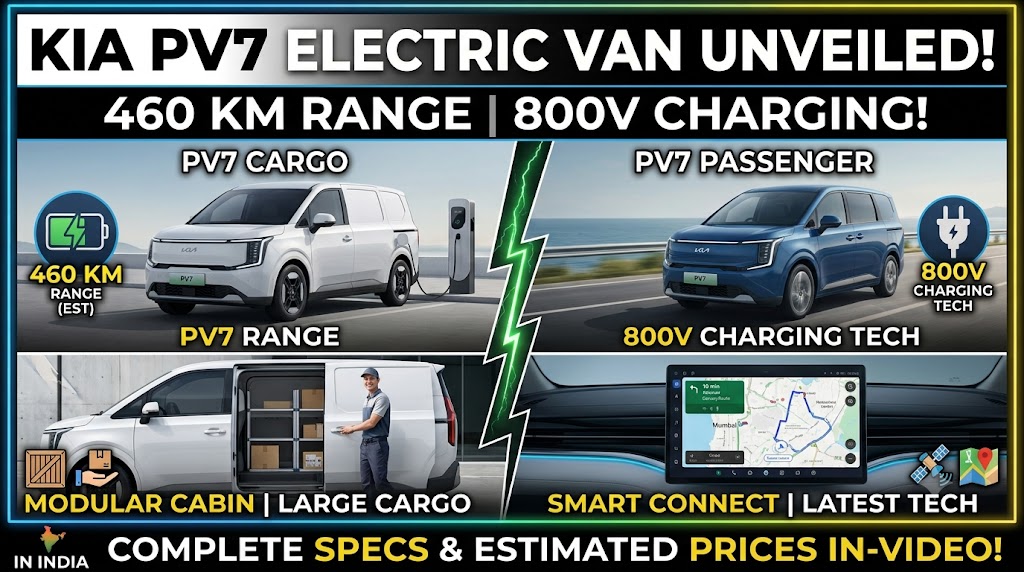
Kia has unveiled its largest electric commercial vehicle to date, the PV7 , a full-electric van built on a dedicated EV platform with up to 460 km range and 800V ultra-fast charging.
Unveiled today at the IAA Transportation show in Hanover, Germany, the PV7 is designed for both cargo and passenger operations, ranging from last-mile delivery fleets to airport shuttles and corporate people-movers.
The PV7 is built on a van-specific variant of Kia’s global electric platform. This results in several advantages compared to traditional, converted internal combustion engines:
Flat floor and low loading height: Battery integrated into the floor lowers the centre of gravity and makes loading/unloading easier.
800V electrical architecture: Unlike the smaller PV5’s 400V system, the PV7 uses 800V technology which enables much faster DC charging and better thermal management under heavy use.
Motor and drive options: A 200 kW (around 268 bhp) electric motor delivering 420 Nm of torque is offered in rear-wheel drive and all-wheel drive layouts, depending on variant and market.
This is aimed to provide the PV7 with punch to allow highway runs and fully loaded city duties while maintaining energy efficiency.
Battery options and real-world range
Kia is offering two nickel‑cobalt‑manganese (NCM) battery packs for the PV7:
71.5 kWh (standard range)
96.2 kWh (long range)
For the Long Range Cargo version with the 96.2 kWh pack, Kia quotes over 460 km (around 285–286 miles) on the WLTP cycle, based on internal measurements ahead of final homologation. The smaller battery variant will have lower range but a lower purchase price which is suitable for urban fleets with predictable daily routes. In real-world fleet use, however, actual range will depend on payload, driving style, climate control usage and route profile. With a 400+ km usable range, the PV7 is competitive with inter-city logistics and regional passenger services.
800V fast charging and dual charging ports
One of the PV7’s big selling points is its charging capability:
10–80% charge in the mid‑20‑minute range: On a 350 kW DC fast charger, the 800V system can top up the battery from 10% to 80% in roughly 25 minutes (figure still provisional pending final validation).
Dual charging ports: The PV7 gets a combined AC/DC port at the front and an optional additional AC port towards the rear, which Kia says is a first for its vans. This allows fleets to charge from either end in tight depots without manoeuvring the van excessively.
V2L (Vehicle-to-Load): The van can supply power to external devices, useful for mobile workshops, events or emergency power.
For fleet operators, faster turnaround at chargers and flexible port placement can significantly improve daily utilisation.
Variants: Cargo and Passenger
Kia is launching the PV7 in two core body styles, each with multiple wheelbase and roof options:
PV7 Cargo
Payload: Up to 1,200 kg depending on configuration.
Cargo volume: Up to 8.0 cubic metres in the long-wheelbase, high-roof form.
Length: Around 5,350 mm for the long version shown at IAA, with a 3,500 mm wheelbase.
Use case: Ideal for e-commerce delivery, cold-chain logistics, tradespeople and regional distribution.
Watch this- Volvo XC90 Long Drive Review | 1800 KM Mileage Test!
PV7 Passenger
Seating: Up to 9 seats in certain configurations, targeting airport transfers, hotel shuttles, corporate transport and tourism.
Comfort features: Expected to include improved NVH insulation, flexible seating layouts, large sliding doors and connected telematics for fleet management.
Both variants benefit from the same underpinnings and battery choices, allowing operators to mix and match based on route needs.
Technology and fleet-focused features
The PV7 is not only about hardware, but also Kia is positioning it as a connected business tool:
Pleos Connect: Kia’s commercial telematics platform offers real-time vehicle tracking, energy management, route optimisation and predictive maintenance alerts.
FMS integration: Compatibility with third-party fleet management systems helps large operators to monitor charging schedules, driver behaviour and total cost of ownership.
Driver assistance: Expect a suite of ADAS features (lane-keep, adaptive cruise, automatic emergency braking, blind-spot monitoring) which are tailored for commercial use.
These features are aimed to reduce downtime, improve safety and help fleets to transition from diesel to electric with minimal operational disruption.
How the PV7 compares to rivals
In the global electric van segment, the PV7’s main strengths are:
Longest claimed range in its class at over 460 km WLTP for the long-range cargo version.
800V charging in a commercial van, which is still rare among competitors.
Flexible body options (cargo vs passenger, multiple wheelbases and roofs) on a dedicated EV platform.
Compared to current electric vans which offer around 250–350 km range and 400V charging, the PV7 aims to reduce “range anxiety” and charging downtime for serious commercial users.
India relevance and what to expect
While the PV7 has been unveiled for global markets (with European launch expected in the second half of 2027), its India story is still evolving. Kia has been expanding its EV portfolio in India and a future local or CBU introduction of the PV7 could make sense for:
E-commerce and logistics fleets looking for high-range electric vans.
Airport and corporate passenger transport in metro cities with tightening emission norms.
Government and institutional fleets targeting electrification of large vehicles.
Key challenges will be pricing, local charging infrastructure for large EVs and after-sales support for commercial fleets. If Kia positions the PV7 correctly, it could become a benchmark for electric vans in India, much like the PV5 aims to do in the smaller segment.
For now, the PV7 shows how seriously Kia is taking the electric commercial vehicle space: long range, fast charging and serious payload, all wrapped in a van designed from the ground up as an EV.
Watch this-